Egypt gave the ancient world its paper. Papyrus, harvested and pressed from the reeds of the Nile, carried Greek philosophy, Roman administration and Egyptian religion alike, and it is the reason we can read anything at all from large stretches of antiquity. So there is something fitting about the fact that the greatest surviving collection of ancient books is a stack of Egyptian paper in an Italian town, cooked solid by a volcano.
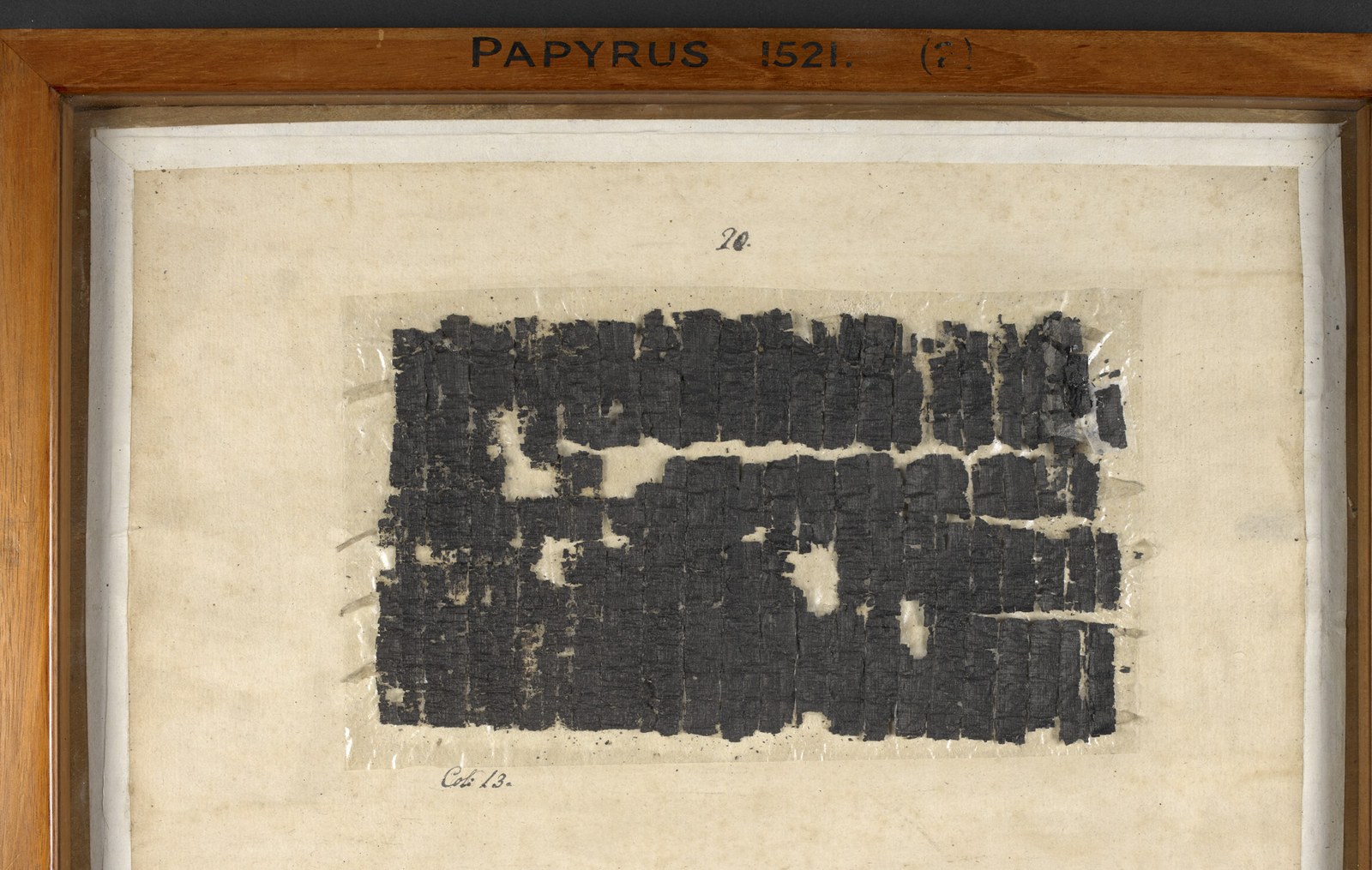
When Vesuvius erupted in AD 79 it buried Herculaneum, a seaside neighbour of Pompeii, under surges of hot gas and ash. In one grand villa, now called the Villa dei Papiri, the heat carbonised an entire library where it sat: hundreds of scrolls turned to brittle cylinders of carbon, looking for all the world like burnt logs. It is the only intact library known to survive from the classical world. Everything else we have from ancient literature survived by being copied, and copied again, down the centuries. These books survived by being buried.
The cruelty is that surviving and being readable are not the same thing. From the 1750s onwards people tried to open the scrolls, first with a purpose-built unrolling machine of weights and silk threads, later with chemicals and knives. A few scrolls gave up their text this way. Many were destroyed. The lesson, learned expensively, was that the library could not be opened by hand.
The modern approach does not open them at all. A scroll is scanned in a particle accelerator, producing a three-dimensional X-ray image fine enough to distinguish individual layers of papyrus wound hundreds of times around each other. Software then traces each layer through the scan, unrolls it virtually, and flattens it into a readable sheet. The final step is the hardest: the ink is carbon and the burnt papyrus is carbon, so the writing is nearly invisible even in the scan. Machine learning models, trained on fragments where the ink can be photographed directly, learn to recognise the faint textural traces ink leaves behind.
For years this produced tantalising fragments. Then, this year, the effort behind it, an open research competition called the Vesuvius Challenge, announced that a complete sealed scroll, catalogued as PHerc. 1667, had been virtually unwrapped and read from end to end without being opened. Nobody unrolled anything. The scroll is still sitting in its tray, intact, and its text is out.
Every unread scroll is a sealed envelope from the first century. Most are thought to contain Greek philosophy, but nobody knows what else the villa's owners collected. Lost plays, lost histories and lost poems are all possible, and for once "lost" may be a temporary condition.
Readers of this site may wonder what a Greek library in Italy has to do with Egyptology. Quite a lot, potentially. Egypt has its own carbonised papyri, including documents from the Delta burnt in antiquity, and a great many more texts survive rolled, folded, or recycled into mummy cartonnage, where physically extracting them destroys them. A mature technique for reading writing inside an object, without touching it, is the kind of tool that changes what counts as recoverable. The Herculaneum scrolls are the proving ground; the method is bigger than one library.
There is also a personal note. The Vesuvius Challenge runs in the open: the scan data is public, the code is public, and the organisers have published a frank list of the unsolved problems where help is wanted, from tracing papyrus fibres to repairing the virtual surfaces the software reconstructs. I have spent my working life in film, software and, lately, artificial intelligence, and I study hieroglyphs for the same reason I built Hierolyte: deciphering ancient writing is one of the great puzzles a person can spend time on. So I am getting involved, on the geometry and machine learning side, and I expect to report back here on how it goes.
Champollion needed the Rosetta Stone to unlock a script everyone could see but no one could read. Herculaneum is the inverse problem: a language scholars read fluently, on pages no one can see. It says something rather hopeful about our moment that the second problem is now falling too.