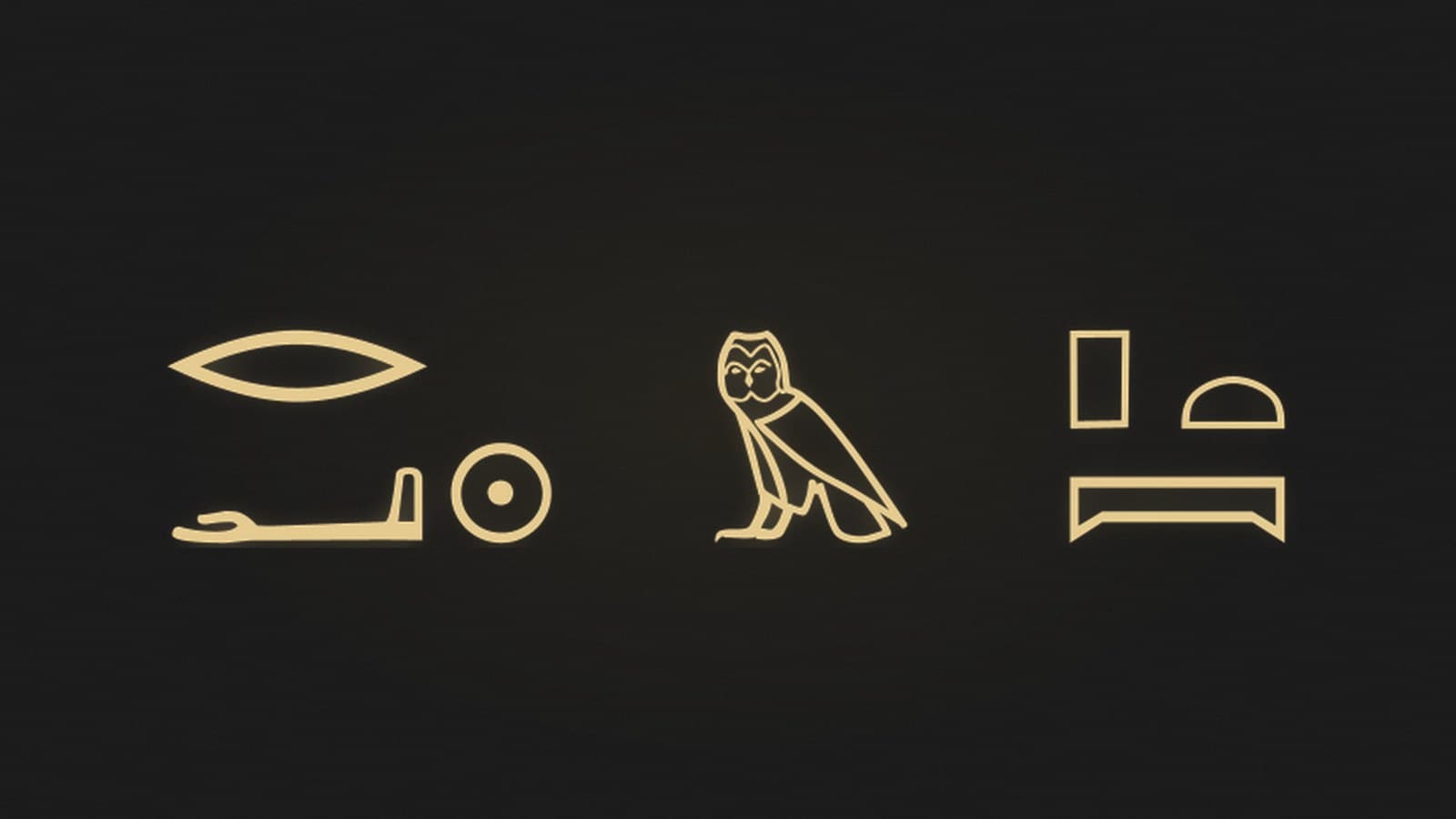
The last lesson ended with Rꜥ pw, "he is Rēꜥ". Alan Gardiner lists pw beside pn in his table of words for "this", as an older form, and he shows how it came to mean "he", "she", "it" or "they". But the more surprising thing about Rꜥ pw is what is missing. There is no verb in it.
James Allen explains why. English cannot say "this plan excellent": every sentence needs a verb, so it adds "is". Egyptian has no verb corresponding to "is", and like Arabic and Russian it does perfectly well without one. Gardiner calls these non-verbal sentences and sorts them by the predicate, the part that says something about the subject. There are three kinds. In Allen's summary, they tell you where something is, what it is like, and who or what it is.
The first kind has an adverb, or a preposition with its noun, as the predicate. The subject comes first and the rest follows, just as in English but without "is". Gardiner's simplest example is rꜥ m pt, "the sun is in the sky", literally "sun in sky".

The suffix pronouns from the third lesson fit straight in. Gardiner quotes ẖrt·k m pr·k, "your rations are in your house", from the story of the Eloquent Peasant, and Allen gives a near twin from the same story, "your possessions are in your house".

Sentences of this kind are often introduced by a small word, iw: iw rꜥ m pt means the same, "the sun is in the sky". Gardiner says iw gives the statement more prominence, while leaving it out makes a quieter description. Allen admits that Egyptologists still debate exactly what it adds, though it often marks something true at a particular time rather than always.
The second kind has an adjective as the predicate, and here the order flips: the adjective comes first. Gardiner draws special attention to this. Allen's pair shows the difference. sḫr pn iḳr is "this excellent plan", a phrase, with the adjective after the noun as in the second lesson. iḳr sḫr pn is "this plan is excellent", a sentence. In this use the adjective never changes for gender or number:

"Woman" is feminine, and tn, "this", agrees with it, but nfr keeps its plain masculine form. The only ending it can take is the exclamation -wy: nfrwy ḥmt tn, "how beautiful is this woman!" Gardiner's example with a suffix pronoun is nfr mtn·i, "my path is good".
The third kind has a noun as the predicate. Gardiner explains that the oldest way was simply to put two nouns side by side, subject first, but by Middle Egyptian that was nearly obsolete unless the subject was a pronoun, as in ink šmsw, "I was a follower". ink, "I", belongs to a separate set of pronouns that a later lesson will introduce.
For everything else, Egyptian used pw. Placed after a noun, it means "he", "she", "it" or "they", and it never changes for gender or number, rather like French c'est and ce sont.

So ḥwrw pw is "they are wretches", and ḥmt wꜥb pw n Rꜥ is "she is the wife of a priest of Rēꜥ". In that last example pw slips in before the indirect genitive n Rꜥ from the fourth lesson, because, as Allen puts it, pw stands as close to the front of the sentence as it can.
When both halves are nouns, pw goes between them. Gardiner's example is dmi pw Imnt, literally "an abode is it, namely the West". Gardiner notes that the word before pw is in most cases the predicate, the new information, and Allen that English often has to turn the sentence round: "the West is an abode".

One last point. None of these sentences says when. Allen stresses that they carry no tense, which is why Gardiner can translate ink šmsw as "I was a follower": the context supplies past, present or future. There is more to come, including pronouns such as sw in nfr sw, "he is good". The next lesson turns to the opposite, how to say that something is not so, and Gardiner shows that for a sentence like rꜥ m pt it takes only one word, nn, placed before the subject.