The last lesson asked questions. One of the small words that can turn a statement into a question, in, belongs to a larger family that Alan Gardiner calls particles. He uses the name for minor words such as mk, ist, grt and is, "of which the characteristic is that they usually stand either at or very near the beginning of the sentence". The name "sentence-adverb", he says, is "much nearer the mark", since they often present a whole sentence in a certain light. James Allen calls the class "a kind of catchall" for words that fit none of the other parts of speech.
Particles come in two kinds, by where they stand. Gardiner calls them non-enclitic and enclitic, and only the first kind can open a sentence. The second takes its name from the Greek enklitikos, "leaning upon": these words need a word in front of them to lean on, "presumably because they possess no accent or tone-vowel of their own". Allen calls the first kind proclitic, "leaning forward", always first in their clause, and the second enclitic, usually second. A third group, the interjections, can stand alone, he says, or be left out without much change of meaning. His proclitics begin with iw, the small word of the eighth lesson, which he calls the most common of all Egyptian particles; Gardiner leaves it out of his particles and treats it with the verb "to be".
The best-known opener is mk, "behold", which the eleventh, eighteenth and nineteenth lessons met with a dependent pronoun. Both grammars explain it as m, perhaps an old imperative, "behold" or "see!", joined to a pronoun for the person spoken to. So it changes with the listener: mk to one man, or to no one in particular; mṯ to a woman; mṯn to several people. Allen adds that it always introduces a main clause, calling it to the attention of whoever is addressed.
Gardiner calls mk "essentially pictorial": it depicts a fact as vividly present in the mind. With the sḏm·n·f of the seventeenth lesson it gives the sense of the English present perfect, as in this line from the story of the Shipwrecked Sailor:

In pḥ·n·n, "we have reached", the first n belongs to the verb form and the second is ·n, "we", from the third lesson. The goat skin spells ḫn in ḫnw, "home". With the plain sḏm·f, Gardiner notes, "curiously enough", the event mk pictures is nearly always in the future: mk wnn rn·k r nḥḥ, "behold, your name shall exist for ever". And with a pronoun alone it simply points: mk wi, "here am I", like French me voici.
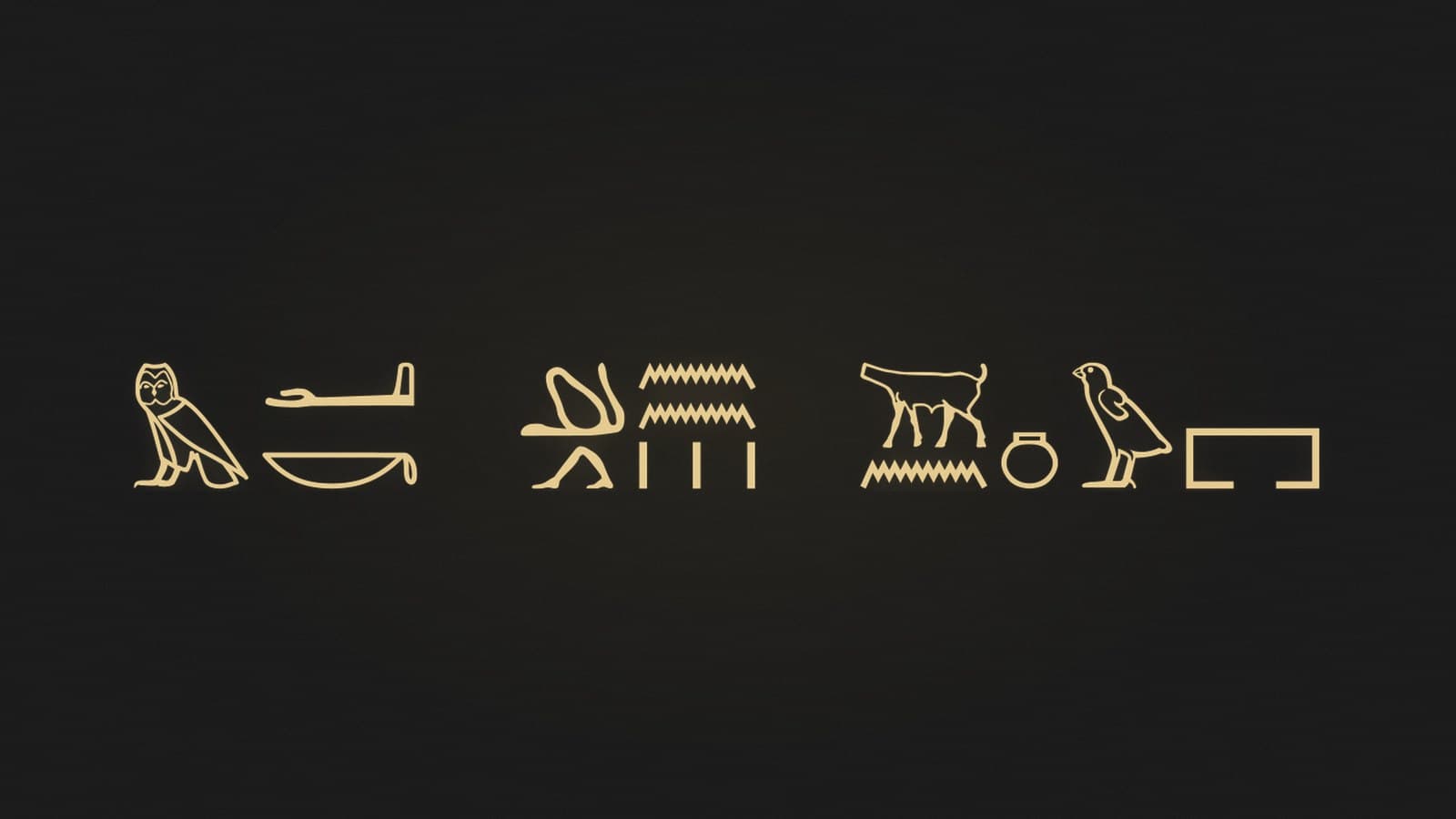
The second opener, ist, is usually translated "lo", but Gardiner warns that this "is purely conventional". The particle describes a situation or an accompanying fact, so a sentence with ist can often become an English clause of time or circumstance, with "while". Gardiner writes it isṯ, with the tethering rope, and notes that texts of the Eighteenth Dynasty often have ist. This line, which follows the date "Year 30", ends the word with a loaf:

There is no verb: "His Majesty" is simply placed "in the land of Retjnu", the kind of sentence met in the eighth lesson. Gardiner traces isṯ to the enclitic is, below, with a shortened pronoun "you" added, but says this origin was no longer felt: unlike mk, it has no forms for a woman or for several people. Allen says it can mark a clause as dependent on the one before, though often the link is less obvious. Followed by rf, both grammars translate the pair "now", bringing in the next part of a story.
Wishes have openers of their own. Gardiner says ḥꜣ and ḥwy introduce "wishes or requests"; Allen translates "if only, I wish, would that", and says they suggest some doubt whether the wish will come true. ḥꜣ is written with a clump of papyrus, which Gardiner's sign list reads ḥꜣ. His example recalls iw n·k ꜥnḫ, "life is to you", the fifteenth lesson's way of saying "you have":

Literally it says "would that there were to me any efficacious idol". For an unfulfilled wish, Gardiner says, the sḏm·n·f form was used: ḥꜣ rf ir·n·i ḫrw·i m tꜣy ꜣt, "would that I had made my voice (heard) at that moment!". ḥꜣ can even be a noun: "there is no 'would that!' with you". Most of these openers, Gardiner adds, take a dependent pronoun, as mk does, while the three that may come from verbs, among them ḫr, "then", take a suffix.
The enclitics come second. One of them, is, Gardiner thinks was in origin an exclamation, with "some such meaning as 'lo'", and one of its main jobs is "to give a certain impressiveness or emphasis" to a statement. Here it follows the verb rḫ·n·i, "I know", whose "I" is written with a falcon on a standard, the sign Gardiner's sign list gives for "I" when the king is speaking:

The thing known is itself a sentence with pw, from the eighth lesson: nḥḥ pw Wꜣst, "Thebes is eternal". The ninth lesson met is after the negative n, and the twelfth after the independent pronoun. Here the grammars part company. Allen sees is differently: he calls it "a syntactic element" that shows its clause to be subordinate.
Gardiner's list of enclitics goes on. grt, met in the thirteenth lesson, is nearest to the English "now" that claims the listener's attention, though he says it is often best left untranslated; Allen gives "now, moreover, but" and says it marks a new topic. ḥm is "assuredly" for Gardiner but "and, also, moreover" for Allen. tr, "forsooth" or "I wonder" in Gardiner's English, is common in questions, and Allen says it occurs only in them; Gardiner finds rf common in questions too. And the small words pile up: Egyptian, Gardiner says, "is by no means averse from accumulations of particles", such as ist rf and mk grt.
Last come the interjections, a very small group, Gardiner says. In everyday speech the person addressed, the vocative of the twentieth lesson, needed no word in front, but in religious and semi-religious texts i is frequent for "O":

The reed leaf is followed by a man with his hand to his mouth, and snḏ is the "fear" of the twentieth lesson's m snḏ. Gardiner's rarer synonym hꜣ, "O", with a plain h written by a reed shelter, is a different word from ḥꜣ, "would that"; Allen says it occurs mostly in religious texts, usually before the name of the dead. Gardiner adds hy, "hail", and tiw, "yes", with a rare use of nn for "no"; Allen gives m-biꜣ, "no!", and says that it and tiw, "yes!", are used only as words on their own. The next lesson turns to the passive.