The last lesson used sḏm·f to express a wish, "may he give". Alan Gardiner sorts sentences by what the speaker intends: statements give information, questions seek it, desires are "a class including commands, exhortations, and wishes", and exclamations show a feeling. Commands and wishes have had their lessons. This one turns to questions.
Gardiner divides them in two. A question either asks for "confirmation or denial of its whole content", to be answered "yes" or "no", or it uses a question word, such as "who?", to ask for one particular detail. He calls these questions for corroboration and questions for specification. James Allen draws the same line under other names: predicate questions and adjunct questions.
English marks a yes-or-no question by turning words round, so that "it is" becomes "is it?". Gardiner calls this "an inversion of words unknown to the ancient language". In the plainest case nothing marks the question at all. Gardiner conjectures that the earliest questions were marked only by the speaker's tone of voice:

Word for word this is "water is there", a sentence without a verb like those of the eighth lesson, with im, the adverb form of the preposition m from the tenth lesson, as its predicate. Allen quotes the same words, followed by nn mw im, "or is water not there?", with the nn of the ninth lesson. He calls these virtual questions. They were presumably spoken differently, but since Egyptian writing has no punctuation, they "look exactly the same as statements", and only the context decides. Here the two grammars differ. Gardiner calls Middle Egyptian examples rare; Allen finds them "about as common in Egyptian as they are in English".
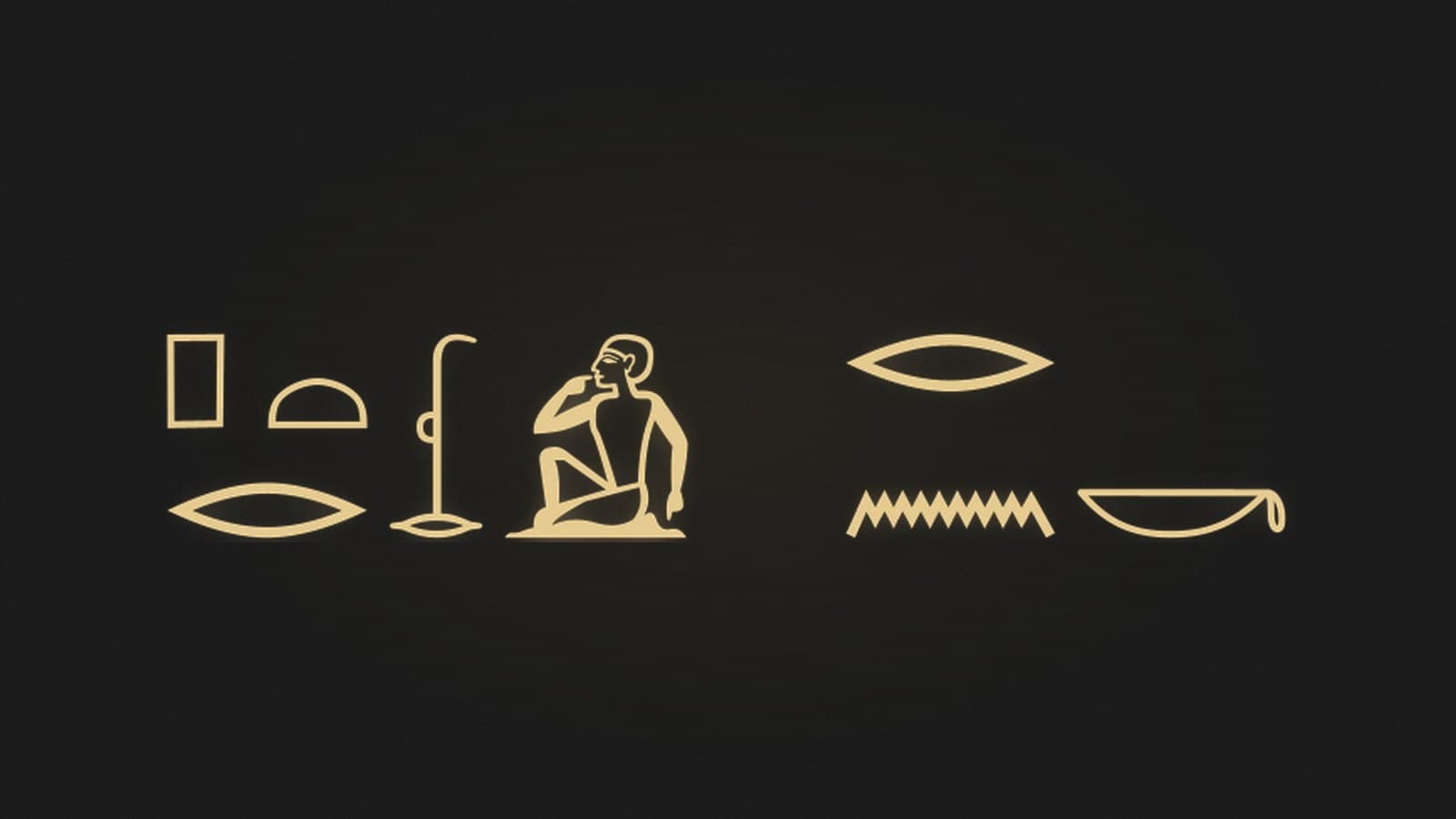
Most yes-or-no questions do carry a mark. "The chief interrogative particle", Gardiner says, is in, "which stands at the beginning of the question". Allen calls it a kind of Egyptian "question mark", which, like a question mark, is not normally translated. Particularly common is in iw, with the iw of the eighth lesson:

iw·k is iw with ·k, "you", and hr·ti is a stative, the form of the eighteenth lesson, with the ending ·ti, "you", written with the pestle and a reed leaf. Gardiner's sign list quotes the same word under the pestle as a plain statement, "thou art content". Being a question, he stresses, "exerts no influence upon its syntax": the ordinary sentences, with or without a verb, simply follow in or in iw.
One detail is special to questions. Allen notes that iw regularly follows in before an adverbial predicate, and can even come before a noun predicate, which a statement would not allow. Gardiner makes the same point with in iw mꜣꜥt pw pꜣ ḏd, "is the saying true?". Both say small words can be added inside the question, such as tr, which Allen says is usually left untranslated, though it sometimes means something like "really".
When the asker expects the answer "yes", Gardiner adds, the negative n or nn is used, "as in English and in the Latin nonne": "is it not...?". Allen warns that n can also be a writing of in itself, so that a question may look like a negative statement until the sentence pattern gives it away.
Questions that ask for a detail always contain a question word, and Gardiner's rule for it is short: it "occupies just the same place in the sentence as it would occupy in a non-interrogative statement". English pulls "what" to the front; Egyptian leaves it where the answer would go:
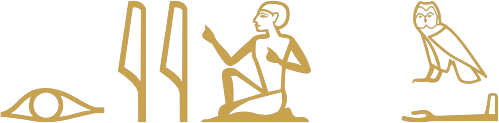
iry·i means "I shall do", and m, "what?", follows it as its object, in the order of "I shall do what?". Egyptian, Gardiner concludes, "did not feel the same compelling need as is felt in English to place interrogative words at the beginning of the question".
That m is, in his words, "the commonest word for 'who?', 'what?'", and Allen agrees, adding that it behaves like the dependent pronouns of the eleventh lesson and stands mostly after other words. It often follows a preposition: mi m, "how?", is literally "like what?", and ḥr m, "why?", is "on account of what?". When "who?" is the subject of a verb, though, m usually comes first, after in, with a participle after it:

Gardiner points out that this in is "the emphasizing (not interrogative)" one, and Allen translates the pattern, in and m with an active participle, literally as "who is it who...?". Where the answer is a number, Gardiner renders the same words "what says it?", and the reply is in 20 ḏd sw, "20 says it". Both grammars trace in m, said as one word, to the Coptic nim, "who?".
The other everyday word for "who?" and "what?" is ptr. Allen says it matches the independent pronouns of the twelfth lesson and usually stands first; Gardiner calls it the logical predicate, with the subject straight after it. Both grammars quote this question:

Here the order happens to match English: ptr, then rn·k, "your name". The word is made of pw, the "this" of the seventh lesson, and the particle tr. Allen takes the pw to be the demonstrative itself; Gardiner sees a very rare question word pw derived from it.
For "where?" Egyptian has ṯn, which Allen calls its one interrogative adverb, and which Gardiner glosses "where?" and "whence?". It too stands where an adverb would:

This is the eighth lesson's sentence again, "you are", with "where?" in the place of a phrase like "in the house". Gardiner lists tnw among the spellings written "probably less correctly"; Allen says it is borrowed from the word for "each". Gardiner's sign list explains that the throw-stick and the alighting duck at the end came to serve as a determinative for the sound ṯn. Allen builds "when?" from sy, "which?", and nw, "moment", and Gardiner quotes the pair in ms·s irf s(y) nw, "at what moment will she give birth?".
Egyptian questions, then, mostly keep the shape of statements and add a small word: in at the front, or a question word in the place of the answer. Gardiner notes that a wish can likewise be marked by ḥꜣ, "would that!", with sḏm·f, and the next lesson turns to such particles and interjections: mk, "behold", ist and ḥꜣ.