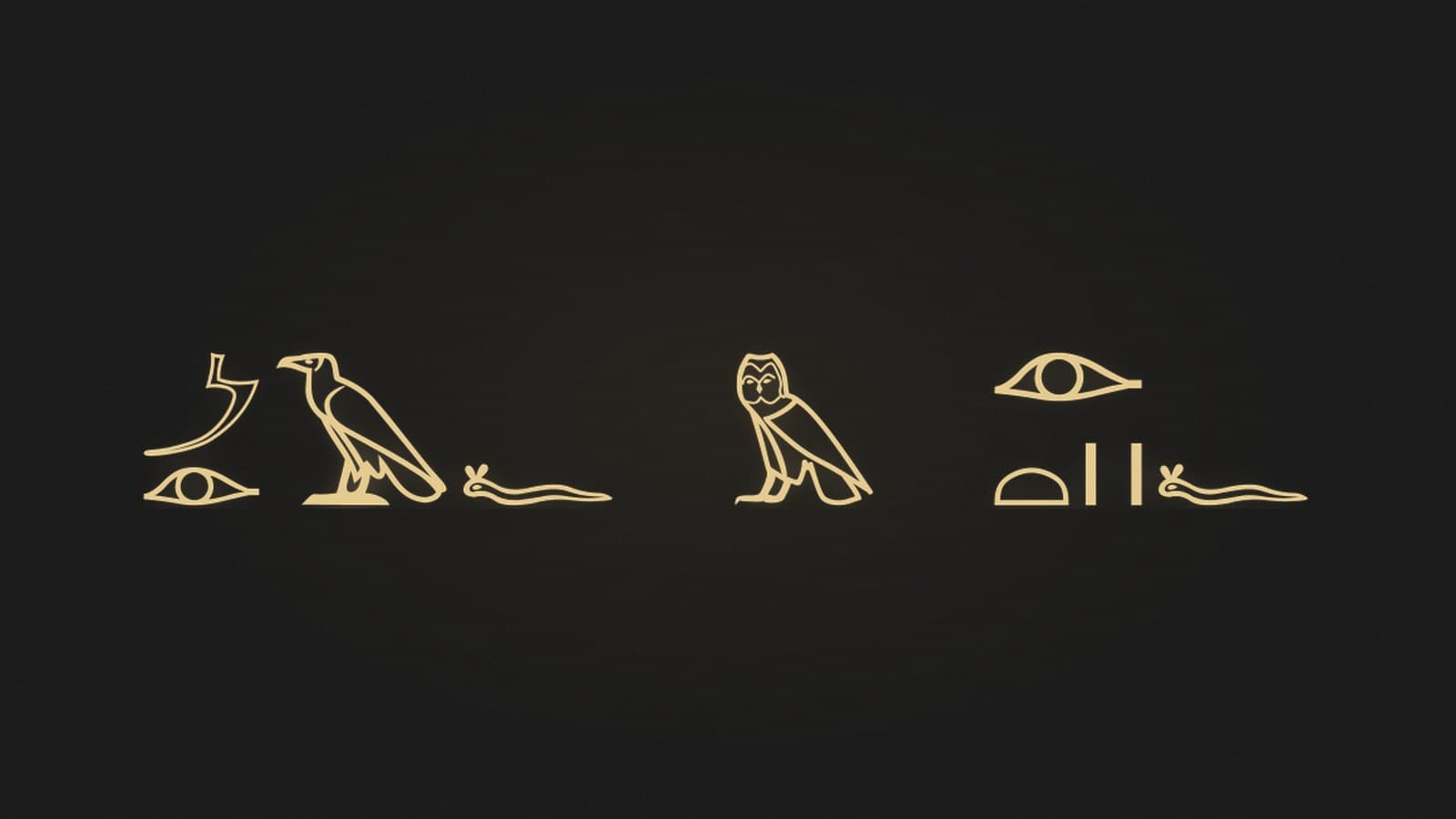
The last lesson ended with a promise: a return to sḏm·f, the verb form of the thirteenth lesson, in its use for wishes. Alan Gardiner calls sḏm·f "by far the most important verb-form in the Egyptian language, and at the same time that which presents the most difficult problems". The first problem is that one spelling can hide more than one form.
In a verb like sḏm, "hear", nothing in the writing hints at this. Verbs that can double a letter, the kind met in the twenty-second lesson, show it clearly: Gardiner sets mꜣꜣ·f beside mꜣ·f, from "see", and dd·f beside di·f, from "give". He traces the two kinds to the passive participles of the twenty-third lesson and names them to match: the doubled form is his imperfective sḏm·f, the plain one his perfective sḏm·f. He admits that the plain form "is itself not a unity, but conceals two or more separate forms", which may have differed in their vowels, "just as the imperfect in Arabic has its subjunctive and jussive moods". Since the spelling seldom shows the difference, he treats it as one.
James Allen divides them differently. He counts six verb forms with no special suffix such as the n of sḏm·n·f, which Egyptologists call collectively the sḏm·f, and one of them is the subjunctive. Subjunctive forms, he explains, "mark the statement as contingent, possible, or desirable", and Middle Egyptian has only one. Some call it the prospective, but Allen keeps that name for another form. It "usually has to be recognized by how it is used rather than by how it looks", since in most verb classes it is simply the base stem.
For wishes, the two grammars describe the same thing. Gardiner says the perfective sḏm·f is "common also in wishes and exhortations, which are often hard to distinguish from one another and from the simple future use". For Allen the subjunctive is the form Middle Egyptian normally uses to express a wish in a main clause. One of Gardiner's examples strings three together:


Nothing in the writing says "may": the verb comes first, as usual, and only the sense makes these wishes. int, "bring", is from ini, which the twenty-second lesson showed with three sḏm·f forms; int·f is one of the two without doubling. Gardiner wonders whether it may prove "exclusively prospective in meaning", and Allen gives it as the subjunctive of this verb. The dative n·f, "to him", comes before the noun subject, in the order of the thirteenth lesson. The subject is Ḥp, the Inundation god, written with the twisted flax for ḥ and a stool over a channel of water, and the object is ḥtpt·f, "his offering".
In mꜣ·f, "may he see", there is one vulture, not the two of mꜣꜣ·f. Gardiner's rule is that "the outstanding characteristic of the perfective sḏm·f is absence of gemination", and Allen likewise gives "see" without doubling, mꜣ·k, "you shall see". irty·f is "his two eyes", with the dual ending of the first lesson.
Allen names three such uses in main clauses: a wish; a polite command, like English "should"; and an exhortation, like English "let", which he says "is only expressed by the subjunctive". As a command it is "softer or more polite" than the imperative of the twentieth lesson, so Egyptian prefers it when speaking to a superior, such as a high official, the king or a god: wḏꜣ ḥm·k r prw nw sšw, "May Your Incarnation proceed to the houses of writings". Gardiner adds that the little words r·k or r·f may help to mark such a use, as here, said to "you":

"Give" appears as di·k, without the r of rdi. Gardiner says that forms without r are rather more frequent, and Allen that "give" uses only the stem di in the subjunctive, as in di·k, "you should give". So the "may he give" of the last lesson is di·f, a form Gardiner also lists.
Allen sets the subjunctive against two forms already met. The imperative ꜥnḫ is "live!", and the stative ꜥnḫ(w) of the eighteenth lesson's wish is "may he be alive"; the subjunctive ꜥnḫ·f is "may he live". The subjunctive, he says, denotes action, whereas the stative denotes a state.
What is possible or desirable usually lies ahead, Allen notes, so the subjunctive is often translated with an English future. Gardiner's example of future reference is mꜣ·k pr·k, "you shall see your home". Allen contrasts it with r and the infinitive of the nineteenth lesson, which he calls an "involuntary" future, something bound to happen. The subjunctive is a "voluntary" future, for actions "intended or willed by the actor".
The doubled form can make a wish too, which shows that the grammars do not divide the forms in quite the same way. Gardiner finds the imperfective sḏm·f "also ... in exhortations or wishes", where "sometimes a certain degree of generality is discernible":

Both verbs double their r: irr, from iri, "do", is the eye, read ir, over a mouth for the second r, and mrr·f, "he wills", has two mouths under the hoe. Gardiner admits that "the problem is to discover the reason for the choice of the form with gemination". In Allen's table, the subjunctive of verbs like iri is not doubled.
The twentieth lesson met imi rḫ·f rn·k, "let him learn your name", literally "cause that he learn your name". Here both grammars use the plain form. Gardiner says that after rdi, "cause", the perfective sḏm·f "is used in all verb-classes". Allen calls rdi with the subjunctive "by far the most common" use of the form in a noun clause, quotes the same words, and explains rdi sḏm·f as "cause that he hear", literally "give (that) he hear". Both trace this use into Coptic.
Gardiner adds that the perfective form is always used in clauses of purpose, "as in the closely related wishes and exhortations", and Allen calls purpose the most frequent use of the subjunctive in an adverb clause. To wish that something will not happen, Allen gives im·f sḏm, "may he not hear", from the same negative verb as the m, "do not", of the twentieth lesson.
Allen notes that the subjunctive can also be asked about, as in "So, shall I be robbed in his estate?" The next lesson turns to questions: "who?", "what?" and those answered yes or no.