The last lesson met the participles: a verb used as an adjective or a noun, like mry, "beloved". Alan Gardiner notes that a participle can nearly always be translated by a "who" clause whose subject is the noun it describes, which grammars call the antecedent: "beloved" is "one who is loved". But what of "one whom his lord loves", where someone else does the loving? For this Egyptian has verb forms that Gardiner says "at first sight seem peculiar to Egyptian": the relative forms.
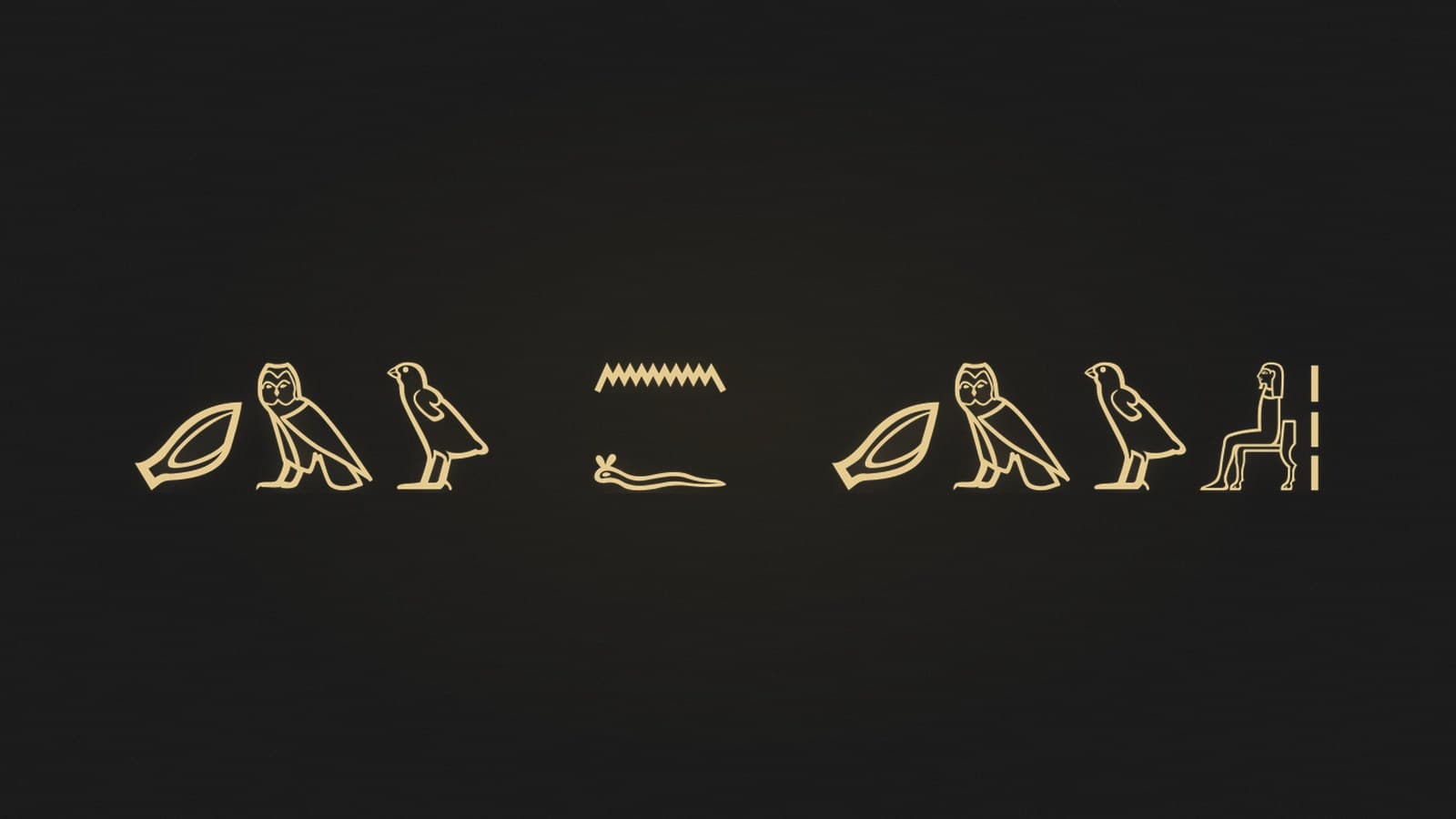
Gardiner's first example gives this lesson its title.

The first sḏmw is a relative form of sḏm, "hear, listen". The second is its subject, "judges", a word that in its literal sense means "hearers", with a man of rank on a chair and three plural strokes. Between them, n·f, "to him", points back to the person described: Gardiner translates "one to whom (lit. to him) judges listen". The pronoun comes before the noun subject, in the order the thirteenth lesson taught.
James Allen makes the contrast with a pair of his own. In sꜣ sḏm n it(i)·f, "the son who listens to his father", sḏm is an active participle: the son listens. In it(i) sḏm n·f sꜣ·f, "the father to whom his son listens", it is a relative form, with sꜣ·f, "his son", as its own subject. Unlike participles, Allen says, relative forms have a separate subject, a noun or a suffix pronoun, and English has nothing like them: we cannot say "the father listening his son to".
The twenty-first lesson built relative clauses with nty. For clauses with a verb, Allen divides the work: participles are the normal way when the subject is the antecedent, relative forms when it is not.
Relative forms are adjectives at heart, Allen says, and agree with the noun they describe. With a masculine antecedent, Gardiner adds, they often look exactly like the sḏm·f of the thirteenth lesson or the sḏm·n·f of the seventeenth. With a feminine one, -t follows the verb stem, before any determinative. His second example shows it:

The verb is ḳmꜣ, "create". The person described is female, so it takes the -t, above the papyrus roll that ends the verb; the n of the sḏm·n·f type sits below the roll. The subject is bꜣw Iwnw, "the souls of Heliopolis", and nfr·s, literally "her beauty", carries the word that points back, the suffix ·s.
For verbs whose stem never changes, Gardiner says, only two kinds can be told apart, one like sḏm·n·f and one like sḏm·f. Verbs that can double a letter, the kind met in the twenty-second lesson, show that the second is really two. With mri, "love", he lists the imperfective relative form mrrw, feminine mrrt, with the doubled r; the perfective relative form mr or mry, feminine mrt, without it; and the sḏmw·n·f relative form mr(w)·n, feminine mrt·n.
Allen names three as well: the perfective, imperfective and perfect relative. The first two match Gardiner's. The third is Gardiner's sḏmw·n·f form, and Allen's name matches his name for sḏm·n·f itself, "the perfect", met in the seventeenth lesson. Gardiner explains that his own name "stresses the close relationship to the 'narrative' sḏm·n·f form".
Their meanings follow the participles. For Gardiner the imperfective marks repeated or continuous action, most often translated by the English present; the sḏmw·n·f form refers in the large majority of cases to the past; the perfective can refer to the past in early Middle Kingdom texts, and otherwise often to the future. Allen broadly agrees: the perfect relative describes completed action, the imperfective repeated or ongoing action, and the perfective has no tense of its own.
Now the word that points back, which Gardiner calls the resumptive pronoun and Allen the coreferent. When the antecedent is the direct object of the relative form, Gardiner says, "no resumptive pronoun is ever used": Egyptian does not add the dependent pronoun sw, "him", of the eleventh lesson. His example of a relative form used as a noun, "that which", shows it too, in the feminine, with nbt, "all", from the second lesson:

Allen notes that nb comes as close to the relative form as it can, though a dative pronoun such as n·i, "to me", may come between them.
In other cases a pronoun normally points back, as here after a preposition:

Word for word this is "the road it came on it". wꜣt, "road", is feminine, so the verb takes -t and the pronoun after ḥr, "on", is ·s. With verbs like "come", which take no object, Gardiner says a resumptive pronoun must be used; he finds it left out commonly only with im, "in it", and Allen agrees that one after m can be omitted.
Why should a direct object need no pronoun? Gardiner's answer is that the relative forms grew out of the passive participles of the last lesson. Take mrrw nb·f:

Gardiner translates it both "one beloved of his lord" and "one whom his lord loves". Read the first way, mrrw is a passive participle and nb·f, "his lord", a direct genitive, the noun-after-noun "of" of the fourth lesson. Read the second way, it is an imperfective relative form with nb·f as subject, and "it does not matter" which, he says. Since mrrw already means "one who is loved", there is no room for "him"; for Gardiner this "is the corner-stone of the theory". The sḏmw·n·f form he traces to a passive participle with n, "to": "the voice heard to him", later felt as active, just as Low Latin ego habeo factum became French j'ai fait.
Allen does not argue for an origin here; he notes only that the perfective and imperfective relative forms generally look like the passive participles. And where Gardiner inclines to class mrrw nb·f as a passive participle with a genitive, Allen reads the royal epithet mry with a god's name, "beloved of" that god, as a perfective relative form with the god as subject.
Allen admits that students, and even experienced Egyptologists, usually find relative forms harder than any other part of Middle Egyptian grammar. His advice is to translate them word for word first, "the road it came on it", and only then turn the result into proper English. The next lesson goes back to sḏm·f itself, in its use for wishes such as "may he give", the form Allen calls the subjunctive.