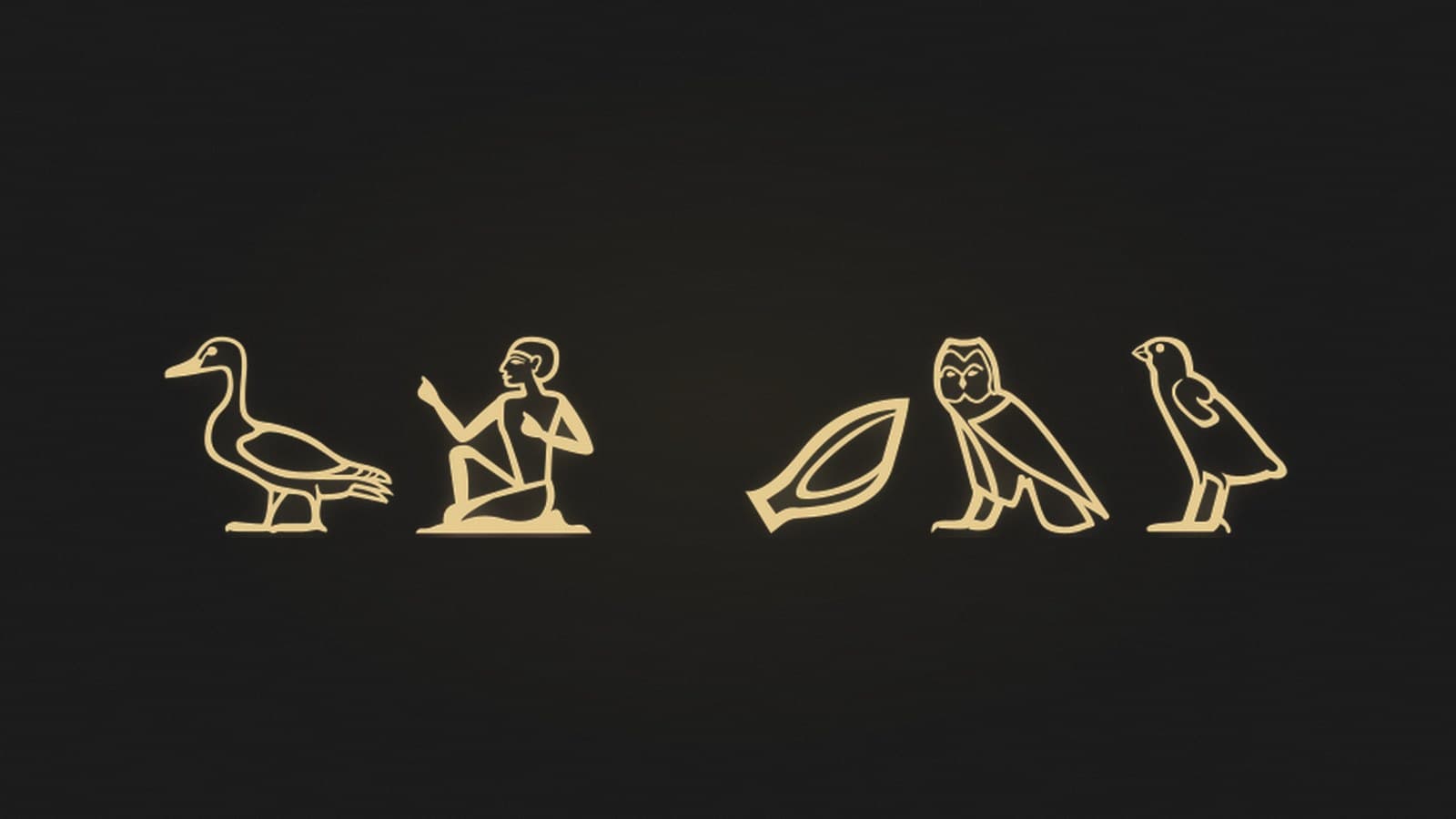
The last lesson sorted Egyptian verbs into classes by their consonants, and showed that some forms double a letter while others drop one. This lesson meets the forms where that doubling matters most. Alan Gardiner defines the participle as an adjective "displaying the meaning of a verb as exercised actively by, or passively upon, somebody or something". Like any adjective, he says, it can describe a noun or stand as a noun itself.
James Allen agrees: participles are "verb forms that are specifically meant to serve as adjectives". English has two, the "burning" of "a burning log" and the "burnt" of "burnt toast", and Allen calls them "simply concise ways of expressing a relative clause in a single word": a log that is burning, toast that has been burnt. Gardiner's first example is a line of Ptahhotep:

sꜣ is "son", and sḏmw is built on sḏm, "hear", with the quail chick for w. On its own, Gardiner says, sḏmw means "one hearing" or "a hearer", and his examples could just as well be put with "who": "a son who hears", "one who hears". Here the grammars part. Allen quotes the same line and argues that sḏmw cannot be a participle, because the masculine singular active participles do not end in -w. For him it is a noun, "listener", so the phrase is literally "a son, a listener". Gardiner lists it among the uncommon participles that do write a -w.
That example is active: the son does the hearing. Gardiner's second is passive, describing what was done to someone:

iryt, "done", comes from iri, "do", and Gardiner notes that iryt r·f alone means "that done to him". Both grammars also quote the phrase with the doer added, in sn·f Stẖ: Gardiner translates "the evils done to him by his brother Seth", Allen "the evil done against him by his brother Seth".
Because participles are adjectives, they follow the rules of the first two lessons. Gardiner says they agree in number and gender with their noun, using the same endings as an ordinary adjective. Allen sets them out on mr, "loving": sꜣ mr, "loving son", but sꜣt mrt, "loving daughter". Gardiner's masculine plural is:

Literally it is "doing wrong", with -w and plural strokes on irw. The endings come before any determinative, and they are often left out: the masculine plural -w often, and the w of the feminine plural -wt always.
A participle can also stand alone as a noun, and then English usually needs "one who" or "that which". Gardiner notes that a determinative is sometimes added to show what kind of person is meant, as in ḥsy, "one who is praised". A feminine participle on its own, often with plural strokes, stands for a "thing": irrt, "what is done". Gardiner's example of "living" shows a rare ending -y: ꜥnḫy, from the common phrase bꜣ ꜥnḫy, "living soul".

How many participles are there? Gardiner counts four: active and passive, each in an imperfective and a perfective form. He calls the two "tenses", but says they refer to "the duration and the frequency of the verbal action rather than to its time-position". The imperfective was originally for action that is repeated or continuous; the perfective presents the action "simply as occurring". Allen agrees on the meanings but calls the difference one of aspect, not tense, and he counts five. His fifth, the prospective participle, is for action still to happen, "who will hear". Gardiner calls that form the sḏmty·fy (Allen's sḏmtj.fj) and keeps it apart, as "built on too different lines to be included among the participles".
Telling the four apart is not easy. The endings are seldom written, so Gardiner warns that a plain sḏm can mean anything from "who hears" to "who had been heard", and often only the context decides. This is where the doubling of the last lesson helps. Gardiner's rule is that "the imperfective participles, whether active or passive, show the gemination, while the perfective participles do not". From the verb "go forth", the perfective is pr, the imperfective prr. Laudatory epithets, which Gardiner calls very common in Egyptian inscriptions, use both:

In the second, an extra mouth sign writes the doubled r. Gardiner explains that the imperfective means "he who is (or was) wont to do" something, while the perfective says "who does (or did)" it, "stating the fact, but not the custom". In many such cases, he adds, the choice has nothing to do with time: one and the same text uses first one, then the other. Allen notes that the difference seldom matters much in translation. Knowing whether a participle is active or passive matters far more.
From "love", the perfective passive is mry, "loved", with the ending -y that Gardiner calls characteristic of its class. The fifth lesson met it in mry Imn, "beloved of Amun". Gardiner notes that the perfective passive is common in epithets describing a present state, since an act that "has been" done "is" done, and remains done. His example:

Word for word it is "his son, beloved of him". The one who loves can follow a passive participle as a direct genitive, from the fourth lesson, here the suffix ·f; or with in, "by", as in "by his brother Seth"; or with n, as in mry n it·f, "beloved by his father". Allen's sꜣ mry is "the beloved son".
Allen calls the participles the normal way Middle Egyptian expresses a relative clause with a verb; clauses with nty and a verb are fairly uncommon. Gardiner describes them as "who"-clauses: the son is the one who hears. For "whom" and "whose", as in "one to whom judges listen", Egyptian has the relative forms, the subject of the next lesson.