The last lesson attached whole clauses to nouns with nty and iwty; this one turns to the verb. So far the series has treated sḏm·f, from the thirteenth lesson, and sḏm·n·f, from the seventeenth, as a fixed stem with endings added. Alan Gardiner's grammar does the same at first, then warns that "while unchangeable stems are in the majority, they are by no means universal". Which verbs can change depends on their class.
Hieroglyphs write only consonants; the vowels are not shown. The consonants of a verb make up its root, and James Allen explains that "each consonant of the root is called a 'radical'". The typical verb has three, like sḏm, "hear", with s, ḏ and m. Gardiner calls consonants like these strong. Weak consonants are the ones that tend to vanish: Allen names ꜣ, i, y and w, "known as 'weak' consonants because they were often omitted in writing". In verbs, the weak radicals that matter are i and w.
Both grammars sort verbs by how many radicals they have and whether any is weak or repeated. The class names are old Latin labels, usually abbreviated: 2-lit. and 3-lit. (biliteral, triliteral) for two or three strong radicals, 2ae gem. (secundae geminatae) when the second and third radicals are the same, and 3ae inf. (tertiae infirmae) when the third is weak. Gardiner admits the names are "not altogether satisfactory". Allen keeps the abbreviations but notes that most English-speaking Egyptologists translate them: "second-geminate", "third-weak". Gardiner adds a second test of a class: whether its infinitive, the verbal noun of the nineteenth lesson, is masculine like ꜥnḫ, "to live", or ends in a feminine -t, like mst, "to bear".
Gardiner calls 2-lit. and 3-lit. verbs, like mn, "be firm", and sḏm, immutable: they keep one stem, with a masculine infinitive of the same shape. Allen is less strict, giving ḏd, "say", a doubled stem ḏdd, which Gardiner explains as a different sort of repetition.
The first class that changes is the 2ae gem. Gardiner's model is wnn, "be, exist", which appears in two different sḏm·f forms, "each with its own particular range of meaning". One writes both ns, the other only one:

Gardiner's explanation lies in pronunciation. When two identical consonants came together with no stressed vowel between them, scribes tended to write them once, so wnn·f points to a vowel of some importance between the two ns, and wn·f to a form where they ran together. Allen says the same of mꜣꜣ, "see", which has a base stem mꜣ and a geminated, or doubled, stem mꜣꜣ. Gardiner knows of only twenty to thirty verbs in this class, "but most of its members are important".
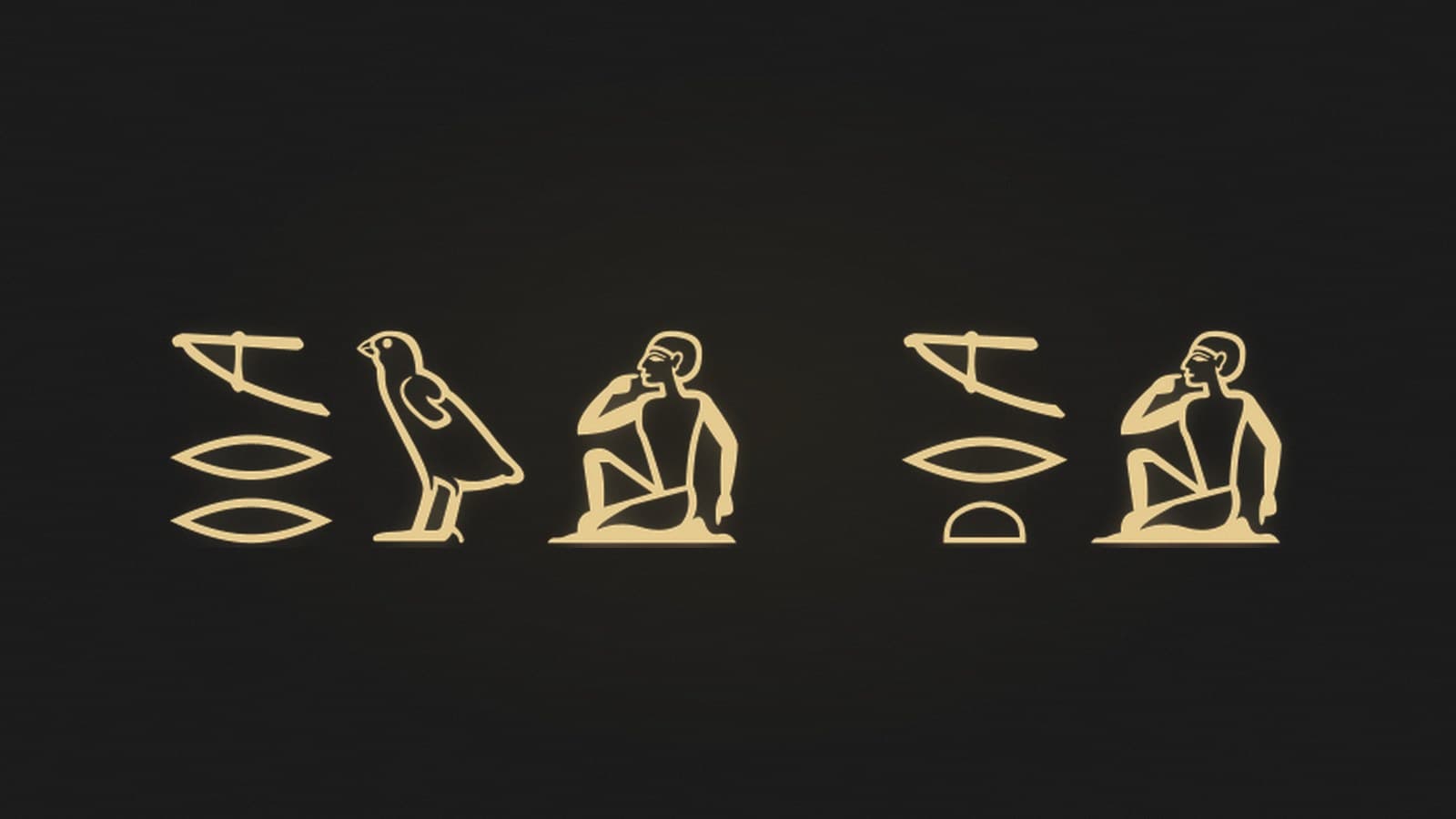
The biggest class that changes is the 3ae inf., whose third radical is a weak i or w; Gardiner counts more than a hundred. The weak letter is rarely written. Instead, some forms double the radical before it, which Gardiner calls "a characteristic feature" of the class, while the infinitive adds -t and never doubles. mri, "love", shows both:

Each word begins with a hoe, read mr, over the mouth sign for r, and ends with a man with hand to mouth. mrrw writes the mouth twice and adds the chick for w; mrt has one mouth and a loaf for t. The weak i appears in neither. Gardiner reports the view that the weak letter was absorbed into the radical before it, turning an older mrw·f into mrr·f. Allen simply gives mri a base stem mr and a geminated stem mrr.
That -t explains a word from the nineteenth lesson. In mšꜥ ḥr prt, "the army is going forth", prt is the infinitive of pri, "go forth", which Gardiner lists in this class. Allen gives the general rule, with two exceptions: verbs with a weak final radical form the infinitive with -t, and the other classes have an infinitive that looks like the root.
Longer verbs are sorted the same way, in classes of four and five radicals and a fourth-weak class (4ae inf.) such as ḥmsi, "sit". There are also causatives, made by putting s before a verb. From ꜥnḫ, "live", the ankh of the eighteenth lesson's wish, comes sꜥnḫ, "make to live", "nourish":

Gardiner notes that, with one exception, a causative falls into the class it would have if the s were a radical, so sꜥnḫ behaves like a verb of four strong radicals. Allen counts fifteen classes in all, eight simple and seven causative, and finds that about two-thirds of all verbs are 3-lit., 3ae inf. or 2-lit.
Gardiner calls a few very common verbs anomalous: verbs that, "but for certain peculiarities", would be 3ae inf. The first is "give", which appears both with and without an r. The eleventh lesson met rdi·n·(i) wi, "I placed myself", and the seventeenth di·n·(i) n·k, "I give to you". Gardiner prefers to see one verb, rdi, that lost its first and last consonants in some forms, and he transliterates the r only where it is written. Allen describes two base stems, di and rdi. Both give it a doubled stem dd, which Gardiner notes is written with the conical loaf twice and never with r, and an infinitive rdit, with the -t of the weak verbs.
"Come" has two stems, iw and ii, and the eighteenth lesson used both: mk tw iw·t(i), "behold, you have come", and ii·ti n·i, "welcome to me". Each has an infinitive in -t:

Gardiner treats them as "two distinct verbs", though clearly related, and finds no doubled forms. Allen thinks they were separate in Old Egyptian but mostly behave as one verb by Middle Egyptian, with two base stems and a geminated stem written like iw, very rarely iww.
Gardiner adds a third anomalous verb, ini, "bring"; Allen's anomalous class has only "give" and "come". It mostly behaves like a 3ae inf., with the infinitive int, but has three distinct sḏm·f forms, one doubled and two not:

Why does the class matter? Allen says a verb's class "determines the shape of many of its forms", much as English learners must know that "fall" makes "fell" but "call" makes "called". He adds that Egyptian is easier: its classes generally look different, and the verbs of each class generally follow one pattern. The doubled stem also carries meaning: Gardiner says that to writing the doubled letter or leaving it out "there regularly corresponds a difference of meaning". The clearest case is the participles, "a hearing son", "living" and "beloved", which are the subject of the next lesson. Gardiner also calls the relative forms, two lessons on, "extensions of the passive participles".