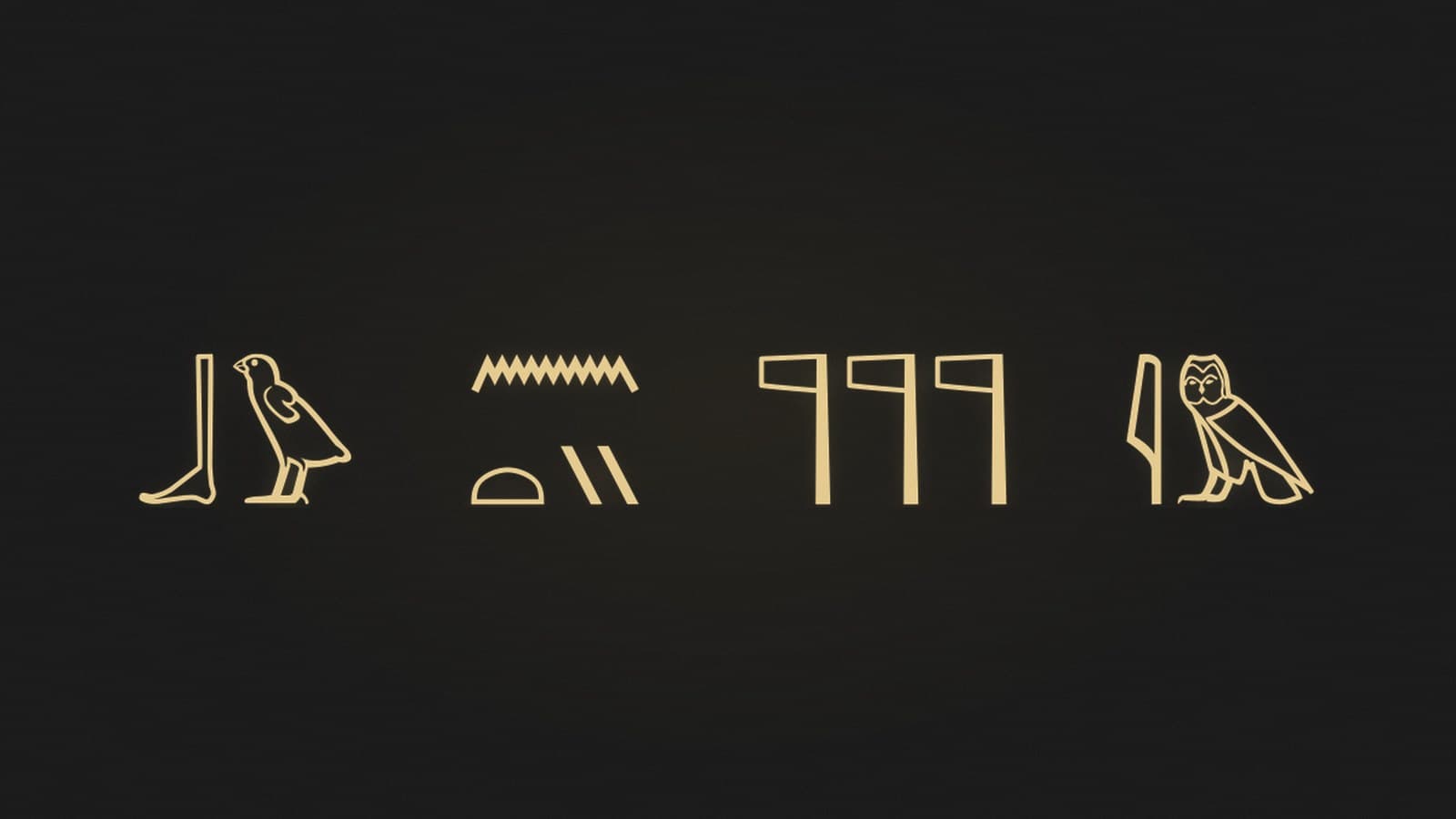
The last lesson gave commands. This one builds descriptions. Alan Gardiner defines a relative clause as a clause "equivalent to an adjective", and James Allen agrees: "A clause that is used like an adjective is called a relative clause." In "the place where the gods are", the clause "where the gods are" describes "the place", which grammarians call its antecedent.
English builds such clauses with "who", "which" or "where". Allen points out that Middle Egyptian has no relative pronouns at all. Instead it has two relative adjectives: nty, "who, which", and its negative, iwty, "who not, which not". The first is made from parts already met. Gardiner explains nty as an extension of n(y), the "of" of the fourth lesson, made by adding -y to its feminine nt. Allen puts it in the terms of the sixth lesson: nty is a nisbe.
Being an adjective, nty agrees with its antecedent: nty for a masculine singular, ntyw for a masculine plural and ntt for anything feminine. Gardiner notes that when the antecedent is written out, nty often stands in place of ntyw, and Allen that the feminine and plural forms gradually fell out of use, as they did for other adjectives.
Allen calls nty a relative marker: it lets a whole sentence work as a relative clause, normally a sentence with an adverbial predicate, like rꜥ m pt, "the sun is in the sky", in the eighth lesson. When the subject of that sentence is the antecedent itself, Gardiner says, it is not written, because it is implicit in nty. From the story of Sinuhe:

ntyw is plural to agree with rmṯ, "people", and it is the subject of im, "there". Allen calls this a direct relative clause, because the word that refers back to the antecedent, here ntyw itself, is the subject.
When the clause has a subject of its own, Egyptian needs one more piece. Gardiner explains that, as in the Semitic languages, Egyptian relative words show gender and number but not case. Where English says "the man whom I saw", "whose son I saw" or "in whom I trusted", Egyptian must say "who I saw him", "who I saw his son", "who I trusted in him". The added word is the resumptive pronoun, which Allen calls the coreferent. An adverb can do the same job:

Literally, "the place which the gods are there". Allen points out that nṯrw im, "the gods are therein", is an ordinary sentence with nty put in front. Gardiner's advice is to look first for the resumptive word: it tells you whether to translate "who", "whose", "to whom" or "where".
For a pronoun subject the grammars differ. Gardiner says a dependent pronoun from the eleventh lesson is usually used, as in bw nty st im, "the place where it is"; Allen says the suffix forms are normal, with wi, "I", and st, "it", as the exceptions. Both give bw ntf im, "the place where he is", and Allen notes that without its two strokes this ntf looks just like the independent pronoun of the twelfth lesson.
Like other adjectives, nty can also stand as a noun, "one who" or "that which". With nb after it, from the second lesson, it means "everyone who" or "whatever":

Here the resumptive is the ·f of rn·f, so the literal sense is "every one who his name is on this stela". In the same way ḥnꜥ ntt nbt im·f is "together with whatever is in it". Allen adds nty n·f, "one who has things", a noun made the way English speaks of "the haves and the have-nots".
To negate the clause, the nn of the ninth lesson comes after nty, and both grammars note that the subject must then be written as a separate pronoun, even when it is the antecedent. From the Shipwrecked Sailor:

Allen quotes just ntt nn st m-ẖnw·f, "that which was not inside it". That clause contains a complete sentence, nn st m-ẖnw·f, "it was not inside it", with the dependent pronoun st as its subject.
Most clauses with nty have no verb. Gardiner says it is comparatively seldom followed by sḏm·f or sḏm·n·f, because the participles and relative forms, the subject of later lessons, are the natural way to say the same thing; negative examples such as mi nty n mr·f, "like one who has not been ill", are more common. The stative of the eighteenth lesson can follow nty, and so can ḥr with the infinitive from the nineteenth, which Gardiner calls rather common. A noun or adjective as predicate is another matter: Gardiner's text finds no examples, and his additions supply just one, with a noun, of "a very rare type". Allen suggests a reason. nty is the relative counterpart of iw, from the eighth lesson, which does not normally introduce such sentences either. Gardiner adds that in Middle Egyptian iw itself cannot follow nty.
The negative adjective iwty is, in Gardiner's words, "doubtless a nisbe adjective" too, made from the feminine of an obsolete word iw that survives only in an Old Egyptian negative particle. Allen notes that this is the only word in which the outstretched arms of the ninth lesson's n are read iw or iwt. Its forms follow nty: iwty, iwtyw, iwtt. Gardiner's tip is to put nn in place of iwty to see the matching main clause. iwty n·f, "he who has nothing", literally "who-not (things are) to him", is Allen's "have-not". With a noun and a suffix, iwty denies possession, like the ninth lesson's nn msw·f, "he has no children":

Literally "which not is writing of it": iwtt is feminine to agree with mḏꜣt, and ·s, "its", is the resumptive. Allen translates it "a scroll that has no writing". As nouns, the two adjectives also make a common phrase:

Gardiner glosses it "everything", Allen "everything imaginable". The two grammars weigh iwty differently. Gardiner calls it a common word, though not very common before the sḏm·n·f of the seventeenth lesson, and gives iwty sḏm·f n ḏd ḫt·f, "who does not listen to his belly's prompting". Allen calls it an older form, usually replaced in Middle Egyptian by nty with a negative sentence, yet with sḏm·n·f after a defined antecedent he makes it the normal negative.
The participles and relative forms come later; first, the next lesson explains verb classes, and why some verbs double a letter while others drop one.