The last lesson showed how Egyptian says what someone is doing, with ḥr and an infinitive. This lesson turns from statements to orders. Alan Gardiner defines the imperative "as in other languages": it "expresses a command or exhortation addressed directly to one or more persons", so it always speaks to "you". James Allen agrees: the speaker addresses someone, "or something", in the second person, singular or plural.
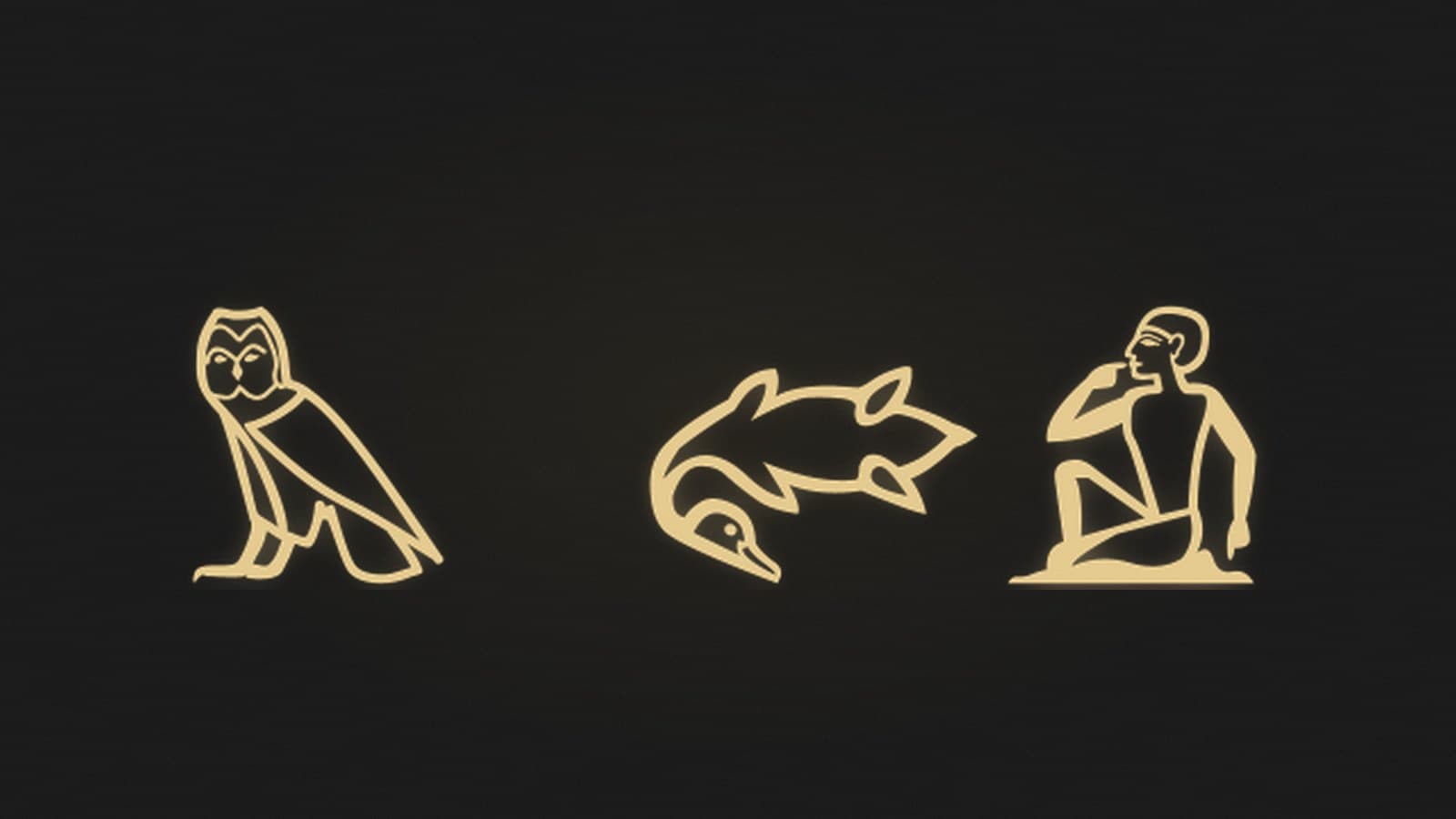
The form is the plainest a verb can take. Gardiner says the singular "has no flexional ending", meaning nothing is added to the verb to mark its job, and his first two examples are sḏm, "hear", and in, "bring". Allen puts it as a rule: for most kinds of verb the imperative is just the root. The ear and the owl are the sḏm of the seventeenth lesson; in is a pot on walking legs over the ripple of water.

The script shows no difference between an order to a man and one to a woman. Allen suggests the spoken language made one, with vowels that hieroglyphs do not write, and points to Coptic, which keeps four forms of "come!"; Gardiner's footnote quotes two of them. A plural order usually looks like a singular one too. Gardiner lists a few rare endings, such as my, "come" said to several people, but says it is "by no means unusual" to find only the plural strokes added, as in wḏꜣ(w), "proceed", a word Allen quotes as well.
A few common verbs are irregular. Gardiner says imperatives from (r)di, "give", and ii or iw, "come", are uncommon, and that other stems ordinarily replace them: imi, "give, place", and mi, "come". Allen calls these irregular imperatives and gives the same pair. For "bring", Gardiner adds, in is common; Allen translates the same verb "get".

In imi the reed leaf and the owl spell i and m. Gardiner's sign list reads the flat sign as im, and names the arm holding a rounded loaf beneath it as a determinative of imi. Both grammars explain that this arm, from its use here, came to stand for the sound mi or plain m, which is why it also turns up in mi, "come".
Some imperatives start with an extra i, which Gardiner calls prothetic and Allen a prefix: is, "go", and ims, "bring". Both grammars quote an order from the Eloquent Peasant, is in n·i ifd m pr·i: Gardiner's "go fetch me a cloth from my house", Allen's "Go, get me a sheet from my house". As in in n·k st sš in the thirteenth lesson, the pronoun dative n·i, "for me", comes before the noun object ifd.
The subject, "you", is normally left unsaid, as in English. When a dependent pronoun from the eleventh lesson follows the verb, the grammars read it differently. Gardiner counts it among the words added "to reinforce the meaning of the imperative", and translates wḏꜥ tw ḏs·k "give judgment thou thyself", with the old English "thou" for an emphatic "you". Allen quotes the same words from the Eloquent Peasant, with the name that follows, and makes tw the subject itself: "You decide by yourself, son of Meru". The name is what he calls a vocative, the person spoken to, which can stand before or after the imperative.

Gardiner names two more ways to strengthen an order. A reflexive dative, n with a suffix for the person addressed, lends it "liveliness", as in ꜥpr n·k, "equip for yourself". Commoner than both the pronoun and the dative, he says, is r with a suffix, as in sꜣ r·k, "tarry thou".
An object pronoun is also a dependent pronoun, as both grammars say. Gardiner's example is two words:
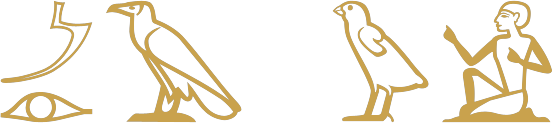
For an order about someone else, English "let him hear", Gardiner says Egyptian uses imi, "give, cause", followed by the sḏm·f of the thirteenth lesson: imi rḫ·f rn·k, "let him learn your name", literally "cause that he learn your name".
To forbid, Egyptian puts m in front, which Gardiner calls the vetitive. Both grammars explain that this m is itself an imperative, of a negative verb imi, a different word from "give"; Gardiner says it is shortened to m. He conjectures that it meant "not be"; Allen glosses it "not be, not do". After it comes a special form of the verb that both call the negatival complement. Its ending w, Gardiner says, "more often than not is left unwritten", so it usually looks like the bare verb. He suggests that m sḏm(w), "do not hear", may at first have meant "do not be (in) hearing".

With adjective verbs, such as "be great", a noun with "your" is often added, and here the grammars part company. For a line of Ptahhotep, m ꜥꜣ ib·k ḥr rḫ·k, Gardiner gives "do not be puffed up (lit. great as to your heart) on account of your knowledge": m keeps its unspoken subject "you", and ib·k, "your heart", only says in what respect. Allen makes the heart the subject, "Don't let your heart get big because of your knowledge", and explains that when the verb takes no object, m can mean "don't let".
A longer pattern later took over. Gardiner says that from Dynasty XVIII onward everyday speech replaced the plain m with m ir, "do not make", followed by the infinitive, and that a few examples appear already in texts of the Tuthmoside period:

Allen dates the start earlier, already in the Middle Kingdom, and says that by the New Kingdom it had become the standard way to forbid, especially in less formal texts. He compares English, where "go not!" gave way to "do not go!". Gardiner adds that m rdi, "let not", negates the pattern with imi: m rdi šm·n ḥr mṯn pf šṯꜣ, "let us not go upon that difficult road".
An order speaks to "you". The next lesson turns to clauses that describe someone, with nty, "who is", and iwty, "who has no".