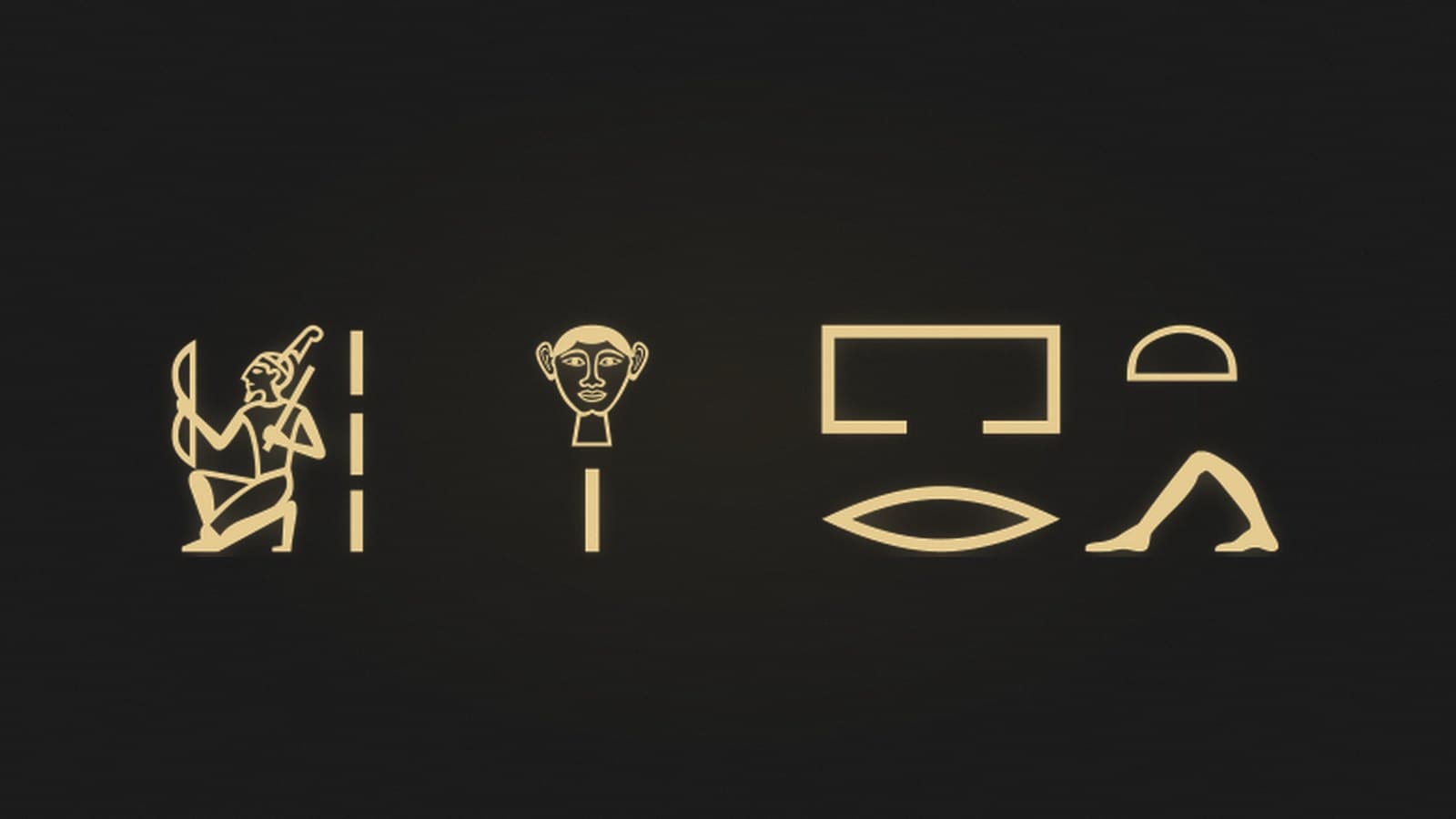
The last lesson ended with Alan Gardiner's first two models of what he calls the pseudo-verbal construction: mšꜥ pr(w), "the army is gone forth", with the stative, and mšꜥ ḥr prt, "the army goes forth". This lesson takes up the second, which is built from parts already met. In the eighth lesson, rꜥ m pt meant "the sun is in the sky": a subject, then a preposition with its noun, and no word for "is". The tenth lesson met the preposition ḥr, "upon". Put a verb after ḥr instead of a noun, and the sentence says what the subject is doing. Gardiner translates mšꜥ ḥr prt "the army goes forth", "went forth" or "is going forth", literally "on going forth".

The word after ḥr is an infinitive. Gardiner defines it as a noun naming the action or state of a verb, like English "to make" or "making". James Allen adds that it names the action just as action, with no tense of its own. Some verbs form it with no ending, others with -t. Gardiner lists prt, "go forth", among the second kind, and Allen notes that the -t is usually written before the determinative, which is why the loaf sits above the walking legs.
Gardiner chose the name pseudo-verbal construction "for want of a better". These sentences mean what an ordinary sentence with a verb means, but they follow the pattern of a sentence like rꜥ m pt. With ḥr, he says, the name is strictly accurate, because ḥr with an infinitive is in fact an adverbial phrase. Allen explains it the same way: "verbal" because it contains a verb form, "pseudo" because grammatically the predicate is adverbial, so it comes after its subject. He allows only three prepositions in it: ḥr, m and r.
The last lesson also showed where the two grammars disagree: Gardiner counts the stative in the same family, because its subject is introduced exactly as it would be if the predicate were adverbial, while Allen calls the grouping "not quite accurate". Gardiner himself admits that for the stative the name is "more open to criticism". What he adds here is how the two divide the work. ḥr with the infinitive is "dynamic, active, and expressive of action", the stative "static, passive, and expressive of condition". So the stative tends to have a past meaning, while ḥr with the infinitive suits the present.
Neither has a tense of its own. Allen calls the construction "nontemporal", like every adverbial predicate. ḥr with the infinitive most often matches English "is doing" or "was doing", an action in progress, and the context decides which. Gardiner's example comes from a story of past events, the Shipwrecked Sailor:

Nothing introduces these two clauses. Both grammars say this is normally possible only when the subject is a noun, and Gardiner adds that even then a main clause usually starts with iw, the small word from the eighth lesson, or a particle such as mk, "to lend importance to the statement".
A pronoun subject needs that support, because, as the eleventh lesson showed, a pronoun cannot open a sentence on its own. With iw it takes a suffix, as in Gardiner's iw·f ḥr prt, "he goes forth"; after a particle it is a dependent pronoun. From the story of the Eloquent Peasant comes mk wi ḥr spr n·k, which Gardiner renders with a plain English present.

With verbs of motion, m, "in", can take the place of ḥr. Gardiner calls it an occasional substitute that perhaps stresses the gradual, drawn-out character of the movement, and quotes the story of Sinuhe:

Literally, Gardiner notes, they "were in coming" and "in going". Allen sees more in it. He says m is used less often than ḥr, and only with verbs that take no object, and that rather than an action in progress it seems to denote the future, like English "Jack is going to Alaska this summer". Gardiner allows that in a few examples the action lay in the future, and is sure of it in one that both grammars quote, "behold, I am going down to Egypt": English, he points out, also says "he is going down" for "he is about to go down".
The third preposition, r, "to, towards", looks ahead. Gardiner says r with the infinitive is often used for future action, "whether simply or as conditioned by the speaker's will", like English "will" and "shall". Both grammars quote a line from the Eloquent Peasant:

Gardiner translates "I will take away", Allen "I have to take away". For Allen, r with the infinitive marks an action still to happen, usually one that is planned or inevitable, like English "is to" or "has to". Gardiner notes that the pattern iw·f r sḏm is particularly common and survived into Coptic as a future tense; Allen traces all three constructions into Coptic.
Negation is rare. Both grammars quote nn wi ḥr sḏm st, which Gardiner renders "I do not hear it" and Allen "I was not hearing it": the same words in two tenses. Usually Egyptian denies such statements with a verb form instead, and for a continued or repeated action Gardiner names the n sḏm·n·f of the seventeenth lesson.
So the three prepositions of the tenth lesson, with an infinitive after them, let Egyptian say what is happening, what is on the move and what is still to come.