The last lesson ended with a division of labour. Egyptian uses sḏm·n·f for the past of verbs that take an object, but for verbs like "go" it prefers a form that describes the state left behind by a completed action. James Allen calls it the stative. Alan Gardiner calls it the old perfective, and rejects the older name "pseudo-participle" as less suitable. Gardiner sees it as "the sole surviving relic in Egyptian of the Semitic finite verb"; Allen notes that most of Egyptian's Afro-Asiatic relatives, from Akkadian to Arabic and Berber, have it too.
What marks it out is a set of endings. Gardiner stresses that they belong to this form alone and cannot be identified with any of the Egyptian pronouns, so they are not the suffix pronouns of the third lesson. Allen calls them suffixes of a special form, found with the stative and nowhere else. Gardiner sets them out on the model verb sḏm, "hear":

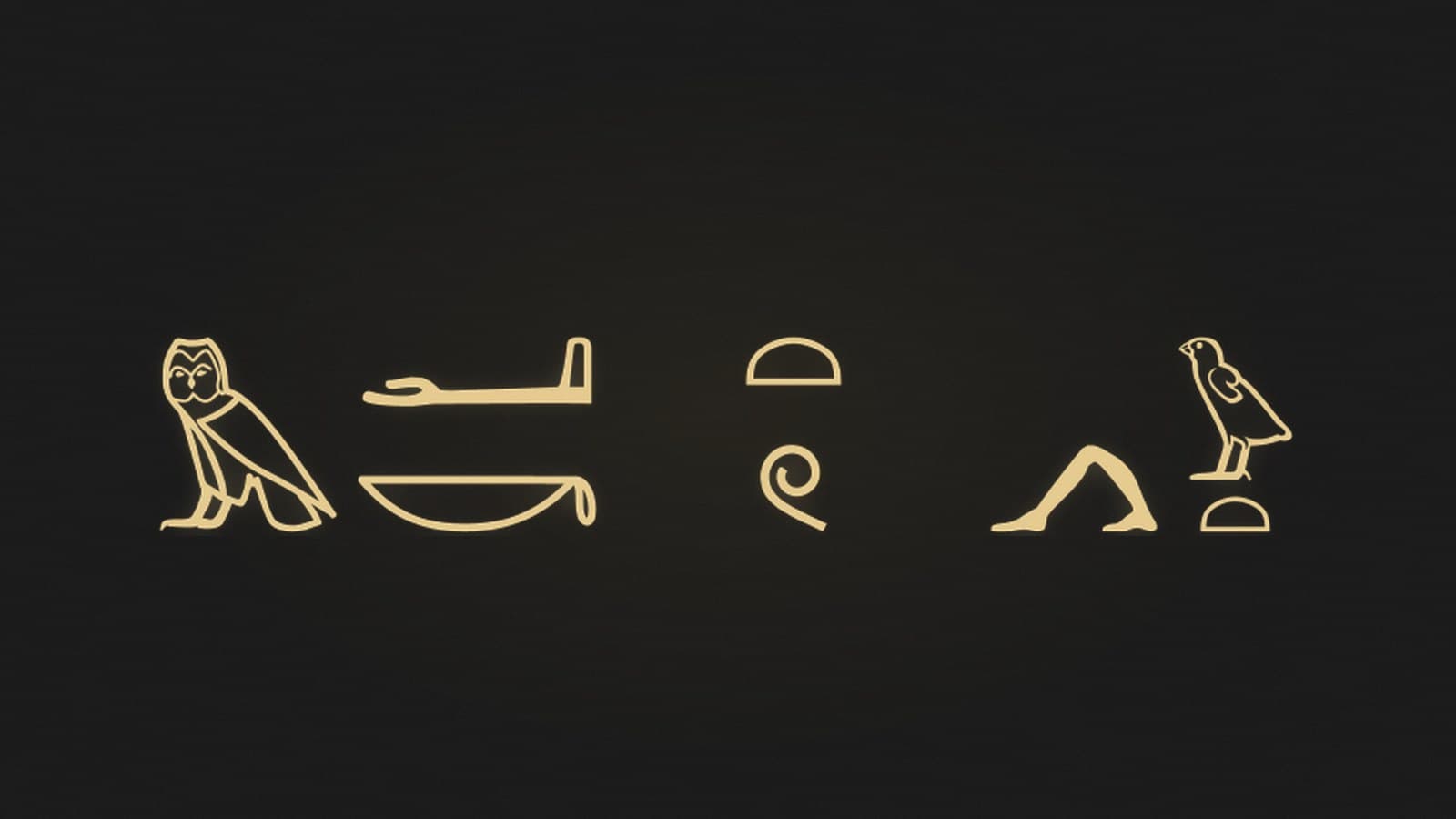
In order, these are ·kwi, "I", written with the basket, the quail chick and the seated man; ·ti, "you", said to a man or a woman, with the pestle and a reed leaf; ·w, "he", which is often not written at all; ·wyn, "we"; and ·tiwny, plural "you", with a vulture. The same ·ti also serves for "she", and the masculine ·w for "they". Gardiner warns that only "I", "we" and plural "you" are really distinctive, and that short writings like sḏm and sḏmt are easily confused with other parts of the verb, so the way the form is used is often the best clue. Allen writes the endings .kw, .tj, .w, .wjn and .tjwnj; this series keeps Gardiner's spelling.
Gardiner describes the meaning as a state or condition: static, where the forms built like sḏm·f are dynamic. Allen compares the English past participle: "the table is set" describes a state, and the action that produced it. With a verb that takes no object, the state is one the subject has reached by its own action, as in "Jack is gone" or French le soleil est paru, literally "the sun is appeared". With verbs of motion, Gardiner says, the form describes not so much the movement as the position reached by it.

Literally this is "behold you, you are come". tw is the dependent pronoun after mk from the eleventh lesson, and iw·t(i) is the stative of iw, "come", with the ending written as a loaf alone. Gardiner's rule is that any subject written out, noun or pronoun, must come before the stative.
With a verb that takes an object, the stative is passive. In the eleventh lesson hꜣb·k wi meant "you send me". In the stative the same verb gives "I have been sent", in Gardiner's example h(ꜣ)b·kw m ipt n sr mn, "I have been sent on a mission to the official so-and-so". He adds that the sḏm·n·f of the last lesson supplies the matching active.

One verb breaks the rule. rḫ, "know", stays active, so rḫ·kwi is "I know", not "I am known". Allen explains that rḫ really means "learn about", and the state that results from learning is knowledge.
A noun subject also comes first. In ist mniwt nbt sspdw m ḫt nbt nfrt, "lo, all ports were supplied with everything good", the particle ist, "lo", is followed by the subject mniwt nbt, "all ports", then the passive stative sspdw, "supplied", and last m ḫt nbt nfrt, "with every good thing", a phrase from the first lesson. Here the ending w is written out, and, as Gardiner notes, it comes before the determinative. Allen adds that the stative agrees with its subject as far as it can, and stays as close to it as possible.

The stative itself has no tense, Allen says: the context decides. In a story, Gardiner translates it with the English past or present perfect. It is common with adjective verbs, as in Gardiner's wsr·kwi, "I was powerful". Allen notes that with these verbs the stative implies an earlier change: his example means "his heart had become, and was now, good". With "I", and as a rule only then, it can stand alone as a main sentence: špss·kw ꜥꜣ·kw, "I was wealthy and I was great".
Very often the stative adds a circumstance to a main clause, describing a noun or pronoun already in it. The hero of the Shipwrecked Sailor says:

Literally this is "I spent three days, I being alone". ir·n·i is a sḏm·n·f, and wꜥ·kwi is the stative of wꜥi, "be alone". Allen quotes the same line and notes that when the subject has already been mentioned, the stative usually stands without one. Gardiner notes that English may need an adjective, a participle, a clause or an adverb for it.
The second person can stand alone in greetings. Gardiner quotes ii·ti n·i, "welcome to me!", literally "you are come to me", and snb·t(i), "farewell", literally "be healthy". The third person appears in a very common wish, written after nb, "my lord", after the names of honoured people, especially in letters, and later after words for the king such as ḥm·f, "His Majesty".

English translations shorten it to "l.p.h." Allen renders it as an epithet, "alive, sound, and healthy". He also points out that the same pattern of subject and stative lies behind many names: Imn-ḥtp(w), Amenhotep, "Amun is contented"; Ḏḥwty-ms(w), "Thoth is born", the Tuthmosis of the fourteenth lesson; and Nfrt-ii·ti, Nefertiti, "the beautiful one has come".
When a subject has no other job than to go with a stative, Gardiner notes that the stative behaves like the adverbial predicate of the eighth lesson. He groups this pattern with one more under the name pseudo-verbal construction. Allen keeps the name subject-stative construction and calls that grouping not quite accurate, because the stative is a real verb form. Gardiner's first models show the two together: mšꜥ pr(w), "the army is gone forth", and mšꜥ ḥr prt, "the army goes forth", literally "is on going forth". That second pattern, a subject followed by ḥr and the infinitive, the Egyptian way to say "he is hearing", is the next lesson.