The thirteenth lesson put the verb first. In hꜣb·f ṯw, "he sends you", the verb hꜣb came before its subject and its object, and both grammars said that the same order holds beyond that one verb form. This lesson meets the next form. Alan Gardiner calls it "this second common form of the verb" and "the staple of most past narrative".
Grammars name it sḏm·n·f, "he heard", with the same model verb sḏm, "hear". Gardiner says it is built exactly like sḏm·f, with a noun or a suffix pronoun as its subject straight after the verb. The only difference is an extra n, written with the ripple of water, which comes immediately after the verb, or after its determinative if it has one. James Allen calls the same form "the perfect", and pronounces it "sedgem-EN-ef".
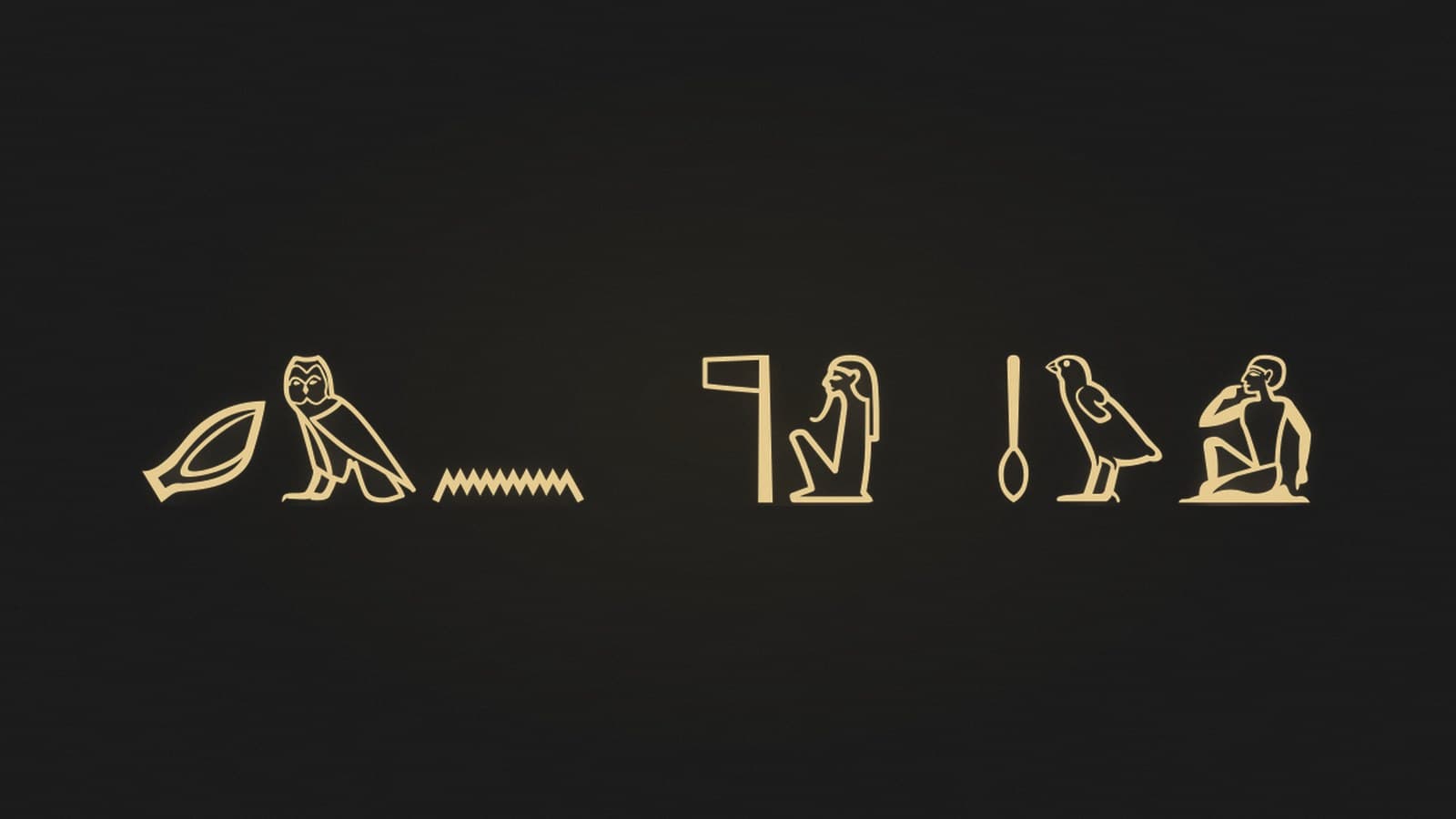
Gardiner's first example is sḏm·n·i ḫrw·f, "I heard his voice". The ear and the owl spell sḏm. Next comes the n, with the seated man under it for ·i, "I", and then ḫrw, "voice", ending with a man touching his mouth, and the suffix ·f, "his".

With a noun as subject, the noun takes the place of the suffix: sḏm·n nṯr ḫrw, "the god heard the voice". Allen quotes the same sḏm·n nṯr but translates it "the god has heard".

Gardiner adds that the word-order rules of the thirteenth lesson apply here too, and that a full table of forms is unnecessary: "the one point to remember is that the formative n is inseparable from the verb-stem". Nothing comes between the verb and its n; after that, the old rules hold. In sḏm·n st nṯr, "the god heard it", the dependent pronoun st, "it", from the eleventh lesson, stands ahead of the noun subject nṯr, because a noun must not come before a pronoun.

The dative moves forward too. In hꜣb·n n·k nb·k, "your lord has sent to you", two ns stand side by side. The first belongs to the verb form. The second is the preposition n, "to", from the tenth lesson, carrying the suffix ·k, and it comes before the noun subject nb·k, "your lord". Allen agrees: his order VsdoSOA applies to every clause with a verb.

Gardiner thinks this n was originally the same preposition. In his view the form began as a passive form of the verb followed by a dative, so that pr·n·f, "he went out", would first have meant "gone out to him", and sḏm·n·f "heard to him". Since it expresses "what occurs or happens" to someone, it was at first no more tied to a time than sḏm·f. In practice, apart from a few special cases, it is restricted to the past, and English may render it "he heard", "he has heard" or "he had heard".
Allen's name reflects a different emphasis. For him the perfect expresses completed action: it is an aspect, not a tense. But Middle Egyptian has no separate past tense, so the perfect does that job as well, just as French j'ai trouvé and German ich habe gefunden mean both "I have found" and "I found". Gardiner names the form by its look, Allen by its meaning.
In a story the form often follows a short introductory word. Gardiner says that iw, from the eighth lesson, is often put in front of it to mark an event of some importance, and both grammars quote a prince telling the king iw in·n·i Ḏdi, "I have brought Djedi". Allen adds mk, "behold", from the eleventh lesson, and ꜥḥꜥ·n, "then", the commonest of all when the form reports a past event. The eleventh lesson already showed one: rdi·n·(i) wi ḥr ḫt·i, "I placed myself on my belly". Allen explains that "I" is missing because the suffix was only the vowel i, and before wi the group was probably said as one word.
One common use is not past at all. In scenes of the king before a god, the god often speaks to him in this form. Gardiner's example is the god Dedwen leading prisoners to the king: di·n·(i) n·k tꜣw nb, "I give to you all lands". He reads it as an action spoken and performed at the same moment, and translates it with the English present. Allen translates the same formula "I have given to you": the giving is complete from the point of view of the god who speaks.

The negative needs care. The ninth lesson said that with one common verb form, n mostly gives a past meaning. That form was sḏm·f, and Gardiner says n sḏm·f is the ordinary way to say "he did not hear": it is the negative of sḏm·n·f. Put n in front of sḏm·n·f itself and the meaning is often present. Both grammars quote the same line from Ptahhotep: the mouth is silent, n mdw·n·f. Gardiner translates "and does not speak", Allen "without being able to speak". Here the n of the form follows the determinative of mdw, "speak".

Gardiner warns against the obvious guess. Because sḏm·n·f can mean "he had heard", it is tempting to read n sḏm·n·f as "he had not heard", but it "appears never to have this meaning". It denies that an action happens at all over a stretch of time, which is why it is common in proverbs and statements of custom. Allen puts it in terms of completion: n sḏm·n·k is something like "you do not complete hearing", so "you do not hear" or "you cannot hear".
Gardiner's pr·n·f, "he went out", shows that verbs of motion can take this form too. But Allen notes that Egyptian prefers it for verbs that take an object, and uses another form for verbs like "go": one that describes the state left by a completed action. That form is the stative, Gardiner's old perfective, and it is the subject of the next lesson.