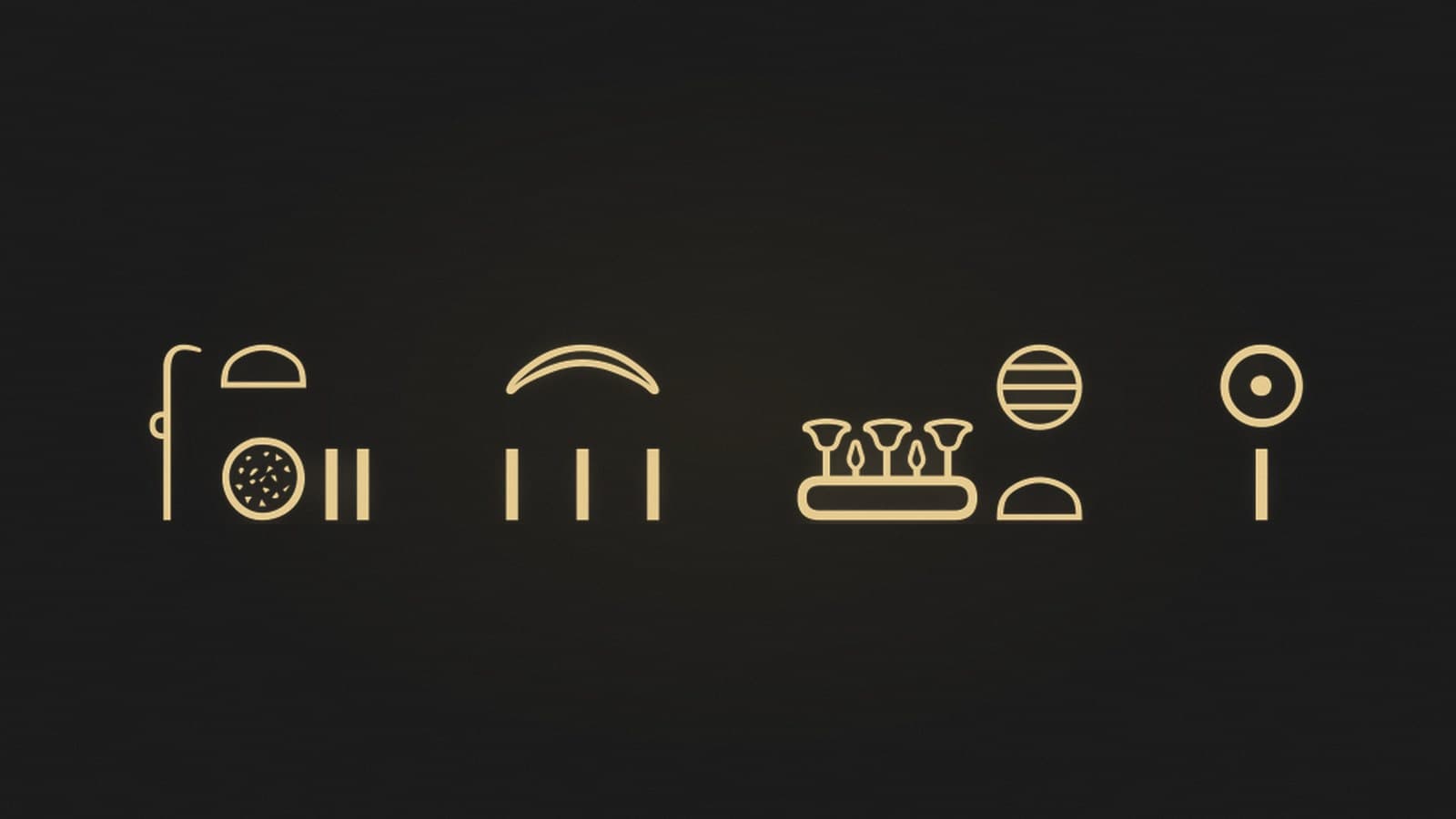
The last lesson looked ahead to dates, which put the number signs from the earlier lesson "Count like an Egyptian" to work: a stroke for 1, a hobble for 10, a coil of rope for 100, each repeated as often as needed. Alan Gardiner stresses that throughout Pharaonic history no continuous era was ever used, nothing like our count from AD 1. The Egyptians dated by the years of the reigning king. James Allen adds that each new reign was thought of as a new creation, and so began a new count of years.
The civil year had twelve months of thirty days. Five extra days at the end brought it to 365; Gardiner calls them the epagomenal or "added" days, in Egyptian ḥryw rnpt, "the days upon the year", and Allen notes that each was celebrated as the birthday of a god: Osiris, Horus, Seth, Isis and Nephthys. The months were grouped into three seasons of four months each.
ꜣḫt is the inundation, when the Nile flooded the fields. prt is presumably, says Gardiner, the season of the "emergence" of the fields from the water. šmw has been "daringly guessed", in Gardiner's words, to mean "deficiency of water". He translates the last two "winter" and "summer". Allen prefers "Growing" and "Harvest", and places the seasons, ideally, from mid-July to mid-November, mid-November to mid-March and mid-March to mid-July. Two of the three end with the sun, which Gardiner calls the ordinary determinative of time.

A date opens with the year of the reign. The group begins with the palm rib that writes rnpt, "year", but Gardiner insists that in dates the word is not rnpt, which never takes a round sign. It is ḥꜣt-sp, and the round sign is sp, "occasion" or "time". The times were once counts of cattle: in the Fifth and Sixth Dynasties, Gardiner explains, years were numbered by a census held every second year, so a date could read "beginning of time 14 of the numbering of the oxen and of all small cattle"; later ḥꜣt-sp simply meant "year". Allen tells the same story but reads the group rnpt-ḥsb, "year of counting", which he translates "Regnal Year". Gardiner notes that his own reading was disputed; this lesson follows him.
Gardiner's first example is a date of Ammenemes III of the Twelfth Dynasty (Allen's Amenemhat III), which Allen quotes too:


After the year and its two strokes comes the crescent moon, ꜣbd, "month", with three strokes: the third month. Then the season, and last the sun with one stroke, sw 1, "day 1". Gardiner notes that the word for "day" in dates was sw, not the everyday hrw. As always in Egyptian writing, the number follows the thing counted, a habit Gardiner traces to book-keeping, like the English £6 for "six pounds"; in speech the number came first.
How were dates said aloud? Gardiner thinks the numbers after "year" and "day" were cardinals used with the sense of ordinals, as English says "year two" for "the second year". The month, he argues, was a true ordinal, with the word for "month" left unspoken: "third of inundation". That is why he transliterates it (ꜣbd) 3(-nw n) ꜣḫt. Allen goes further and suggests that every number in a date was probably spoken as an ordinal.
The second half names the king. ḫr ḥm n, "under the Majesty of", is the phrase met in the tenth lesson, and the title nsw-bity and the cartouche are those of the fourteenth, with the sun written first. Allen gives this as the full Middle Egyptian pattern: year; month, season and day; then the king, "during the incarnation of the Dual King" in his translation. Gardiner adds a quirk: in the Middle Kingdom a king's second year began at the first New Year's Day after his accession, so his first year was only the odd months and days left after his predecessor died.
Two words stand in for numbers. The first month of a season is often written tpy, "first", here with the dagger sign, instead of the crescent and one stroke, and the thirtieth day is ꜥrḳy, "last day". Both grammars take these as signs that the numbers in dates had an ordinal sense. New Year's Day, wpt-rnpt, "the opening of the year", was:

Gardiner's second example, a date of Tuthmosis III, stands in the middle of a sentence, so it begins with m, "in", which he notes is never used at the beginning of a text. As often, the king is not named. The year is two hobbles and four strokes, 24:

The calendar did not stay in step with the river. Gardiner explains that the true New Year's Day came to be the morning the star Sirius, the goddess Sothis, was first seen again before sunrise, about when the Nile began to rise. But the civil year had 365 days, the real year about a quarter of a day more, and no leap day was ever added. The calendar slipped a day every four years, until the real summer sometimes fell in the calendar's winter; the two met again only after about 1,460 years in Gardiner's figure, 1,453 in Allen's.
The months had names too, which later documents give in Greek as Thōuth, Phaōphi and the rest. Gardiner calls it "a gross anachronism" to put those on a Middle Kingdom date, and keeps the numbers: "fourth month of winter". Allen notes that hieroglyphic texts rarely use month names, though they were surely common in speech, as we say "April" rather than "month 4".
The next lesson turns from dates to verbs, and to the past tense with sḏm·n·f, "he heard".