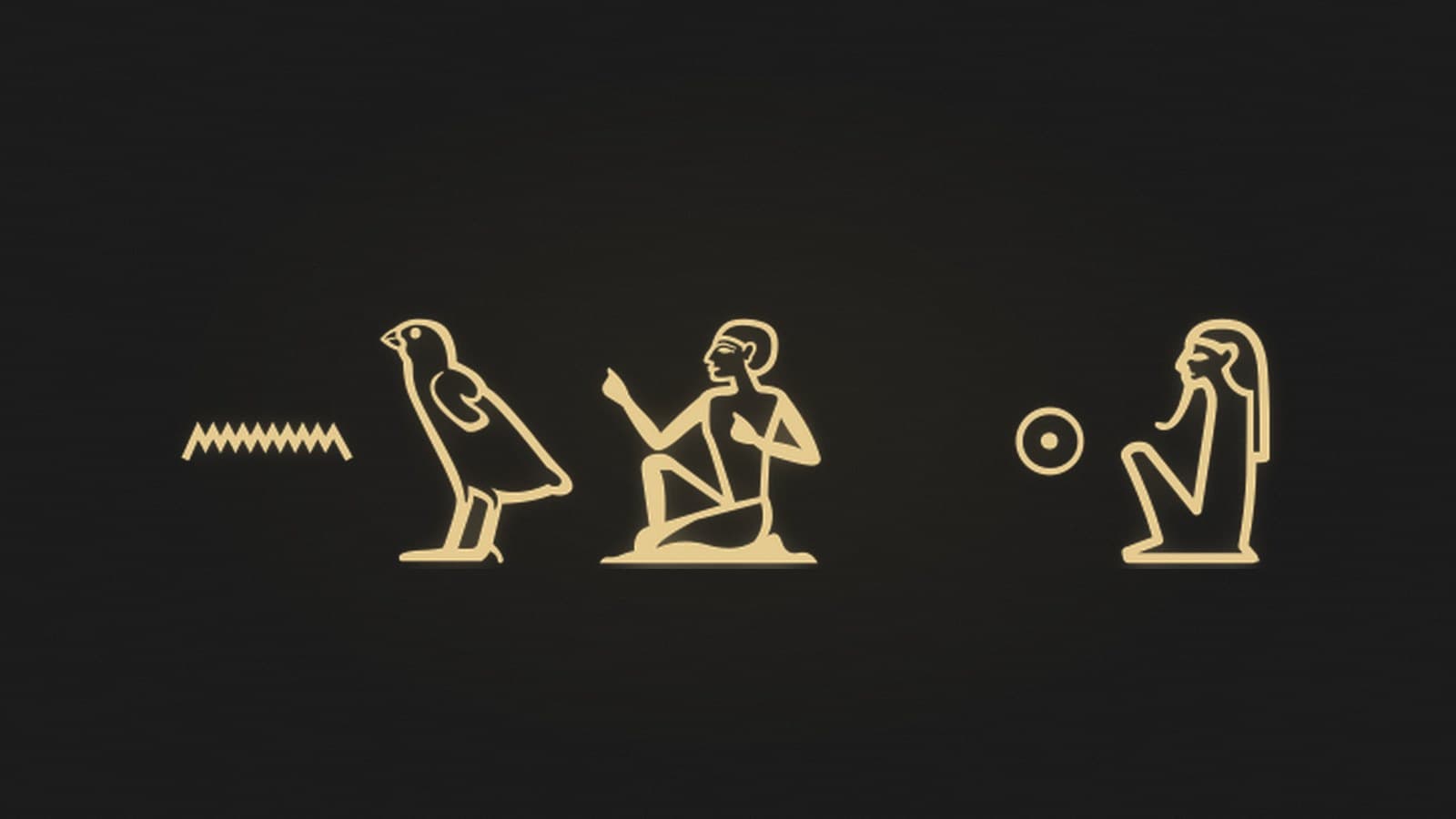
The third lesson in this series said "my house" with a suffix pronoun: pr·i, literally "house of me". Alan Gardiner calls this the usual way to say "my" or "your", but lists some less common alternatives, and they lead to a bigger point. Egyptian has no verb meaning "to have" or "to possess", and none meaning "to belong to". James Allen notes that Arabic and Russian also manage without "have". This lesson covers the words for "my" and "mine" and the sentences Egyptian uses instead.
The first alternative grows out of the seventh lesson. From the demonstratives pꜣ, tꜣ and nꜣ, Gardiner explains, Egyptian made possessive adjectives by adding y and a suffix pronoun: pꜣy·i, "my", before a masculine noun, tꜣy·i before a feminine one and nꜣy·i n before a plural, with the same pattern for the other persons.

Allen explains that the suffix is added to the demonstrative instead of the noun, so pꜣy·sn pr means the same as pr·sn, "their house". The demonstrative part agrees with the thing owned and has nothing to do with the owner. Gardiner adds that they behave like the demonstratives they come from, so they stand before the noun, with the plural joined to it by n, as in nn n srw. Both grammars quote the same two examples from the Kahun papyri, tꜣy·i ḥmt, "my wife", and nꜣy·s n ẖrdw, "her children".

How common were they? Gardiner says they are not uncommon in the more popular writing of the Twelfth Dynasty and later, but did not become usual until Late Egyptian. Allen traces them to the spoken language, alongside the weakening of pꜣ to "the", and says they appear occasionally in Middle Egyptian texts from the Second Intermediate Period on. Either way, in classical Middle Egyptian the suffix is still the normal way to say "my".
Now the sentences. Gardiner explains that Egyptian uses the preposition n, "to, for", from the tenth lesson, together with words made from it. The plainest way is a sentence with an adverbial predicate, like rꜥ m pt in the eighth lesson: the thing owned is "to" its owner.
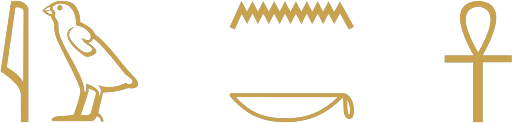
Here n·k, "to you", has jumped ahead of ꜥnḫ, "life". Gardiner points out that this is the pull to the front that the thirteenth lesson saw in the dative with a suffix, and he compares Latin est mihi, "is to me". With a noun as owner the subject comes first, as in a man's will quoted by both grammars: ḫt·i nbt m šꜣ m niwt n sn·i, "all my property in country and in town (shall belong) to my brother". The nn of the ninth lesson negates it: nn n·k st, "it does not belong to you", and nn is n sbi, "the rebel shall have no tomb". Allen says Egyptian prefers this kind of sentence for possession.
A second pattern makes "belonging to" itself the predicate. When the subject is a pronoun, Gardiner explains, the genitival adjective n(y) of the fourth lesson comes first, like the adjective in nfr sw, "he is good", and the subject is a dependent pronoun. His example is literally "I am belonging-to Rēꜥ".
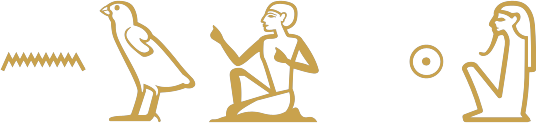
Allen quotes the same line, from Papyrus Ebers. Both grammars note that n(y) never changes for gender or number here, and Allen adds that "I" is allowed in this pattern, although the eleventh lesson found it missing from ordinary adjectival sentences. The two words were said as one, and Gardiner notes that in n(y)-sw, "he belongs", the two-consonant sign ns regularly replaces the n, linking the words together. The pattern is common in personal names, Allen says, with the god written first, as in N(y)-sw-Mnṯw, "he belongs to Montu".
To put weight on the owner, Gardiner says, Egyptian uses the independent pronouns of the twelfth lesson, or forms very like them, for "belongs to me" or "I am owner of".

The grammars analyse these words differently. Gardiner takes ntk as the independent pronoun or something close to it. Allen takes it as n(y) plus ntk, said as one word, so the shared n is written once; with "I" the pair contracts to nnk, as in nnk pt nnk tꜣ, "the sky is mine, the earth is mine". Gardiner knows nnk too, from some religious texts of the Middle Kingdom. If the thing owned is a pronoun, it is a dependent one: ink sy, "she belongs to me", is an Egyptian personal name.
For "of mine" Gardiner gives a more emphatic set, n·i-imy, n·k-imy and so on, which follow their noun: hdmw n·sn-im(y), "footstools belonging to them", a phrase Allen quotes too. The same forms make sentences, as in this line from the Shipwrecked Sailor:

Two more patterns remain. The ninth lesson's nn msw·f, "he has no children", has a positive twin: ist wn ḥmt·f, "and he has a wife", literally "lo, there was a wife of him", from the Eloquent Peasant. And nb, "lord", also means "owner": ink nb ꜥꜣw nb ḫbsw, "I was an owner of donkeys and an owner of ploughlands". Allen stresses that such a man has donkeys; he does not rule them. Gardiner adds that this use is especially frequent with abstract words, which is why the fourth lesson's nb imꜣḫ, "possessor of veneration", means nearly the same as imꜣḫy, "revered".
Every one of these, Allen points out, is a sentence without a verb. The next lesson turns to dates: how Egyptian wrote the year, the season, the month and the day.