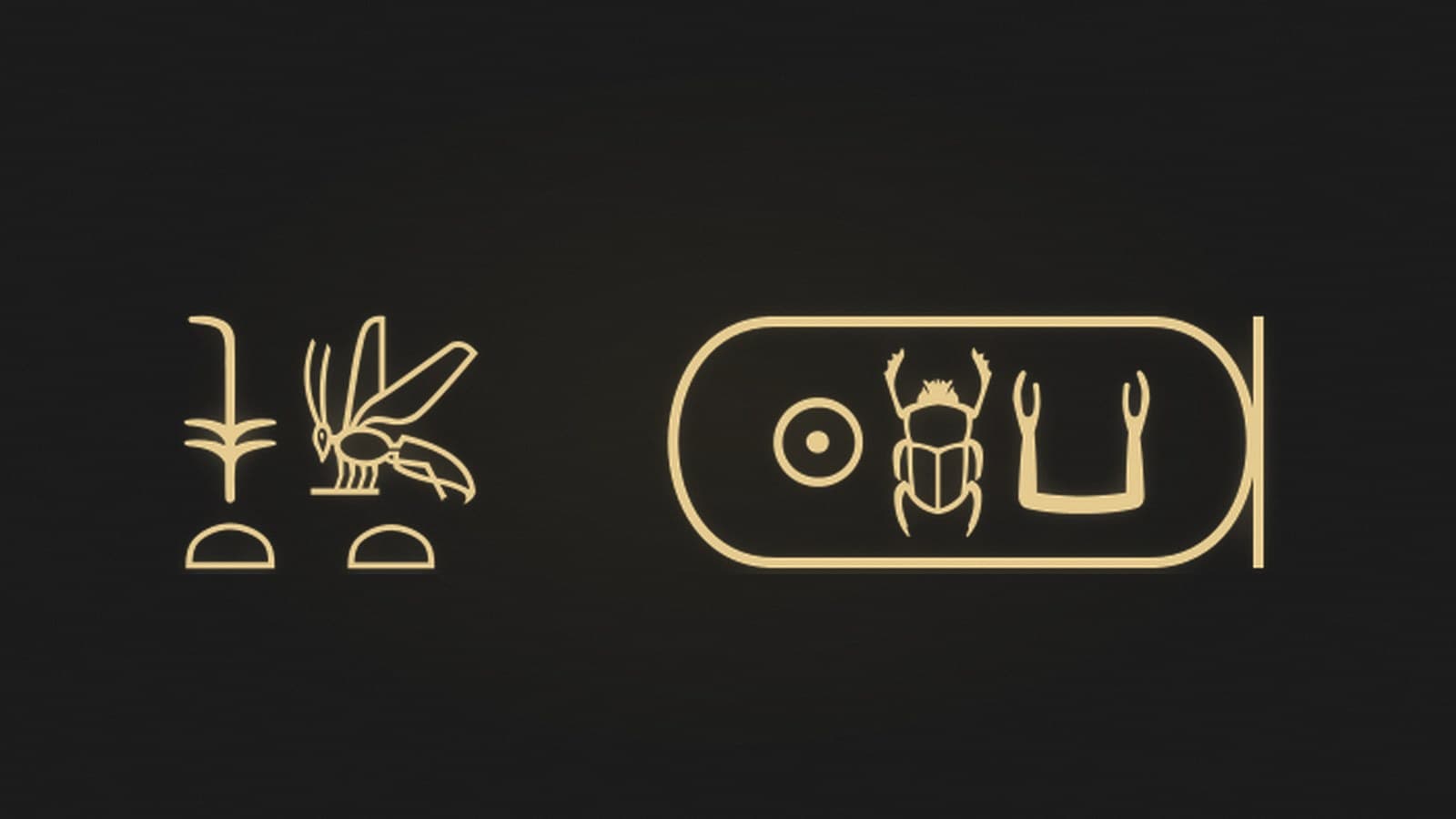
After seven lessons of his grammar, Alan Gardiner stops to make a promise. The student, he says, now knows enough writing and grammar "to decipher the royal names and titles occurring on innumerable monuments of stone". The full set of a king's names is called the titulary. In Middle Egyptian it was made up of five "great names", which the pharaoh took on the day he came to the throne. This lesson reads one complete set, the titulary of Sesostris I of the Twelfth Dynasty, as Gardiner prints it.
Each name comes in two parts: a title that every king shares, followed by a name that is his alone. Gardiner compares it with English names: where an Englishman has a Christian name and a family name, an Egyptian king had five, which he calls the Horus name, the nebty name, the golden Horus name, the prenomen and the nomen. James Allen's terms are Horus, Two Ladies, Gold Falcon, throne name and Son of Re name. This lesson uses Gardiner's.
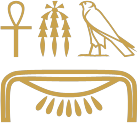
The Horus name, the oldest of the five in Allen's account, presents the king as the earthly form of the falcon god Horus. It is often written inside a tall frame, the serekh, with recessed panelling at the bottom and the falcon perched on top. Gardiner thinks the frame more probably shows the palace than the tomb, and Allen agrees: the panelling is the niched front of an early palace, and the space above it a ground plan. Allen reads the whole group as "the divine power of kingship (Horus) is incarnated in the individual who resides in the palace". Sesostris I's Horus name is ꜥnḫ mswt, "Life-of-births"; in Gardiner's words he is "the Horus who infuses life into all who are born". In Gardiner's printing of this titulary the falcon stands alone, without the frame.

The second title is nbty, "the two ladies": the vulture goddess Nekhbet of El-Kab in Upper Egypt and the cobra goddess Wadjet (Gardiner's Edjo) of Buto in Lower Egypt, each sitting on a basket. Gardiner thinks Menes, founder of the First Dynasty, was probably the first king to take it, as a sign that he had united the two kingdoms; Allen says only that it first appears in that dynasty. Sesostris I simply repeats "Life-of-births".

The third name is where the grammars part company. Gardiner calls the golden Horus name "more disputed". Some scholars took it as Horus triumphant over his rival Seth, but Gardiner finds the older evidence points to plain "Horus of gold", and says that which god was meant is "a problem still unsolved". Allen is more confident: a falcon perched on the sign for gold shows the king as the human incarnation of Horus, since gold was the traditional material of the gods' skins. Allen dates the title to the Fourth Dynasty. Gardiner notes Fourth Dynasty kings with two falcons on the gold sign, but traces the golden falcon itself with certainty only to the Eleventh. In Gardiner's printing, Sesostris I's name sits on the gold sign beside the falcon, shortened to the ankh and the sign for ms.
The last two names are the ones written in cartouches, a loop of doubled rope with the ends tied. The Egyptian word was šnw. Gardiner derives it from šni, "encircle", and suggests the king was ruler of all "that which is encircled by the sun"; Allen takes it as the circle of the world. After the Middle Kingdom, Allen adds, queens and royal children could have cartouches too.
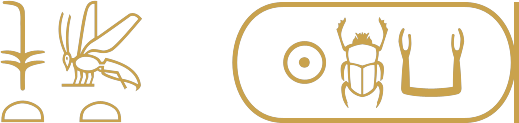
The prenomen follows the title nsw-bity, the sedge and the bee, which the fifth and sixth lessons took apart. Gardiner translates it "King of Upper and Lower Egypt". Allen prefers "Dual King", because bity is also a general term for "ancestral king", so the title presents the king as the latest of a line of royal ancestors. The prenomen almost always contains the name of the sun god, and Allen notes that Rēꜥ is always written first, by honorific transposition. Sesostris I's is Ḫpr-kꜣ-Rꜥ, Kheperkarēꜥ, "the ka of Rēꜥ comes into being": the sun disc comes first in writing and last in speech. Both grammars date the prenomen to the Fifth Dynasty, and Allen calls it a kind of motto for the reign. In Middle Egyptian it is the king's principal name, often found alone or with only the nomen.
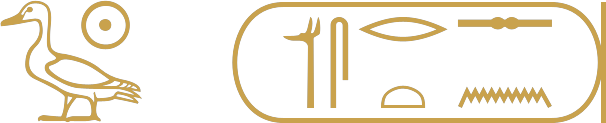
The nomen follows sꜣ Rꜥ, "son of Rēꜥ". Gardiner explains that it was, as a rule, the name the king had borne before he came to the throne, almost a family name: the Twelfth Dynasty is a run of Ammenemes and Sesostris. Egyptologists use the nomen, Allen notes, and because the same nomen recurs they number the kings, a modern convention the Egyptians did not use. Sesostris I's nomen is S-n-Wsrt, "man of the goddess Wosret", and once again the goddess is written first. Gardiner notes that the name was formerly read Usertesen.
Gardiner ends with a word on English. The Horus, nebty and golden Horus names can be translated, but the names in the cartouches should be left in Egyptian: calling a king "Thoth-is-born" instead of Tuthmosis would be absurd. Where the Greek historian Manetho preserves a recognisable form he uses it, which is why this king is Sesostris rather than S-n-Wsrt.
Next time you see a cartouche on a museum object, look in front of it for the sedge and bee or the duck and sun, and you will know which of the five names you are reading.