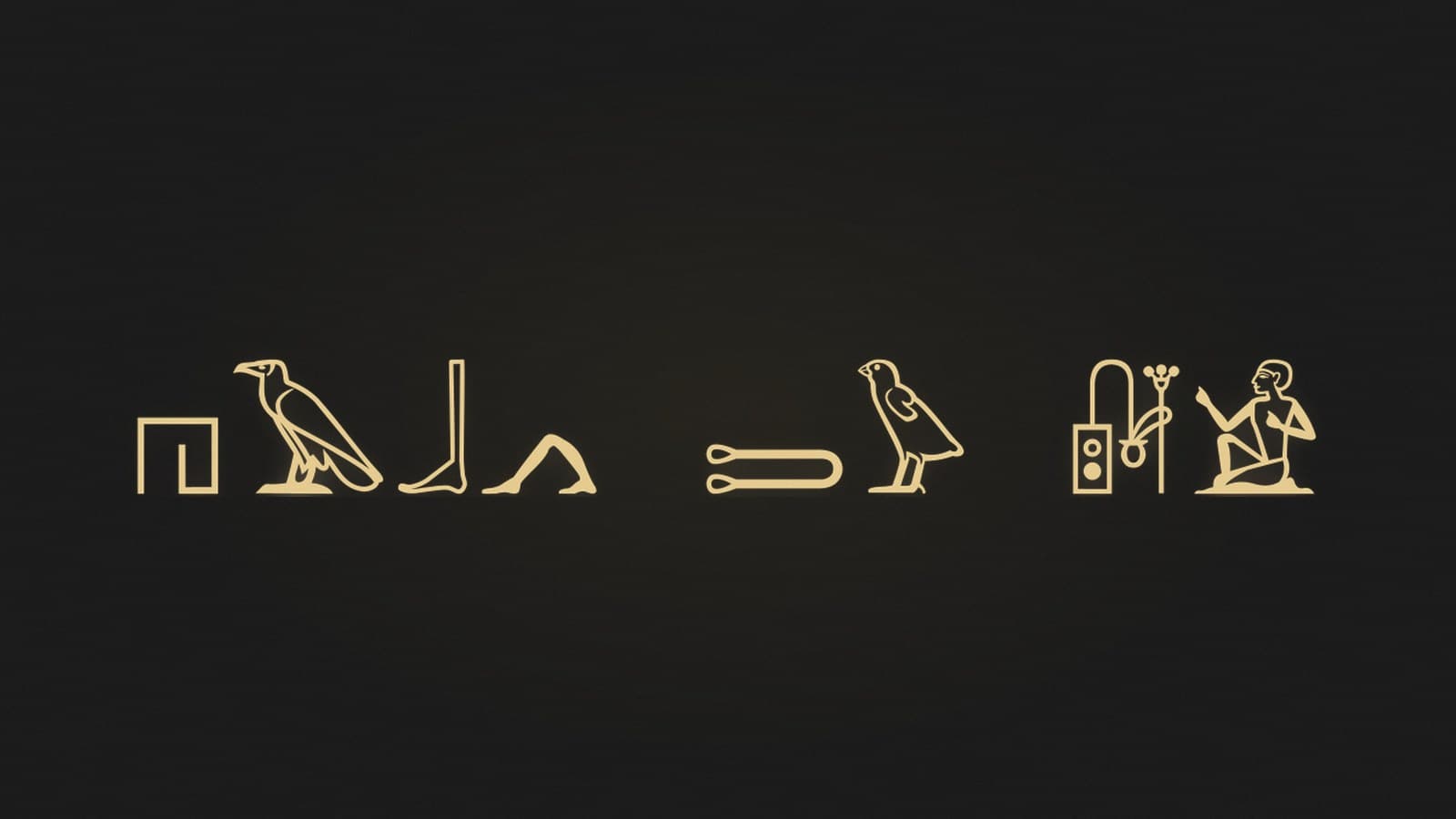
The last lesson finished the pronouns. This one puts a verb at the centre of the sentence. In the eighth lesson, rꜥ m pt meant "the sun is in the sky": the subject first, then where it is. Alan Gardiner gives the normal order of a sentence with a verb as the verb, then the subject, then the object, and last any adverb or phrase made with a preposition. His first example adds one verb to that same sun: wbn rꜥ m pt, "the sun rises in the sky".

English says "the sun rises", subject first. Egyptian says "rises the sun". James Allen calls this order VSO, for verb, subject, object, against the SVO of English. Gardiner notes that a sentence like rꜥ m pt follows the same order, just without a verb or an object, which is why the phrase "in the sky" stays at the end in both.
Only one verb form is needed here. Grammars call it sḏm·f, "he hears", after the model verb sḏm, "hear". Gardiner describes it as the form in which the subject, either a noun or a suffix pronoun, is added straight after the verb: sḏm sš is "the scribe hears", and sḏm·f is "he hears". So when the subject is a pronoun, it is one of the suffix pronouns from the third lesson, fixed to the verb itself. In hꜣb·f ṯw, "he sends you", the verb is hꜣb, "send", its subject is ·f, "he", and the object is ṯw, "you", one of the dependent pronouns.

With a noun as the object, the object follows the subject. Gardiner's example is hꜣb·k sš n nb·k, "you send the scribe to your lord". After the verb and its subject ·k comes the object sš, "the scribe", and then n nb·k, "to your lord". Gardiner calls a phrase with n, "to, for", the dative: it names the person something is sent, given or said to.

Gardiner gives one longer sentence as the usual word order, and every part of it is in its place: smi sš sštꜣ pn n nb·f m niwt tn, "the scribe reports this secret to his lord in this city". The verb smi, "reports", comes first. Then the subject sš, "the scribe", the object sštꜣ pn, "this secret", the dative n nb·f, "to his lord", and last the phrase m niwt tn, "in this city", with the demonstratives of the seventh lesson.

Pronouns change the picture. Gardiner's rule is that a noun must not come before a pronoun, and a dependent pronoun must not come before a suffix. So when the subject is a noun and the object is a pronoun, the pronoun jumps ahead: hꜣb ṯw sš, "the scribe sends you", literally "sends you the scribe". In hꜣb·f ṯw the order did not change, because the suffix ·f still has to come before the dependent ṯw.

Allen states the same thing in his own terms: pronouns come before nouns, and the subject comes before the object except when the subject is a noun and the object a pronoun. His example is "The scout recognized me", where "me" stands in front of "the scout".
The dative jumps too when it takes a suffix pronoun. In in n·k st sš, "the scribe brings it to you", the verb in, "bring", is followed by n·k, "to you", then st, "it", and only then the noun sš. Allen says the dative n with a suffix normally comes before everything except a pronoun subject, and sums up the whole order as VsdoSOA: verb, pronoun subject, pronoun dative, pronoun object, then noun subject, noun object and the rest, which he calls adjuncts. He suggests a reason. The small pronouns were probably said together with the verb, without a stress of their own, much as English says "giving-him" as one unit.

The two grammars put the dative with a noun slightly differently. Gardiner says it differs from other phrases with a preposition in tending to stay as close as it can to the verb. Allen says that n followed by a noun comes after the subject and object, like any other phrase. Gardiner's long example fits both, since n nb·f follows the object but comes before m niwt tn. For a beginner, Allen's version is the easier rule: nouns in the order subject, object, then the phrases.
A few small words break the pattern. Gardiner notes that mk, "behold", and the negative nn from the ninth lesson stand at the very start of the sentence, even before the verb, while certain little particles that can never begin a sentence, such as grt, "now", may slip in before a noun subject. Other orders are uncommon. Gardiner says they are more often than not for emphasis; Allen adds that a long noun subject is sometimes put in front of the verb and then repeated after it by a pronoun. Both say the same order holds beyond this one verb form: Gardiner for the next form in his grammar, Allen for the whole family of forms that take a suffix pronoun as subject.
Look again at nb·f, "his lord". The next lesson turns to the greatest lord of all, the king, and the royal titulary: the five names he was known by.