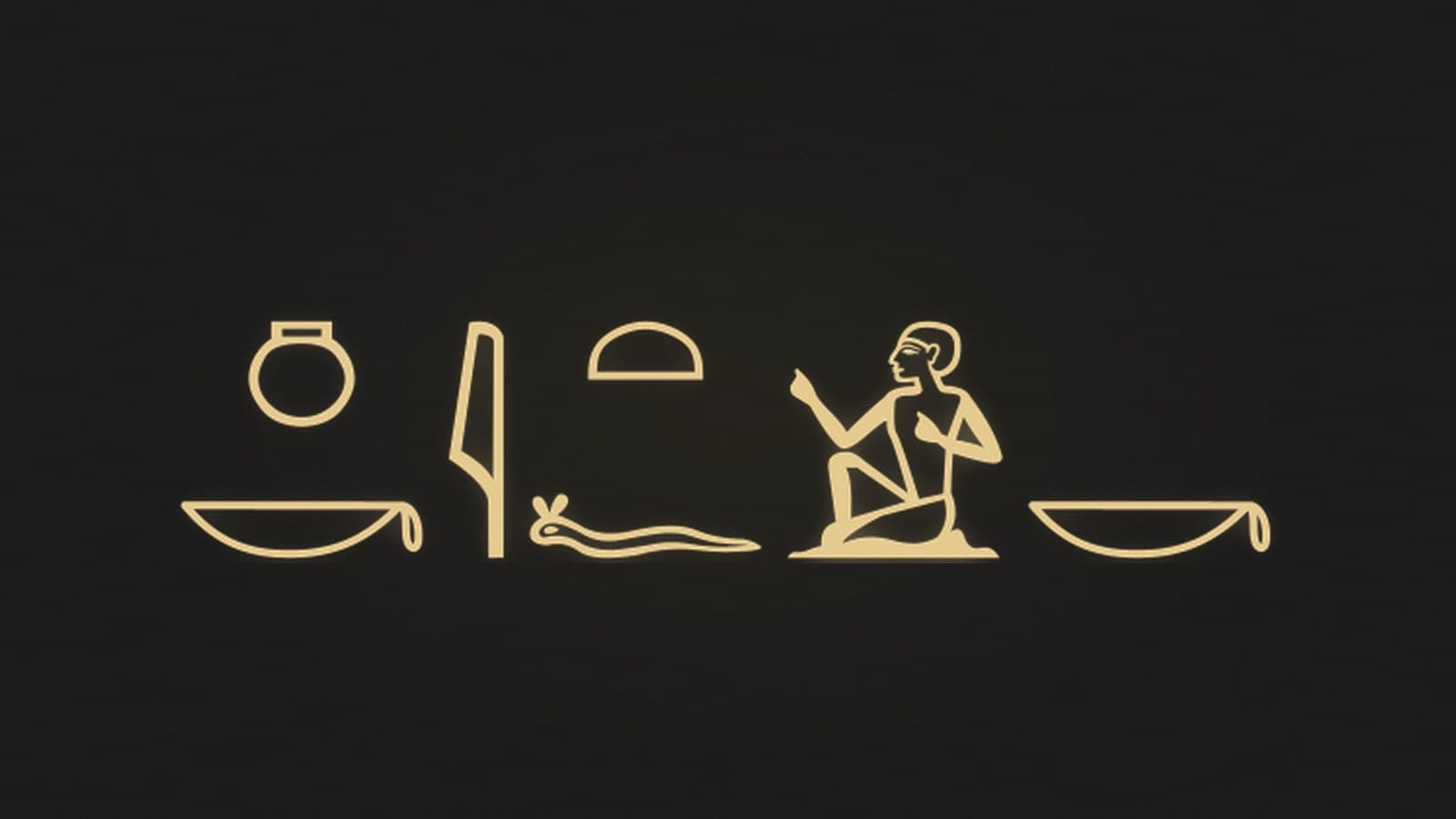
The last lesson met the dependent pronouns, such as wi, "me", and sw, "he, him", which James Allen describes as separate words that normally follow some other word. This lesson covers the third and last set of personal pronouns, the independent pronouns. As the name says, they are separate words that do not need to lean on anything else in the sentence. Alan Gardiner adds that they almost always stand at the beginning of the sentence, and that they carry more or less emphasis.
One of them has already appeared. The eighth lesson quoted ink šmsw, "I was a follower", and promised that ink, "I", belonged to a separate set. Here is the singular as Gardiner prints it.

The plural has three forms: inn, "we"; ntṯn, "you"; and ntsn, "they". Gardiner marks all three as serving men and women alike.

Look closely and a pattern appears. Allen points out that each second and third person form is the element nt followed by a suffix pronoun from the third lesson: nt and ·k make ntk, nt and ·sn make ntsn. The first person forms are built the same way on in. Gardiner agrees that the endings are mainly the suffix pronouns, and notes that the whole series is closely connected with the personal pronouns of Hebrew and Arabic.
The two grammars differ a little on details. For "you" to a woman both give ntṯ, with ntt as a later writing, and this series uses ntṯ. For "we", Gardiner, writing in 1957, says inn had been noted only in very late texts. Allen says it has not been found in any text earlier than the New Kingdom, but that it certainly existed in Middle Egyptian. The seated man often written after ink is a determinative, and both grammars note that a king could put his own figure in its place.
Older forms survive as well. Gardiner explains that in the Pyramid Texts and the Old Kingdom, "you" and "he" in the singular were a different type, made from the dependent pronouns by adding t. Two of them lived on into Middle Egyptian as archaisms: ṯwt, "you", and swt, "he, she, it". Both were originally masculine, but by Middle Egyptian they serve either gender. Allen adds that they turn up occasionally, mostly in religious texts.
The commonest job of an independent pronoun is to be the subject of a sentence without a verb whose predicate is a noun, with the two simply set side by side. Gardiner gives three examples.



In it·k the horned viper is written but not read: Allen notes that it is a determinative of "father". In nb·i the two seated men are the determinative and the suffix ·i, as in the third lesson. The last example uses the older ṯwt. Allen's own example is ink wḥmw iḳr, "I am an excellent herald", and he stresses that the pronoun always comes first.
The second use is with an adjective: ink nfr, "I am good". Gardiner says this is almost confined to "I". The reason is that "he is good" and "you are good" use the dependent pronouns, nfr sw and nfr ṯw, which Allen says are normally limited to the second and third persons. Here the grammars analyse the same words differently. Gardiner treats nfr as an adjectival predicate. Allen says ink nfr is really a sentence with a noun as predicate, literally "I am a good one".

Then there is the emphasis. Gardiner says that in some contexts ink it·k is better translated "it is I who am your father". The stress tends to make the pronoun the new information in the sentence, so ntk it n nmḥ can be "it is you who are the father of the orphan". A stressed pronoun often takes the particle is, as in ink is ḥḳꜣ Pwnt, "it is I who am the ruler of Punt". The eighth lesson met Rꜥ pw, "he is Rēꜥ". Gardiner notes that ntf Rꜥ says the same, but more emphatically, and Allen explains that it answers the question "who is Rēꜥ?" rather than "who is he?".
One thing the independent pronouns never do, Gardiner warns, is stand before a phrase that says where something is: "you are in the house" cannot be made with ntk. He also notes that the same pronouns can be followed by a form of the verb, to say who it was that did something. That pattern waits until verbs have been taught.
With suffix, dependent and independent pronouns all in place, the next lesson can turn to word order in a sentence with a verb: verb, subject, object, adverb, and where each kind of pronoun fits.