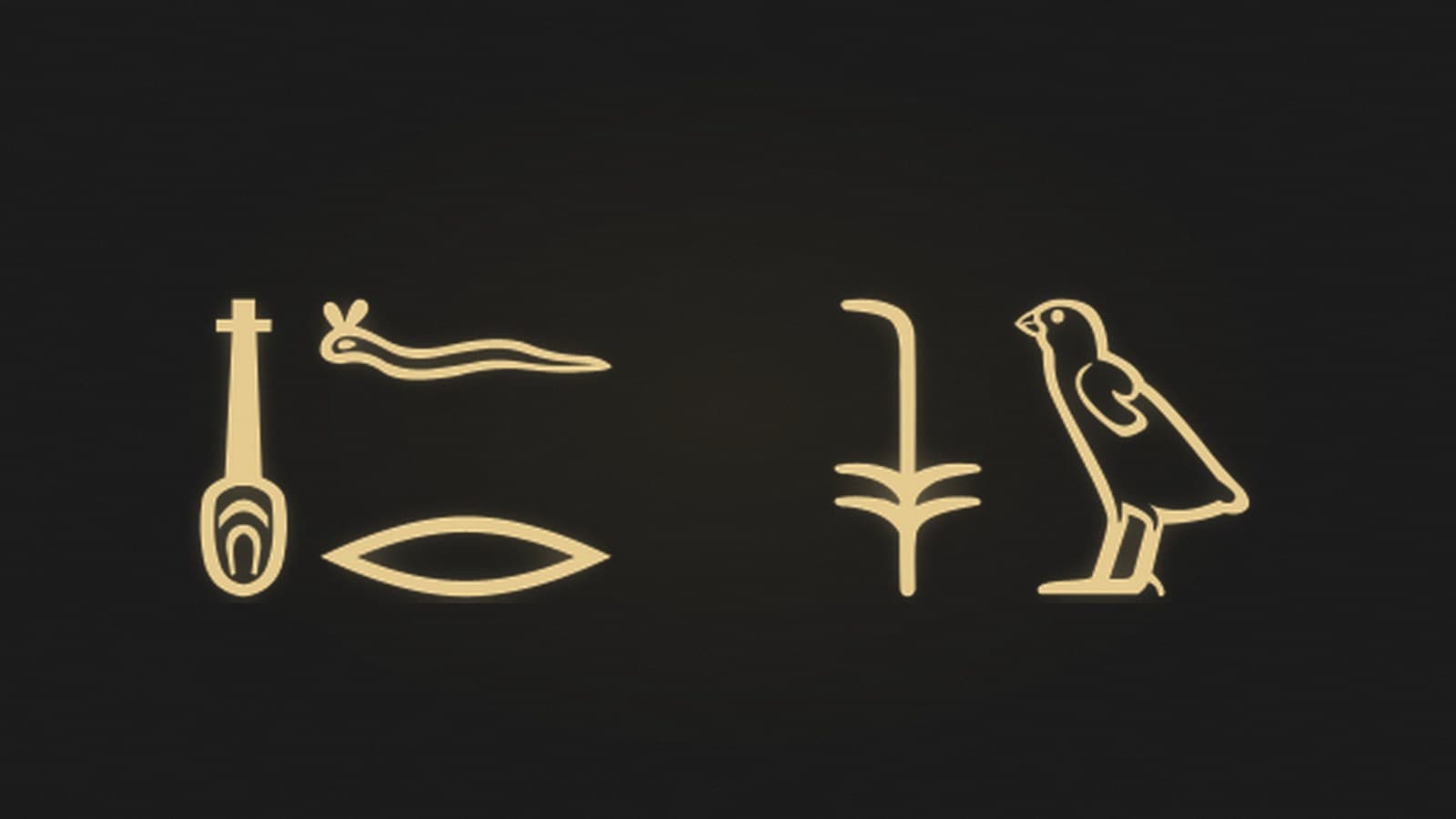
The last lesson, on prepositions, ended by pointing ahead to nfr sw, "he is good", a sentence first promised at the end of the eighth lesson. The sw in it is not one of the suffix pronouns from the third lesson. It belongs to a set that Egyptologists call the dependent pronouns.
Alan Gardiner explains the name. These pronouns are less closely attached to the word before them than the suffixes are, but they can never stand as the first word of a sentence. James Allen puts it the other way round: unlike the suffixes, they are separate words, and they are called "dependent" because they normally come after some other word.
There are eight to learn, plus one extra. In the singular: wi, "I, me"; ṯw, "you" said to a man; ṯn, "you" said to a woman; sw, "he, him, it"; and sy, "she, her, it". Allen writes wj and sj for the same words.

In the plural: n, "we, us"; ṯn, "you", for men and women alike; and sn, "they, them". Allen points out that these look exactly like the plural suffix pronouns, so only their place in the sentence tells you which set you are reading.

Two spelling points carry over from the suffixes. The tethering rope of ṯw and ṯn can later be replaced by the loaf, giving tw and tn. And in wi only the w is always written: the i behaves like the suffix ·i, so it is often left out, and the seated man can be swapped for a god or a king.
The extra pronoun is st, and here the two grammars describe it differently. Gardiner calls it an old form of "she, her", which came to be used mainly for "they, them" or for "it". Allen calls it neutral rather than neuter: it serves for singular and plural alike. In his account sw, sy and sn are mostly used of people and gods, and st of other things. Both grammars quote nfr st r ḫt nbt, "it is more beautiful than anything".
Gardiner lists three main jobs for the dependent pronouns. The first is the object of a verb. His example is hꜣb·k wi, "you send me": the verb hꜣb, "send", with the suffix ·k as the one who sends, then wi as the one sent.

He adds that sn is uncommon as an object, and st usually takes its place. As with the suffixes, there is no special reflexive form, so the same pronoun can mean "myself": rdi·n·(i) wi ḥr ḫt·i, "I placed myself on my belly".
The second job is the subject after a particle, one of the small introductory words such as mk, "behold", ist, "lo", and nn, "not". Gardiner explains why the dependent pronoun is needed here. A personal pronoun cannot open a sentence like rꜥ m pt, "the sun is in the sky", on its own, because the suffixes and the dependent pronouns must always be attached to a word in front of them. After a particle, it is as a rule the dependent pronoun that follows, as in mk sw and nn sw. Allen says the same.
Gardiner's examples include mk wi m-bꜣḥ·k, "behold, I am before you", and mk ṯw m bꜣk·i, "behold, you are my servant", literally "as my servant". Allen notes that mk is more properly mi·k, with a suffix for the person spoken to, and that "behold" sounds too biblical in English, so it is often better paraphrased: his mk wi r gs·k becomes "here I am at your side".

The negative nn from the ninth lesson works the same way. Both grammars quote nn s(y) m ib·i, "it was not in my heart", from the story of Sinuhe, with sy written as a single folded cloth.
The third job is the one the eighth lesson promised: the subject of a sentence with an adjective as its predicate. The adjective comes first, as it did in nfr ḥmt tn, "this woman is beautiful", and the pronoun follows. Gardiner says this kind of sentence demands the dependent pronouns, and Allen lists the forms that occur, among them nfr sw, "he is good".
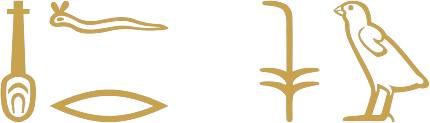
Gardiner's own example is nfr tw ḥnꜥ·i, "you are happy with me", where tw is the later spelling of ṯw.

There is one gap. Both grammars note that the first person is not normally used this way: for "I", Egyptian prefers another construction. The exclamation ending -wy from the eighth lesson fits too. Gardiner and Allen both quote rd·wy sw ib·i, "how strong is my heart!", literally "how firm is it, my heart". Allen points out that sw agrees with ib, "heart", which is masculine.
Allen's advice from the suffix pronouns holds here too: learn sw as "the third person masculine singular dependent pronoun", not as "he" or "him", because one form covers both. The first person in adjectival sentences is the gap that the third set of pronouns fills. The next lesson turns to these independent pronouns, starting with ink, "I", already met in the eighth lesson in ink šmsw, "I was a follower".