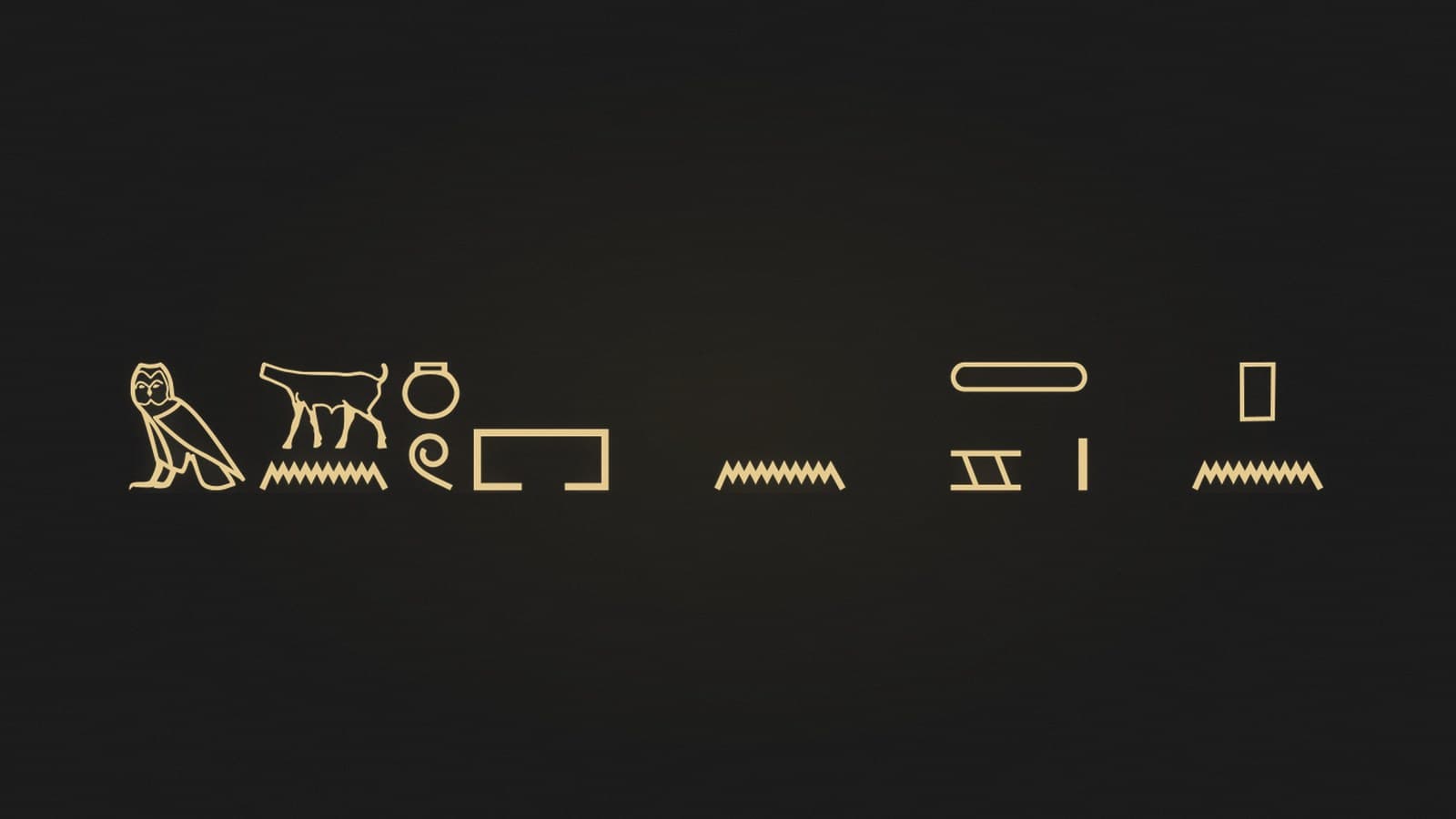
The last lesson ended on ḥnꜥ, "with", in nn mwt·k ḥnꜥ·k, "your mother is not with you". ḥnꜥ is a preposition. James Allen defines prepositions as the words a language uses to relate one thing to another, as "inside" relates a cat to a house in "the cat is inside the house". He also warns that they are among the most idiosyncratic words in any language: French à can mean "to", "at", "into", "on", "by", "for", "from" or "with", so it is rare for a preposition in one language to match exactly one in another. Alan Gardiner divides Egyptian prepositions into simple ones, a single word, and compound ones, made of more than one word.
Gardiner lists the simple prepositions in rough order of importance, and four short words head his list. ḥnꜥ comes further down.

Allen calls m the most common of them all. Its basic meaning is "in": m pr, "in the house", m grḥ, "in the night", m ḥtp, "in peace". Gardiner traces its uses along three lines, "in", "from" and "with" in the sense of an instrument. So pri m is "go out from", and m ḫpš·i is "by my strong arm". Both grammars stress that English "with" has two jobs which Egyptian keeps apart: ḥnꜥ is "with" a companion, and it is never used for the tool, which takes m.
r and n can both be translated "to", but they divide the work. After verbs of motion, Gardiner and Allen agree, n is used for going to a person and r for going to a thing or place: šmi n ky, "go to another person", but šmi r Nn-nswt, "go to Herakleopolis". After an adjective, r means "than": nfr r ḫt nbt, "better than everything".
ḥr meant originally "upon", says Gardiner, as in ḥr mw ḥr tꜣ, "on water and on land", but it stretches much further: ḥr Kmt is "in Egypt", literally "on the Black Land". Allen links it to the noun ḥr, "face". That fits a wider pattern. Gardiner notes that a preposition always comes before the word it governs, which then looks like the second noun of a direct genitive, the construction from the fourth lesson. Some prepositions really are nouns: tp, "upon", is literally "head", and ḥꜣ, "behind", comes from "back of the head".
Prepositions could also mark rank. Gardiner gives ḫr, "with" or "near", a narrow range of uses, above all ḫr ḥm n, "under the Majesty of" a king. Allen explains that an Egyptian spoke n, "to", an equal or someone lower, but ḫr, "near", the king or the gods. With the genitive word n from the fourth lesson, such a phrase becomes an epithet, a phrase describing a person:

Gardiner's literal rendering is "one honoured of with the king".
A noun after a preposition never changes its form. A pronoun does: Allen explains that Egyptian uses the suffix pronouns from the third lesson, so "with me" is ḥnꜥ·i, "with him" ḥnꜥ·f and "with them" ḥnꜥ·sn.

Allen points out that a preposition can have as many as three forms. Before a suffix, m becomes im·, as in wꜥ im·sn, "one of them", and ḥr is often written with the face over a mouth instead of a stroke. mi, "like", resists suffixes altogether: Gardiner says it hardly ever takes one, and Allen that it does not, so Egyptian uses a noun meaning "likeness" instead, as in sḫty mitw·i, "a peasant like me".
Compound prepositions are mostly a simple preposition plus a noun, much as English "alongside" is "along" plus "side". Allen's example is m ḥꜣt, "in front of". Gardiner quotes a phrase from the story of the Shipwrecked Sailor, where the genitive word n appears between the preposition and its noun:

It means literally "in the interior of this isle". With a suffix the n drops out: m-ẖnw·f, "within it". The two grammars count slightly differently. Allen lists seventeen single-word prepositions, among them mm, "among"; Gardiner lists sixteen and files m-m with the compounds, as perhaps just m said twice. Allen also says in, "by", is not really a preposition at all, where Gardiner keeps it in his list with a caveat.
Finally, Egyptian does not like a phrase such as "in the sky" sitting after a noun. Gardiner explains that most simple prepositions have a nisbe, the adjectives in -y from the sixth lesson, and that these are normally used instead: wꜥbw imyw ḥꜣw·sn, "the priests who are in their times". Allen's example is nṯrw imyw pt, "the gods in the sky", never nṯrw m pt. One polite phrase breaks the rule. A writer referring to himself could say bꜣk im, "this thy humble servant", literally "the servant there", with im, the form m takes when it stands alone. Gardiner calls it a respectful way of saying "I".

The next lesson turns to the dependent pronouns, among them sw in nfr sw, "he is good", which the eighth lesson promised.