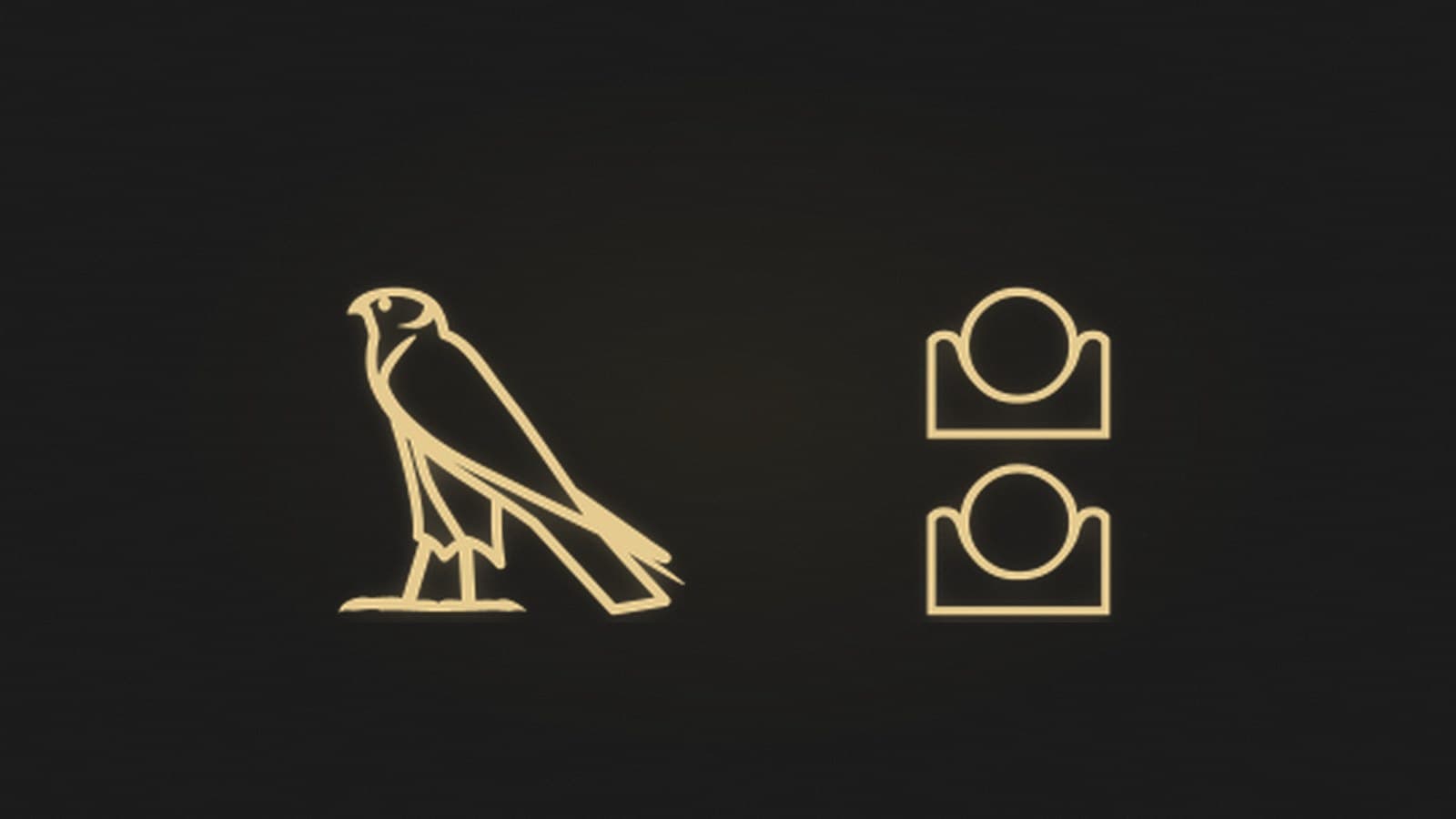
The last lesson ended with bity, "king of Lower Egypt", which Alan Gardiner explains as a form made with -y from bit, "bee". The same ending made the little word ny, "belonging to", from the preposition n, "to, for", in the lesson on saying "of". It is one of the handiest tools in Egyptian: Gardiner explains that -y turns nouns and prepositions into adjectives.
Gardiner notes that the same formation exists in the Semitic languages, and that Arabic grammarians call such words nisbe adjectives, "adjectives of relationship". Egyptologists borrowed the name. James Allen uses it for every adjective made this way, and tells us it is pronounced "NIZZ-bee".
Start with nouns. From rsw, "south wind", comes rsy, "southern", and from mḥyt, "north wind", comes mḥty, "northern". From niwt, "town", comes niwty, "of the town", as in nṯr niwty, "the local god". From ꜣḫt, "horizon", comes ꜣḫty, as in Ḥr ꜣḫty, "Horus of the horizon".



Look at how those two adjectives are written: the town sign twice, the horizon sign twice. Only one town and one horizon are meant. Gardiner explains that some of these adjectives made from feminine nouns sounded like duals, the forms for pairs from the first lesson of this series, so scribes wrote the sign twice as if for two. Allen calls it a "false dual".
Because they are adjectives, nisbes agree with their noun, like the adjectives in the second lesson. Gardiner sets out the forms of iry, "relating to, connected with", made from the preposition r, "to": iry for the masculine singular, iryt for the feminine, iryw for the masculine plural and irywt for the feminine plural. In practice the -y is never written in the feminine, and the y and w are usually left out elsewhere too, so Gardiner recommends the shorter readings, such as irt, as a rule. Even the masculine -y is often, but by no means always, written. Allen gives the same pattern: the feminine puts -t in place of the -y.

Prepositions work the same way. Some change their shape before a suffix pronoun, and Gardiner shows that the nisbe keeps that shape: from ḥr, "upon", comes ḥry, "above", and from m, "in", comes imy, "who is in". This explains a title from the lesson on "of". imy-r, "overseer", is literally "one who is in the mouth" of his subordinates. Gardiner adds that it is sometimes written with the sign of a tongue, "what is in the mouth", a kind of graphic pun. Likewise ḥry-tp ꜥꜣ, the "great chief" of a province, is literally "great one who is over the head". In titles like these the nisbe can be shortened until it looks just like the preposition. A nisbe can even serve as a noun: ḫftyw, "enemies", comes from ḫft, "opposite".
A nisbe from a preposition can still take an object, just as the preposition does: ḥry sštꜣ, "he who is over the secret", was a common title. Gardiner warns beginners that in their briefest writings these adjectives are easily mistaken for the prepositions they come from, as in Inpw tpy ḏw·f, "Anubis who is upon his mountain".
Finally, back to ny. Allen points out that it is itself a nisbe meaning "belonging", though its ending is hardly ever written, and that as an adjective it can do more than say "of". That is how he reads the word for "king" from the last lesson: nsw is probably n(y)-swt, "he who has the sedge", literally "the belonging one of the sedge".
Next time: the Egyptian words for "this" and "that".