
The last lesson ended with two words that seem to break its own rule. ḥm-nṯr, "priest", is literally "servant of the god", and ḥwt-nṯr, "temple", is "house of the god". Both are direct genitives, and James Allen stresses that in a direct genitive the owner always comes second. Yet in both words the sign for "god" is written first.

Gardiner and Allen give the same explanation. Gardiner describes a common tendency to write words like nsw, "king", and nṯr, "god", as well as the names of particular kings and gods, before words that in speech were pronounced first. Allen says the rule seems to have been fixed in the spoken language, and that the writing reverses it out of respect. In his section on the genitive, Gardiner is blunt: putting "god" and "king" first "is purely graphic". Grammars call this honorific transposition.
The practical rule is to read in the spoken order. Allen notes that transliteration follows speech, not writing, often with a hyphen between the two words. So the temple is ḥwt-nṯr, never nṯr ḥwt, which would mean "the god of the enclosure". The Egyptians' own name for hieroglyphs, mdw-nṯr, "god's speech", is written the same way.
The king receives the same honour. Gardiner gives sꜣ-nsw, "prince", literally "son of the king", pr-nsw, "palace", "house of the king", and sš nsw, "scribe of the king". He adds that abbreviated writings are frequent in these phrases. In his sš nsw, the king is a single sedge plant and the scribe a single sign, the scribe's palette and pen case.
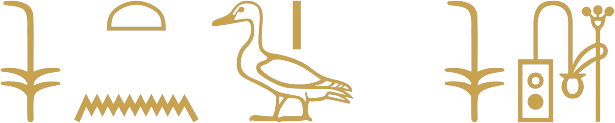
The habit reaches beyond the genitive. Gardiner's examples include mi Rꜥ, "like Rēꜥ", where the sun god is written before mi, "like", and mry Imn, "beloved of Amun", where Amun's name comes before mry, "beloved". In a footnote he even gives "praise god" written as nṯr dwꜣ, and "beloved of his lord" written as nb·f mry.

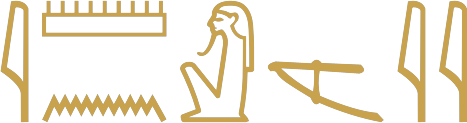
Allen points out that personal names are full of it, so names need care. Sometimes the written order is the spoken order, as in Ptḥ-wr, Ptahwer, "Ptah is great". Sometimes it is not: sꜣ-Ptḥ, Siptah, "Ptah's son", has the god written first. Royal names follow the same pattern, as in Senwosret, "man of the goddess Wosret", and Meryre, "Re's beloved". In Middle Kingdom texts, Allen adds, even a father's name was normally written first out of respect: a line in the Eloquent Peasant reads sꜣ-mrw rnsi, "Meru's son, Rensi". Later texts use the ordinary order.
Not every reversal is about respect. Gardiner notes that signs are sometimes swapped to look better, or for reasons that are harder to pin down. Thin upright signs, for example, like to stand before a bird they should follow, and economy of space explains writings like sbꜣ, "star", with the star placed between the other two signs.
Allen suggests that the word nsw may itself be transposed. It began as an old phrase made of n, "of", and swt, "sedge", the plant of Upper Egypt, yet the sedge is written before the n. Its exact sense is uncertain: Allen prefers "he to whom the sedge belongs", while Gardiner renders the full royal title nsw-bity, "king of Upper and Lower Egypt", as "he who belongs to the sedge of Upper Egypt and the bee of Lower Egypt". Gardiner explains bity, "king of Lower Egypt", as a form made with -y from bit, "bee". That -y ending is the subject of the next lesson.