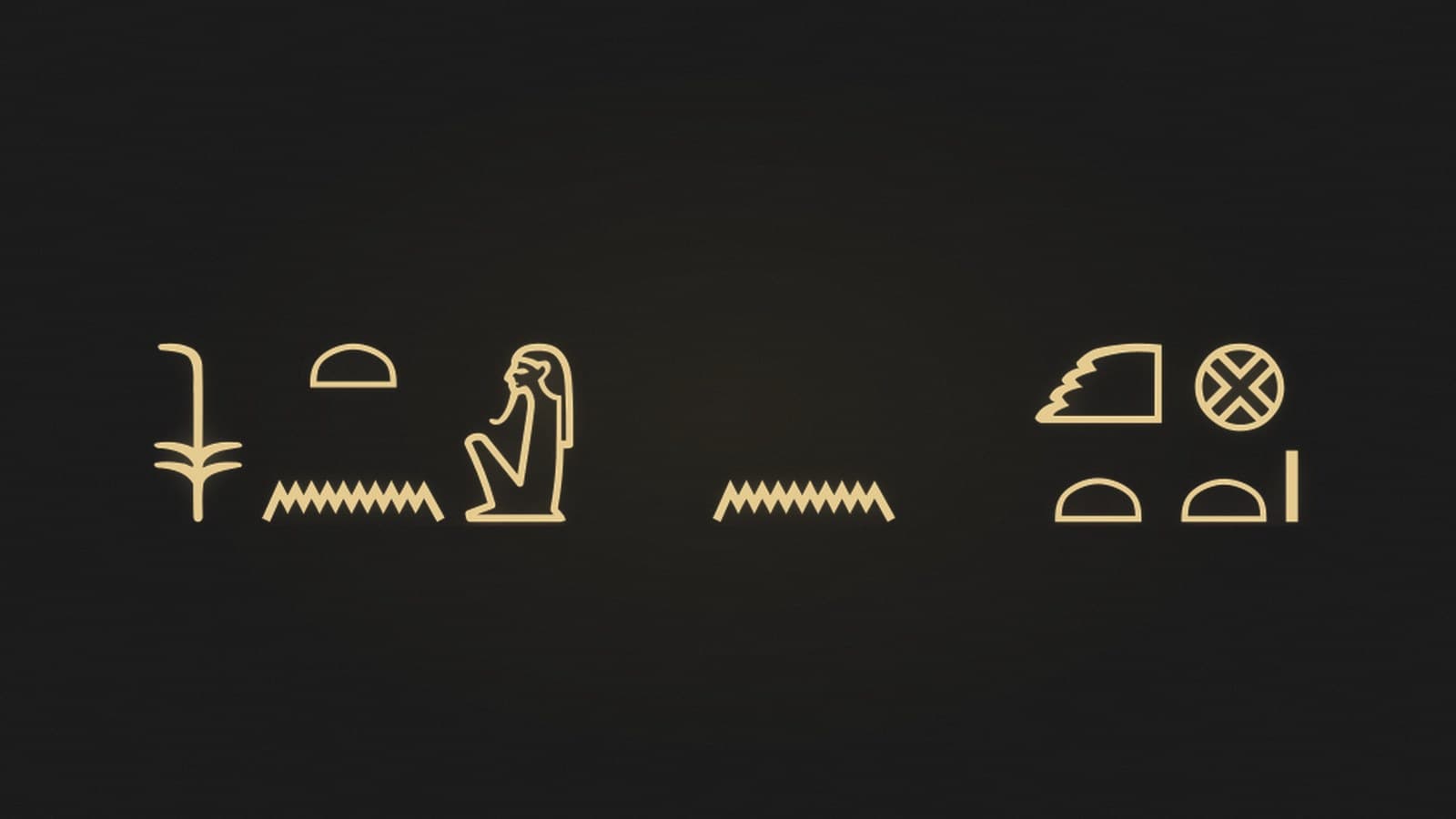
Last time, Alan Gardiner explained pr·f, "his house", as literally "house of him". He also points out that a suffix pronoun joined to a noun is one example of a wider pattern, the genitive: the way Egyptian says that one thing belongs to another.
English has two ways to do this, "the girl's toys" and "the toys of the girl", and James Allen notes that Egyptian also has two. Grammars call them the direct genitive and the indirect genitive.
The direct genitive is the simpler. The owner follows the first noun immediately, with no word between them. The owner always comes second, and neither noun changes, or at least no change shows in writing. Gardiner's examples are imy-r pr, "overseer of the house", that is, a steward, and nb imꜣḫ, "possessor of veneration", that is, "venerable".

Gardiner says this form is usual wherever the two nouns belong closely together, as in titles and set phrases. Allen calls it very common, and either noun can be masculine or feminine, singular or plural. The pair is so tight that almost nothing can come between them, so an adjective describing the first noun normally waits until after the second: imy-r sḫtyw mnḫ, "an efficient overseer of fowlers". Coptic, a far later stage of Egyptian and the only one that writes its vowels, shows that the first noun lost its stress and had its vowel reduced in this construction, though Gardiner notes that hieroglyphic writing never shows it.
The indirect genitive puts a small word between the two nouns. Gardiner calls it the genitival adjective, ny, "belonging to", a form with the ending -y made from the preposition n, "to, for". Because it is an adjective, it agrees in gender and number with the first noun, just as the adjectives in the second lesson of this series did. In practice there are three forms to learn: n after a masculine singular noun, nw after a masculine plural, and nt after any feminine noun, singular or plural. Gardiner gives special dual forms too, but marks them rare and old-fashioned. His examples:



A fourth, ḥmwt nt wrw, "the wives of the chiefs", appears in both Gardiner and Allen: nt, because "wives" is feminine plural. The agreement did not last. Gardiner notes that from the Middle Kingdom on, n often stands in for nw, and less often for nt. His example is ꜥꜣw n sḫty pn, "the asses of this peasant", with n after a plural, and Allen gives the same phrase without "this". Allen adds that by the time Middle Egyptian was no longer spoken, only n was left.
The indirect genitive also solves the problem the direct one cannot. When an adjective or another word has to come between a noun and its owner, Gardiner says the indirect genitive is the one used, as in inw nb nfr n sḫt, "all good produce of the country", with nb and nfr from the second lesson standing between the two nouns.

One caution from Allen. Two nouns side by side do not always mean "of". They can name the same thing, as in sꜣ·k Ḥr, "your son, Horus", or mean "and", as in t ḥnḳt, "bread and beer". ḥmt wꜥb is most likely "a priest's wife", unless the text is about two people, the woman and the priest. Allen's point is that the words and their context almost always rule out all but one reading.
Finally, some direct genitives look as if they are written backwards. ḥm-nṯr, "priest", is literally "servant of the god", and ḥwt-nṯr, "temple", is "house of the god", but in both the sign for "god" is written first. Gardiner explains that this is only a matter of writing, done out of respect. That is the subject of the next lesson.