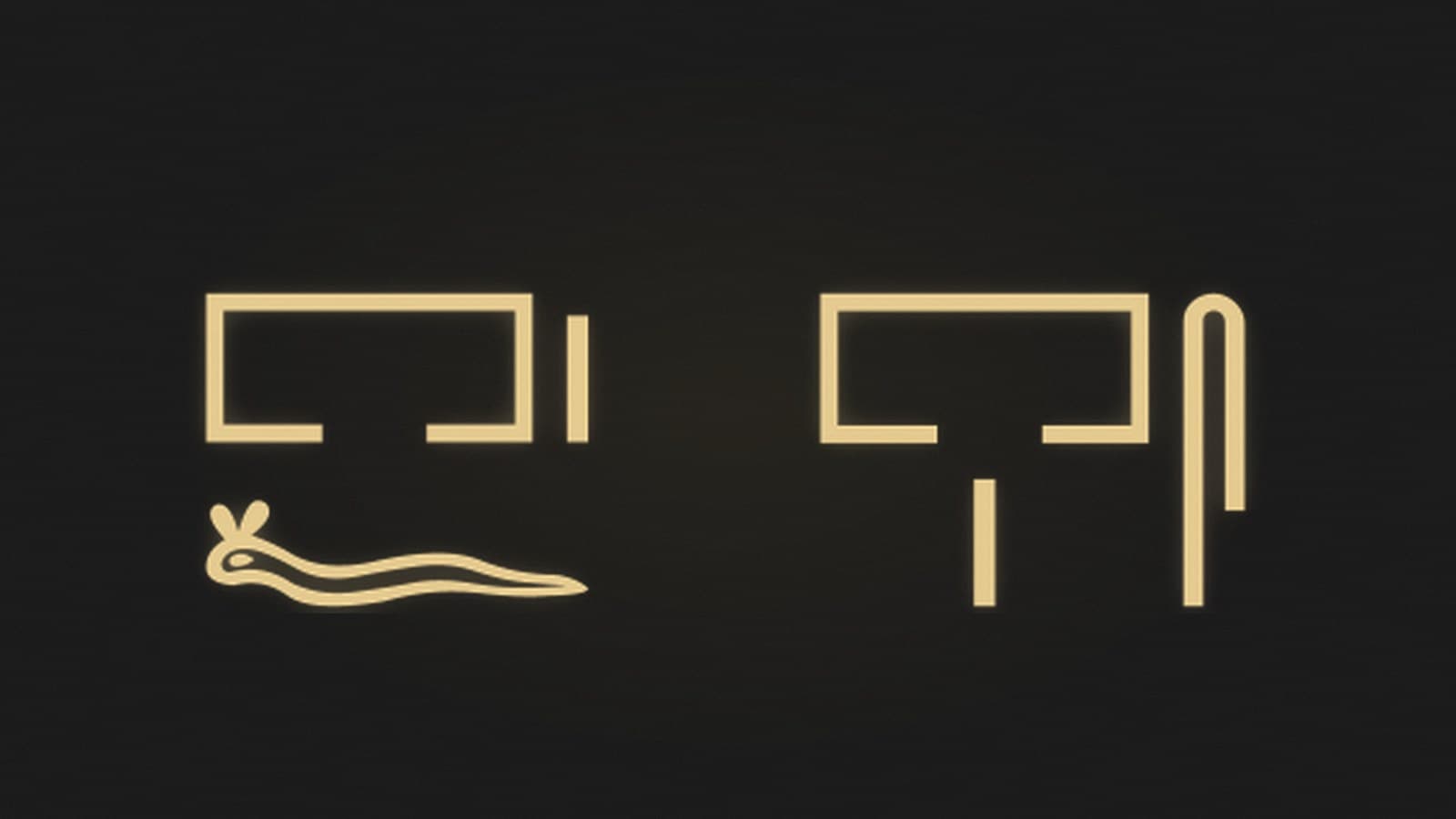
Last time, Gardiner's sꜣt·f šrit, "his little daughter", showed a possessive ending joined to its noun. That ending, f, is one of the suffix pronouns. James Allen calls them the most common pronouns in Egyptian.
Alan Gardiner explains the name: they must follow some preceding word and be attached to it. A suffix pronoun never stands on its own, and of everything that can be added to the end of an Egyptian word, it always comes last.
There are eight to learn. In the singular: ·i, "I, me, my"; ·k, "you, your" said to a man; ·ṯ, "you, your" said to a woman, later also written ·t; ·f, "he, him, his"; and ·s, "she, her". In the plural: ·n, "we, us, our"; ·ṯn, "you, your", for men and women alike; and ·sn, "they, them, their". ·f and ·s also mean "it" and "its". Egyptian once had dual forms for "we two", "you two" and "they two", but by Middle Egyptian they survive only in old-fashioned or religious texts, and the plural does the job instead.
The dot is a modern convention. Gardiner prints a raised dot between a word and its suffix, Allen uses a full stop, and some Egyptologists write an equals sign, so pr·f, pr.f and pr=f are the same word.
Joined to a noun, a suffix says whose it is. Gardiner's examples are pr·f, "his house", literally "house of him", and niwt·sn, "their city", literally "city of them". Allen runs the whole set on pr, "house":


Gardiner adds that pr·f can just as well mean "a house of his", where English would need different words.
The suffix goes at the very end, after any gender or number ending and after any determinative. Allen's examples use the words from the first lesson in this series: snty·f, "his two sisters", and snw·ṯ, "your brothers". As in English, the suffix agrees with the owner, not with the thing owned: his sister, his sisters, our mother, our mothers. After a dual noun the suffix sometimes picks up the dual's y as well, as in Gardiner's ꜥwy·fy, "his two hands".

The suffix that needs most care is ·i. It was just the vowel i, and like other vowels it was often left unwritten, so pr on its own can mean "my house". When it is written, the seated man is an ideogram for the speaker, and a scribe could swap in a woman, a god or a king to suit whoever is speaking. The same seated man can also be a determinative, so Allen points out that a duck followed by one seated man can be sꜣ, "son", sꜣ·i, "my son", or sꜣ·(i), "my son" with the suffix unwritten. A duck followed by two seated men can be "two sons", "my two sons", or "my son" with the first man as determinative and the second as the suffix. Context decides, and in practice it usually does.

Allen gives one piece of advice worth taking early: learn ·f as "the third person masculine singular suffix", not as the English word "he". The same suffix can be "he", "him", "his" or "it", depending on the word it is joined to. Nouns are only the start. Gardiner lists suffixes after prepositions, as in n·i, "to me", and ḥnꜥ·s, "together with her", and after verbs, where they name who does the action, as in ḏd·k, "you say". Egyptian has no special reflexive pronoun, so ḏd·f n·f can mean "he says to himself".

Prepositions and verbs each get a lesson of their own later. For now, when you see one of these eight signs at the end of a word, read it as that word's owner.