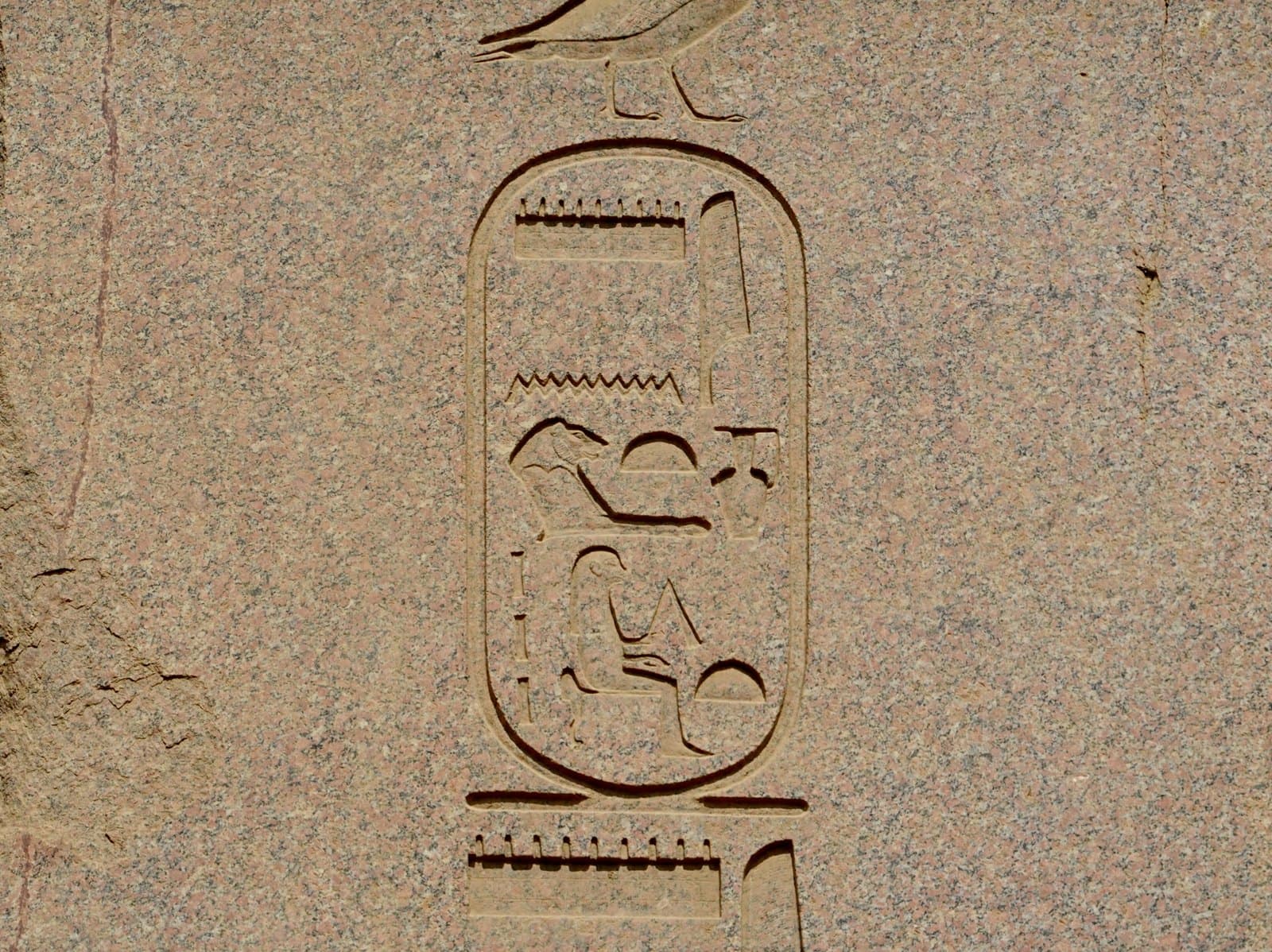
Standing in front of an Egyptian temple wall, faced with hundreds of small figures and shapes, it is easy to assume you need years of study before any of it makes sense. Happily, one of the most rewarding things you can find requires no reading at all. Royal names sit inside an unmistakable oval ring, and once you learn to see it, a pharaoh's name will jump out at you from almost any wall.
That ring is called a cartouche. It is a loop of rope with a tie at one end, drawn around royal names. Spot the oval, and you have found a king or queen. Nothing else on the wall is enclosed quite like this, so the shape alone does most of the work for you.

The name-ring itself: a loop of rope with a tie-bar.
The name we use for it comes from French. Cartouche means a rifle cartridge, whose shape the ring resembled, and the word stuck after Napoleon's expedition to Egypt. The Egyptian term was shenu, related to a word for encircling, which suits the loop of rope rather better than a cartridge does.
Once you have found a cartouche, there is a little more you can learn without reading the name inside it. A king normally had several names. The two you will meet on walls are the throne name, taken at accession, and the birth name. You can tell which one you are looking at by the small cluster of signs that comes just before the ring.
The throne name is introduced by the title nsw-bity, written with a sedge plant and a bee. It is conventionally translated King of Upper and Lower Egypt. When you see the sedge and the bee sitting together in front of a cartouche, the name inside is the throne name.

Sedge and bee: nsw-bity, King of Upper and Lower Egypt. The throne name follows.
The birth name has its own introduction, the title sa-Ra, written with a duck and a sun disc. It means Son of Ra. When these two signs lead into a cartouche, the name inside is the birth name, the one the king was given at birth.

Duck and sun: sꜣ-Rꜥ, Son of Ra. The birth name follows.
To see how this works in practice, take a famous example. Tutankhamun's throne name Nebkheperure is written with a sun disc, which stands for the god Ra, a basket, which gives neb, a scarab beetle, which gives kheper, and three strokes marking a plural, giving kheperu. Four small signs, together, make the whole name.

Nebkheperure, nb-ḫprw-rꜥ - Tutankhamun's throne name.
There is one detail worth knowing about that cartouche, because it can catch you out. The sun disc is written first inside the ring, out of respect for the god, but it is read last. This habit is called honorific transposition. So the sign that sits at the front of the name is not where you begin reading it, and knowing this saves a great deal of confusion later.
That is enough to make you useful in front of a wall. Find the oval, check the signs in front of it to see whether you are looking at a throne name or a birth name, and you have already understood more than most visitors ever will. When you are ready to go further, Hierolyte's Reading Royal Names course walks through cartouches like these one sign at a time, so the names inside the rings begin to open up too.