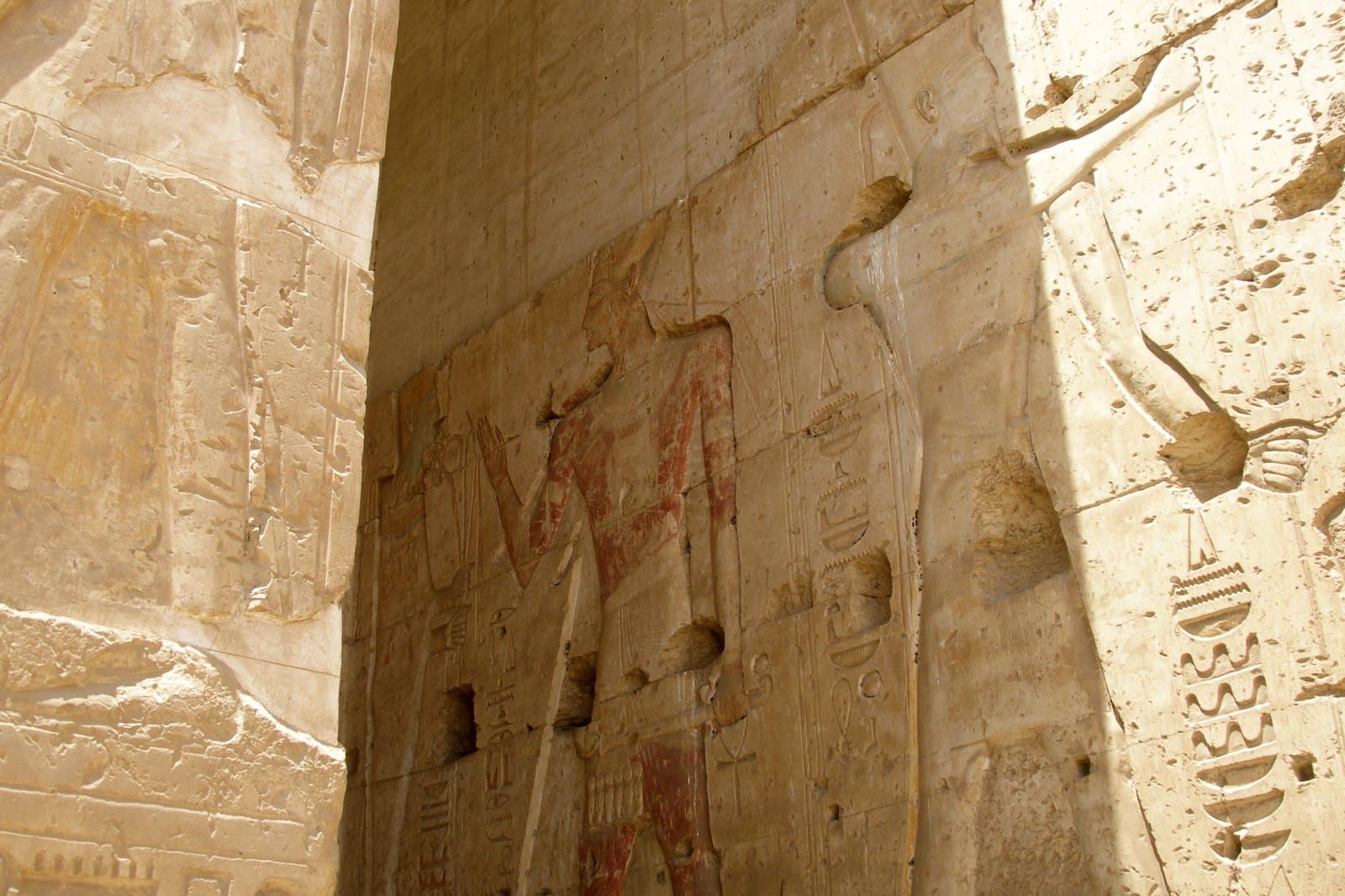
One of the first surprises for anyone learning to read hieroglyphs is that they have no single, fixed direction. The same script can run from left to right or from right to left, and it can be arranged in horizontal rows or in vertical columns. This can feel bewildering at first, as though the rules keep changing under your feet. In truth, the Egyptians were not being difficult. They simply chose the direction that suited the wall in front of them, and they left behind a reliable built-in compass to guide you. That compass is the faces.
Carvers picked whichever layout fitted the space they were decorating. They often mirrored text symmetrically around a doorway, so that the inscription on one side ran towards the opening and the inscription on the other side ran towards it as well. This is why a single monument can show the script pointing in more than one direction without any contradiction. Once you know what to look for, the apparent chaos becomes something you can navigate with confidence.
Here is the key. Many signs have a face: people, birds and animals all look in a particular direction. These signs always look towards the start of the line. Whichever way the faces are turned, that is where you begin. So the rule is short and dependable: find a creature with a face, see which way it is looking, and start reading from that side.

Take the small chick above. It looks to the left, which tells you that the line begins at the left and reads across to the right, the same direction as English. If you had met a whole row of signs and felt unsure where to dive in, this single face would settle the matter for you at once.
The same principle holds no matter which creature you meet. A vulture behaves exactly like the chick: its face shows you where the line begins, and you follow the signs away from that point.

On many temple walls, however, the figures face right instead. When that happens, you simply do the opposite of what you did with the left-facing chick. You start at the right and read leftwards. The logic never changes; only the direction the faces point does. This is why two beginners can look at two different walls, apply exactly the same rule, and end up reading in opposite directions, both of them correct.
Vertical arrangements follow their own gentle rule. Within a column, you read from top to bottom, working your way down the line. The faces still tell you which column to begin with when there is more than one, so the compass keeps working even when the text stands upright.
There is one more feature that makes all of this look so orderly. Egyptian groups its signs into neat invisible squares rather than spacing them out like beads on a string. The carvers packed signs together to fill these tidy blocks, which is why an inscription looks so balanced and composed. It also helps you, because the script breaks naturally into readable chunks as your eye travels along.
With a little practice, checking the faces becomes second nature. Hierolyte drills this with real inscriptions, so reading direction becomes reflex rather than rule. Before long you will glance at a wall, catch which way a bird is looking, and simply know where to begin.