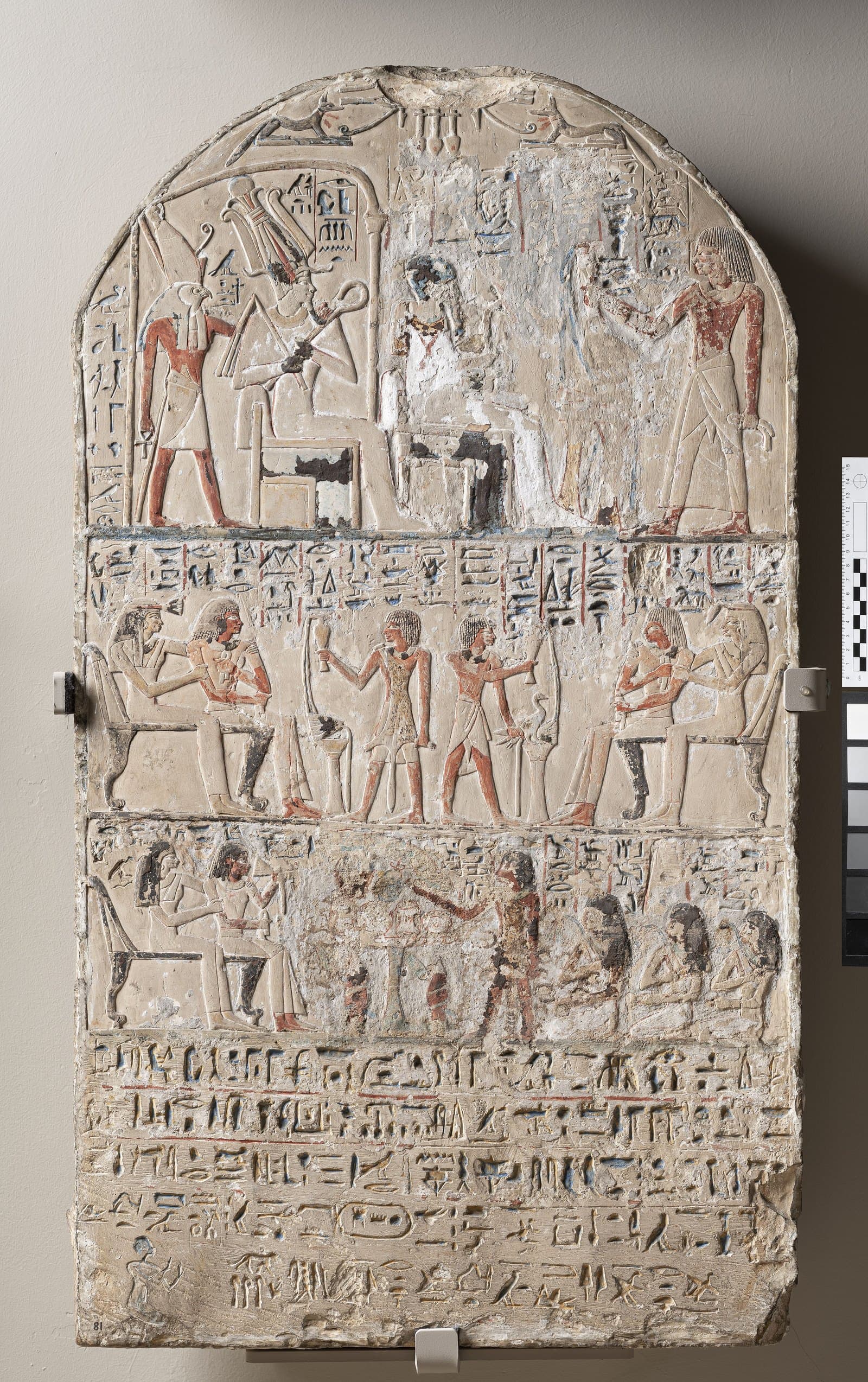
Walk through the Egyptian rooms of almost any museum and you will start to notice a pattern. Stela after stela, tomb wall after tomb wall, opens with the same short run of signs. Once you can recognise it, the cases stop being a blur of unfamiliar shapes and start to feel like variations on a single, familiar tune. That opening run is the offering formula, transliterated ḥtp-dỉ-nsw, and it opens more Egyptian inscriptions than any other sentence in the language.
The name is usually explained as an offering which the king gives. That is the sense conventionally read from the opening signs. The formula asks that offerings reach the person being commemorated, and the goods named are typically bread, beer, oxen and fowl. Written at the top of a monument, it is a request made on behalf of someone, that they be provided for.

What makes this formula such a gift to a beginner is how little it changes. The opening cluster is remarkably stable across two thousand years of writing. The parts that vary are what comes after it: the particular god who is named, and the exact list of goods requested. So the beginning stays recognisable while the ending shifts from one copy to the next. Learn the opening once and you carry it with you into every room, ready to spot it again and again.
At the heart of the formula sits a single sign worth knowing well. Catalogued as Gardiner R4, it shows a loaf on a reed mat. This sign carries the sense of offering, and also of peace, of being at rest or content. That cluster of meanings sits comfortably together once you think of an offering as something that brings calm and contentment, and it is the reason the same sign can feel so central to a sentence about provision.

Because the formula is so standardised, it is usually the first real Egyptian sentence that students learn to read. That is not a coincidence. When almost every monument begins the same way, the reward for learning one sentence is enormous. You are not memorising a curiosity that appears once and then disappears. You are learning the doorway that most inscriptions share, so that your first success repeats itself across a whole collection.
There is real pleasure in this. The first time you catch ḥtp-dỉ-nsw at the top of a stela you have never seen before, something clicks. The object stops being decoration and becomes a message you can partly follow. You know what it is asking, even before you have worked out which god is named or which goods are listed below. From there, the rest of the inscription becomes a puzzle you actually want to solve, because you already have your footing.
The best way to build that recognition is slowly and in order, one sign and one sense at a time, until the whole opening feels automatic. Hierolyte's courses build up to reading this exact formula on a real stela, so that the sentence you meet on the page is the same one you will meet in the glass case. Start with the loaf on its mat, keep the offering formula in mind, and the museum will start repeating itself in the best possible way.