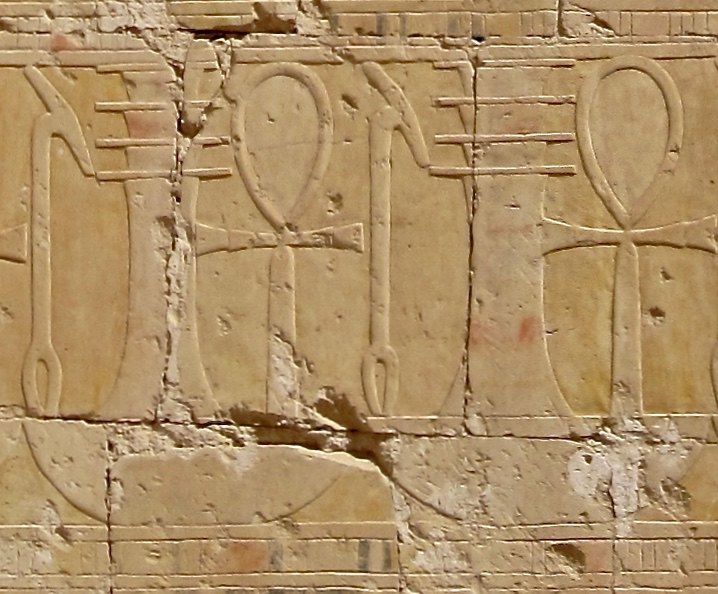
Once you learn to spot three particular signs, a great deal of Egyptian art starts to make sense. They trail royal names across every period, a compact blessing carved so many times that it becomes almost invisible until someone points it out. The three signs are the ankh, the djed pillar and the was sceptre, and together they carry a single wish for the king. Name them once and you will find yourself seeing the same three wishes everywhere.
The first is the ankh (Gardiner S34), a looped cross. It writes the word for life. In temple scenes you often see a god holding the ankh out towards the king's face, presenting life itself as a gift. That gesture is worth watching for, because it shows the sign doing more than spelling a word. Life is being handed over, quite literally, from the divine to the royal.

The second is the djed pillar (R11), which stands for stability and endurance. It is closely associated with the god Osiris, and is often described as representing his backbone. That image of a spine gives you a good sense of what the sign is reaching for: something upright and steady, able to hold firm over time. Where the ankh is about life given, the djed is about life lasting.

The third is the was sceptre (S40), a straight staff with a forked base and an angled head. It stands for dominion and power, and it is carried by gods and kings alike. When you see a figure gripping a tall staff of this kind, you are looking at authority made into an object you can hold. So the three signs together cover a neat range: to live, to endure, and to rule.

That range is exactly why the three appear as a set. They come together in a stock phrase, di ankh djed was, meaning given life, stability and dominion. The phrase follows royal names as a wish for the king, and once you have met it you will recognise the little cluster of signs at a glance. It is one of the most repeated blessings in the whole of Egyptian writing, a formula so familiar that a scribe or a carver could set it down almost without thinking.

The three wishes did not stay on temple walls. All three also worked as amulets, worn in life or placed with the dead. That tells you something about how the Egyptians thought of these ideas. Life, stability and dominion were not only words to write beside a king's name; they were things you might want close to your own body, and things you might hope to carry beyond death.
So the next time you look at a wall of hieroglyphs, try picking these three out first. The looped cross, the pillar, the forked staff. They will not always sit side by side, but they turn up again and again, and each one carries its own small wish. The ankh is day one in Hierolyte, and the app teaches the signs one a day from there, so this trio is a gentle place to begin. Learn to name them, and you have already started to read.