Some hieroglyphs are simply sounds, small pieces of a word. Others carry an entire idea in a single shape. The ostrich feather is one of the great examples. On its own, this upright feather writes a word transliterated m3at, and its meaning reaches far beyond a bird or a plume. It stands for maat: truth, balance, the way the world ought to run. When Egyptians wanted to speak of right order, of the world holding together as it should, they reached for this quiet, single sign.

Maat was more than a word. She was also a goddess, shown as a woman wearing the very feather on her head. So the sign works on two levels at once. It names an idea, and it points to the divine figure who embodies that idea. For a beginner, this is a useful thing to notice early: a hieroglyph can be a word, a picture and the emblem of a god all at the same time, and the feather is a perfect place to see that happening.
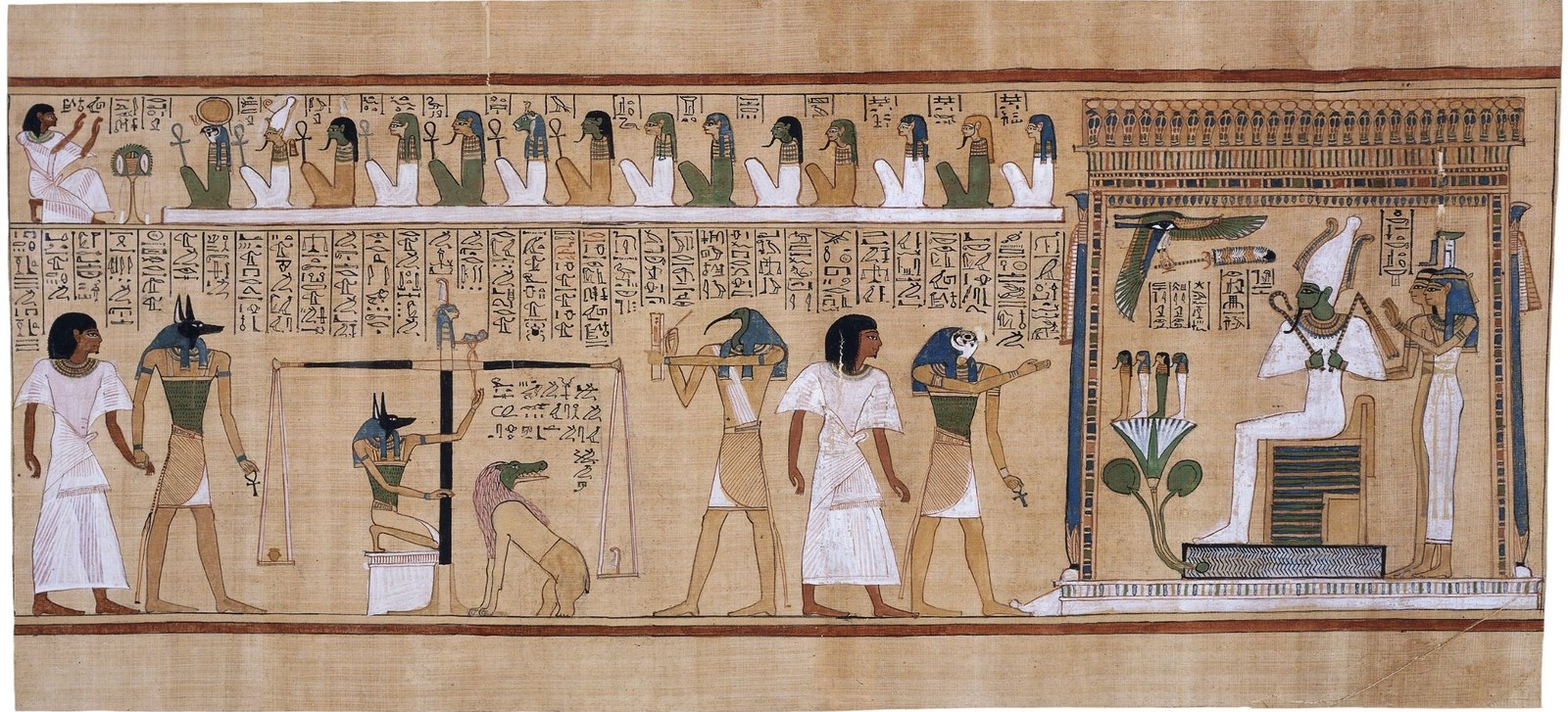
The feather is best known for the role it plays in the judgement of the dead. In scenes from the Book of the Dead, the heart of the person who has died is set on one pan of a great balance, and the feather of maat is set against it on the other. The idea is direct and human. A heart in balance with maat meant the deceased could pass onward. A heart that weighed too heavily met a different fate: it was given to a waiting devourer, a composite creature usually shown with a crocodile head. The whole drama turns on that single feather and whether a life could match its weight.
The scene is rarely staged with just a balance. Papyri commonly show Anubis attending the scales, steadying the moment of weighing, while Thoth, the ibis-headed scribe god, stands ready to record the verdict. Between them, the balance and the feather become the still centre of the picture, the point on which everything depends.
It is worth knowing that the tidy scene most people picture is really a composite. The staging varies between papyri, and no single version is the definitive one. Details shift, figures are arranged differently, and what we carry in our heads is often a blend of several sources rather than one fixed original. One of the best-known stagings appears in the papyrus of Hunefer, made around 1275 BC and now in the British Museum. It is a fine example, but it is an example, not the single correct picture.
You may have heard the phrase light as a feather and wondered whether it comes from all this. The connection is often made, and it is an appealing one, but it is worth being careful here. The link is a modern observation rather than an ancient Egyptian saying. It helps us remember the scene, yet it is our own bridge to it, not a phrase the Egyptians themselves handed down.
For a first sign to learn, the feather rewards attention. It is easy to recognise, it carries a whole idea, and it opens a door onto some of the most vivid imagery ancient Egypt has left us. Hierolyte teaches the feather and its story as part of its daily sign-a-day path, so you can meet it slowly and let its meanings settle. Once you can spot this single upright feather, you will start to see maat threaded quietly through a great deal of what the Egyptians wrote and believed.