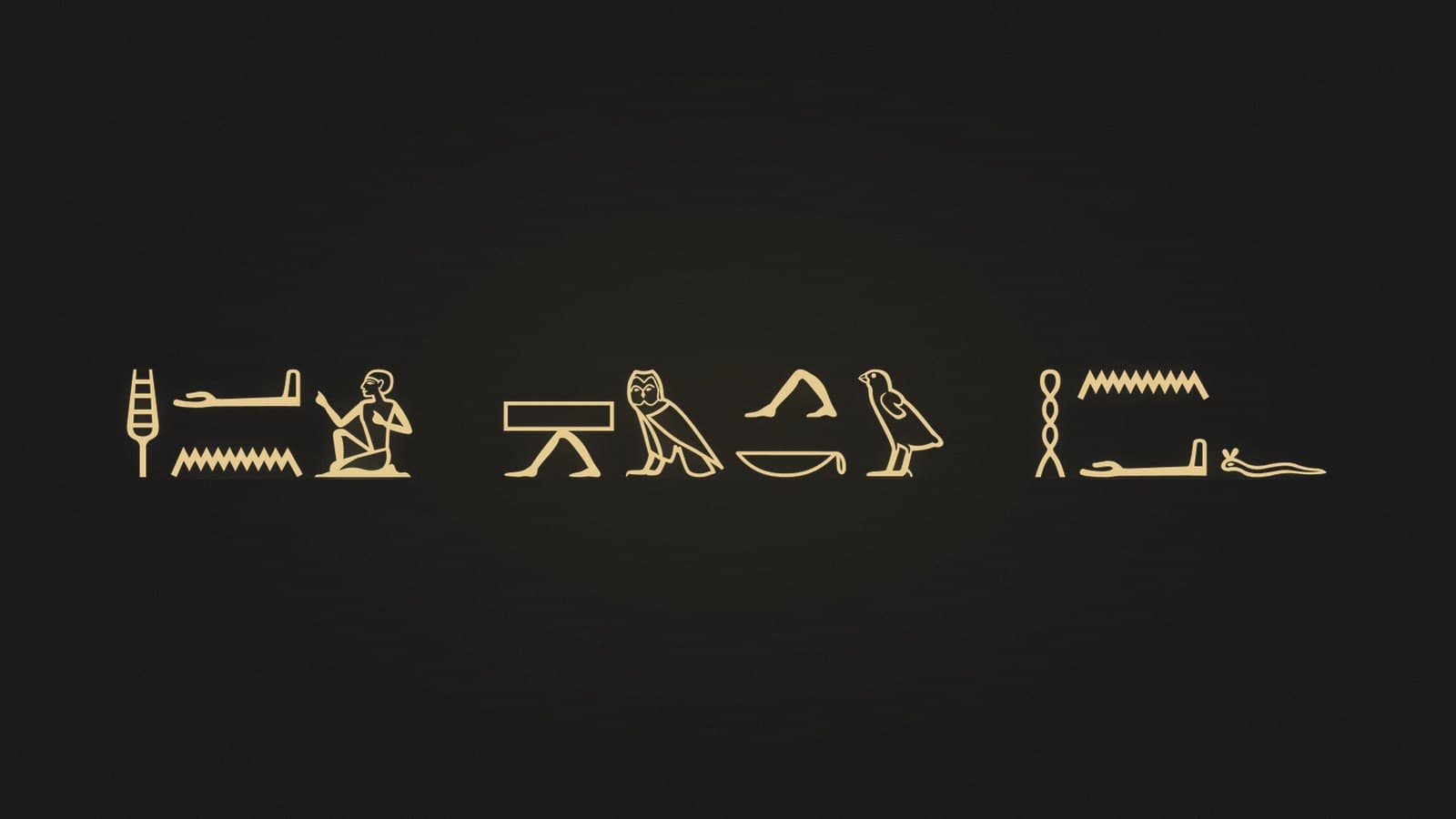
The last lesson met the passive, where the action is done to the subject. Alan Gardiner notes that it has well-marked uses after iw and ꜥḥꜥ·n, two small words much used in stories. This lesson looks at how an Egyptian story moves on. Past narration, Gardiner remarks, "could be managed in a great variety of different ways", and he lists eighteen ways of saying "His Majesty went forth", calling the list incomplete. To tell the same fact, one writer might choose prt pw ir·n·f, another prt in ḥm·f, a third iw pr·n·f and a fourth ꜥḥꜥ·n pr·n·f: "different writers had different preferences". The seventeenth lesson met iw and ꜥḥꜥ·n in passing; this one takes them in turn, then one verb form, sḏm·in·f.
The eighth lesson put iw in front of sentences like iw rꜥ m pt, "the sun is in the sky". Gardiner says it is "also frequently employed before the sḏm·n·f form in main clauses to mark some more or less important event in a narration". One of his examples, iw in·n·i Ḏdi, "I have brought Djedi", appeared in the seventeenth lesson. The other comes from the Shipwrecked Sailor:

wp·n·f is the sḏm·n·f of wp, "open"; r·f is "his mouth" and r·i "to me". Gardiner translates his first example with the English present perfect and this one with the past tense. James Allen quotes the same words from another line of the story and notes that iw often introduces sḏm·n·f as a past tense. He calls iw "the most common of all Egyptian particles", one that asserts that a statement is true from the speaker's point of view. Gardiner suggests that before a verb form it is best taken as an impersonal "it is", "the situation is". He advises students to begin narrative sentences with iw sḏm·n·f, "reserving the simple sḏm·n·f for subsidiary sentences", because it "gives a certain smoothness and elegance to recitals of past events".
The second word, ꜥḥꜥ·n, is built on ꜥḥꜥ, "stand up", "arise". Gardiner says the forms made with it occur only in main clauses and "always carry the action which is being described one step further on". At first, he thinks, ꜥḥꜥ·n sḏm·n·f meant "he rose up and heard". The literal sense faded, which may be why ꜥḥꜥ so often lacks its determinative, the walking legs. He calls ꜥḥꜥ·n sḏm·n·f "a very common narrative tense":

The mast and the arm over the water spell ꜥḥꜥ·n. Then comes rdi·n·f, "he gave", with n·(i), "to me", where the suffix for "I" is not written, and nn, "this", two rushes with shoots. Some texts, Gardiner says, keep this form for incidents of outstanding interest, but others, such as the Shipwrecked Sailor, use it "with almost painful monotony": he counts ꜥḥꜥ·n 26 times there, against 4 times in one manuscript of Sinuhe and 5 in the Eloquent Peasant. It works with verbs that take no object too: ꜥḥꜥ·n sbt·n·f im·i, "then he laughed at me". Allen says that ꜥḥꜥ·n is the word that most often introduces sḏm·n·f as a past tense.
With verbs of motion, Gardiner says, Egyptian prefers another pattern, which is also rather more usual with verbs that take no object: ꜥḥꜥ·n with a suffix as subject, then the stative of the eighteenth lesson. This matches the division the seventeenth lesson ended on, with sḏm·n·f for verbs that take an object and the stative for verbs like "go":

Here the seated man, ·i, "I", follows ꜥḥꜥ·n directly. šm·kw is the stative of šm, "go", with the ending ·kw for "I", and ḥnꜥ·f is "with him". Allen sets out the difference in word order. Before the stative, ꜥḥꜥ·n is followed by its subject; before sḏm·n·f it stands in front of the verb, "since the subject normally follows the verb". His example from the Westcar Papyrus has both: ꜥḥꜥ·n·s šm·ti r ikn n·s nhy n mw, ꜥḥꜥ·n iṯ·n sy msḥ, "Then she went to scoop up for herself a little water. Then a crocodile took her." In the second sentence the pronoun sy, "her", stands before the noun subject msḥ, "crocodile", as the thirteenth lesson's rules require.
The third tool is a verb form of its own. Gardiner groups sḏm·in·f with two relatives, sḏm·ḫr·f and sḏm·kꜣ·f. All three are used only in main clauses and are built like sḏm·n·f, with in, ḫr or kꜣ in place of the n, fixed to the verb after any determinative. Broadly, he says, sḏm·in·f indicates "result or sequel", and it is commonly used "to introduce any outstanding incident in past narrative". The seventh lesson quoted a line of the Eloquent Peasant that opens with it, and Gardiner's first example here has the same opening words:

ḏd, "say", is the cobra over the hand; the reed leaf and the water spell in. The subject follows, as after any verb: sḫty pn, "this peasant". Allen pronounces the form "sedgem-IN-eff" and describes it as past action that follows as a consequence of what went before, which English gives with "so" or "then". It is normally the first word in its sentence, and in stories "its function seems to be to move the story from one event to the next". In that it is much like ꜥḥꜥ·n, but it adds a sense of result. In Allen's example a goose whose head had been severed is fetched, put in place, and Djedi says his magic, each step opening with ꜥḥꜥ·n; the result opens with wn·in: "So, (as a result) the goose stood up waddling."
wn·in is the sḏm·in·f of wnn, "exist", used to give other constructions the sense of the form. Allen says most examples of sḏm·in·f are either wn·in or ḏd·in before a quotation; for other verbs Egyptian usually prefers ꜥḥꜥ·n. Gardiner quotes the peasant again: wn·in sḫty pn ḥr rmyt ꜥꜣw wrt, "then this peasant proceeded to weep very greatly", with the ḥr and infinitive of the nineteenth lesson.
That second use matters because, as Allen points out, hieroglyphic writing has no quotation marks. Stories most often introduce speech with ḏd·in or ꜥḥꜥ·n ḏd·n, "then said", and the speaker. Occasionally the speaker is named after the quotation instead, with a word meaning "says" or "said", like English "said he"; Gardiner's example is ḫr(y)·fy sw, "so said he".
The two relatives of sḏm·in·f are rarer: Gardiner says only the first of the three is really common in Middle Egyptian. Allen explains sḏm·ḫr·f as necessary action, "he must hear", and sḏm·kꜣ·f as future consequence, "then he will hear", the latter mostly in religious texts. None of the three is a tense in itself, Allen stresses. Even sḏm·in·f can look ahead: both grammars quote a medical text where rdi·in·k ḏrt·k ḥr·f follows the examination of a patient, Gardiner's "then thou shalt lay thy hand upon him".
Watch for iw, ꜥḥꜥ·n and sḏm·in·f in the stories both grammars quote throughout: the Shipwrecked Sailor, Sinuhe and the Eloquent Peasant.