The last lesson was about particles and interjections, such as mk, "behold", and ist, "lo". Alan Gardiner points out that after iw, ꜥḥꜥ·n, mk and ist in particular, one verb form serves as the passive of the sḏm·n·f of the seventeenth lesson. In a passive the action is done to the subject. James Allen puts it this way: in "the ball was thrown by Jack" the subject is the ball, while Jack, who does the throwing, is the agent. Egyptian, like English, can name the agent or leave it out.
Egyptian has two ways to make a passive. The first adds a small word, tw, to an active form. Gardiner explains that it is "really an indefinite pronoun like our 'one', French on", still used on its own in ḏd·tw, "one says", "it is said". Put after the verb, it turns sḏm·f, "he hears", into sḏm·tw·f, "he is heard". Allen calls tw the impersonal pronoun. Both grammars agree that a suffix after it is the subject: an object would have been a dependent pronoun, from the eleventh lesson. When the agent is named, it follows in, "by":

The cobra over the hand spells ḏd, "say", followed by the loaf and quail chick of tw. r pn is "this utterance", and in s, "by a man", names the agent. Gardiner adds that ḥr, properly "with" or "near", is used in the same way much more rarely. Allen notes that in is always followed by a noun, never a personal pronoun. The tenth lesson met his view that it is not really a preposition at all, and the twenty-third used it after a passive participle: "by his brother Seth".
Gardiner says tw can make a passive of any of the active forms built like sḏm·f, sḏm·n·f included. It comes after the n, and regularly after any determinative. A line of Sinuhe shows it in the past:

The water-skin and the hand spell šd, "read aloud", with a forearm as determinative. Then come the n of sḏm·n·f, the loaf for t(w) and the viper for ·f, "it". Gardiner calls this passive in tw "not very common", because the second kind of passive does much of its work. Allen goes further: in most cases, he says, sḏm·n·tw·f is not the perfect at all but the perfect relative, one of the relative forms of the twenty-fourth lesson.
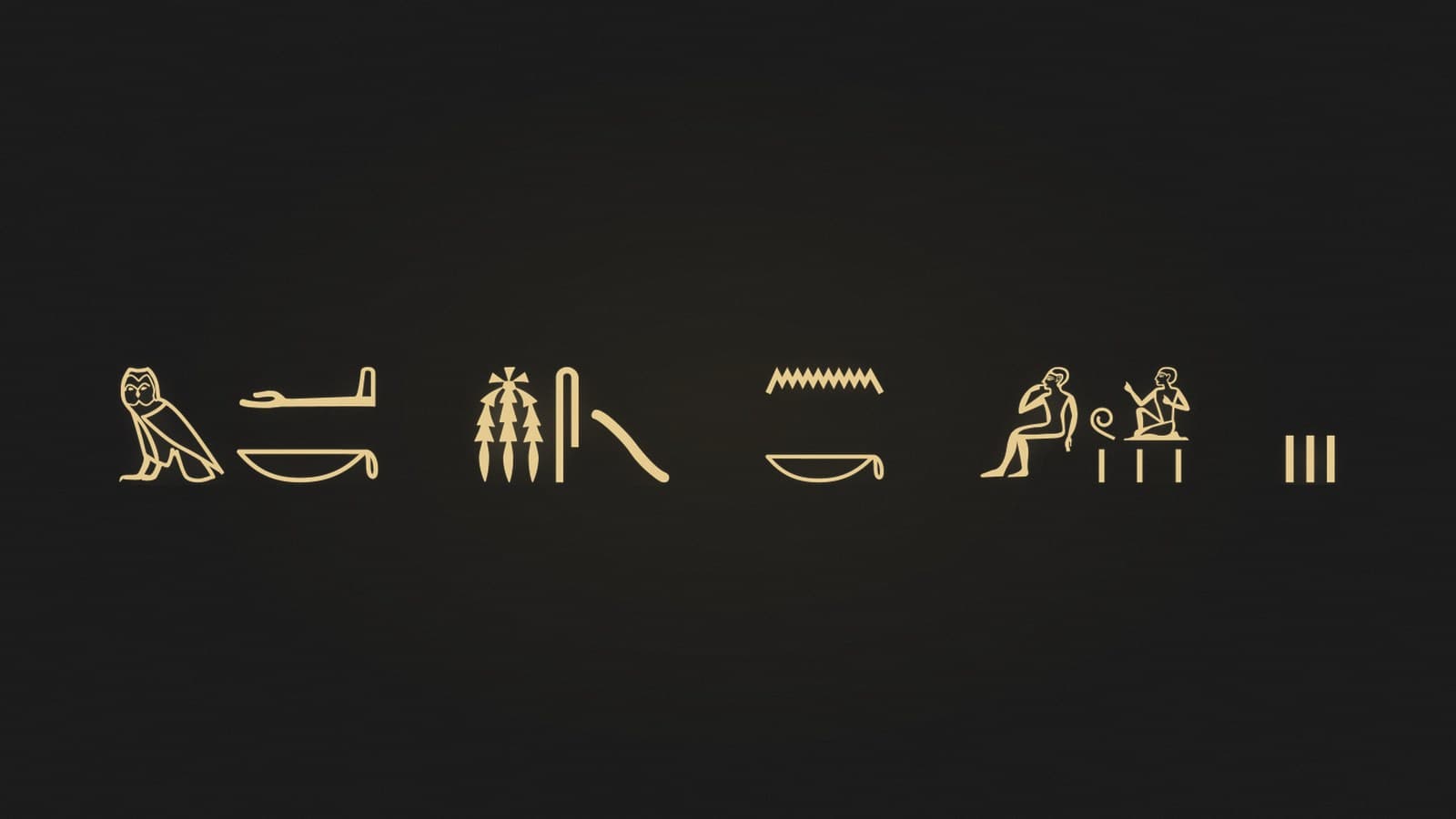
The second kind is a form that is passive in itself. Gardiner calls it the passive sḏm·f, Allen simply the passive. It looks like the active sḏm·f, but its "invariable passive meaning", Gardiner says, makes confusion "impossible in practice": it means "he was heard" or "he is heard" with no tw. Allen adds that, being passive already, it does not take tw. An ending can help to spot it: -w with many verbs, and -y only with verbs whose last consonant is weak, which Gardiner finds mostly before suffix pronouns:

The three foxes' skins spell ms, "give birth", the two reed leaves are the ending -y, and the seated man is ·i, "I". Such examples are not common: Gardiner calls the passive sḏm·f "by no means common" with a pronoun as subject. Allen says that Middle Egyptian then regularly uses the stative of the eighteenth lesson instead: mꜣ Rꜥ, "Re was seen", is the passive, but "he was seen" is the stative mꜣ·w. Gardiner agrees that in first-person narrative the stative often serves as the passive of sḏm·n·f.
Before a noun subject the -w is fairly common, as in this example, which opens with iw:

rdiw is the passive of rdi, "give", with the chick for -w. n·k, "to you", comes before the noun subject ṯꜣw, "breath", by the word-order rule of the thirteenth lesson, which Allen says the passive follows. Gardiner calls iw sḏm·f the passive of iw sḏm·n·f. For Allen the passive is the normal passive counterpart of the perfect, his name for sḏm·n·f: it denotes completed action, and English may need "was seen", "has been seen" or "had been seen". Both grammars quote this line of the Westcar Papyrus:

Gardiner translates "behold, three children have been born to thee", Allen "Look, three boys have been born to you". Here ms has no ending, and a slanting stroke, a hieratic shorthand Gardiner describes, stands for its determinative. After mk, he says, the passive matches the English present perfect; after ist it mostly needs the past perfect, "had been". In medical prescriptions it can look ahead: "she is (to be) caused to spit it out at once". Often there is no subject at all, as in Allen's iw ir mi ḏd·f, "it was done as he said".
With n, "not", in front, Gardiner's translations range from "has not been" to a plain present or "could not": n it iḥw·n, "our cattle have not been taken away", but n ḫꜣy·s, "it could not be measured". Allen says the negated passive denies action, ability or necessity, usually in the English present, and is relatively uncommon outside religious texts.
Gardiner also describes a rare old form, the sḏmm·f, which survives in the Middle Kingdom "practically only in ancient religious texts". It doubles the last consonant even in verbs whose stem otherwise never changes, as in nḥmm, "has been taken away", and he gives it the same uses and meaning as the passive sḏm·f. Allen calls the same form the prospective passive and gives it a future sense, "he will be taken away"; by Middle Egyptian, he says, it was largely obsolete, and forms with tw took its place.
Where did the passive sḏm·f come from? The seventeenth lesson gave Gardiner's view that sḏm·n·f began as "heard to him". If so, he asks, may not sḏm ḫrw, "the voice was heard", be the same thing without the "to him"? He keeps the two forms apart, since the passive can show an old ending and can have a suffix subject, but concludes that both grew out of the perfective passive participle of the twenty-third lesson. Allen does not discuss the origin here.
Allen notes that in main clauses the passive usually follows an introductory word, most often iw, mk or ꜥḥꜥ·n, as in ꜥḥꜥ·n šꜥw nḥbt·s, "then its neck was cut". The next lesson tells a story with ꜥḥꜥ·n, "then", and the other narrative forms.