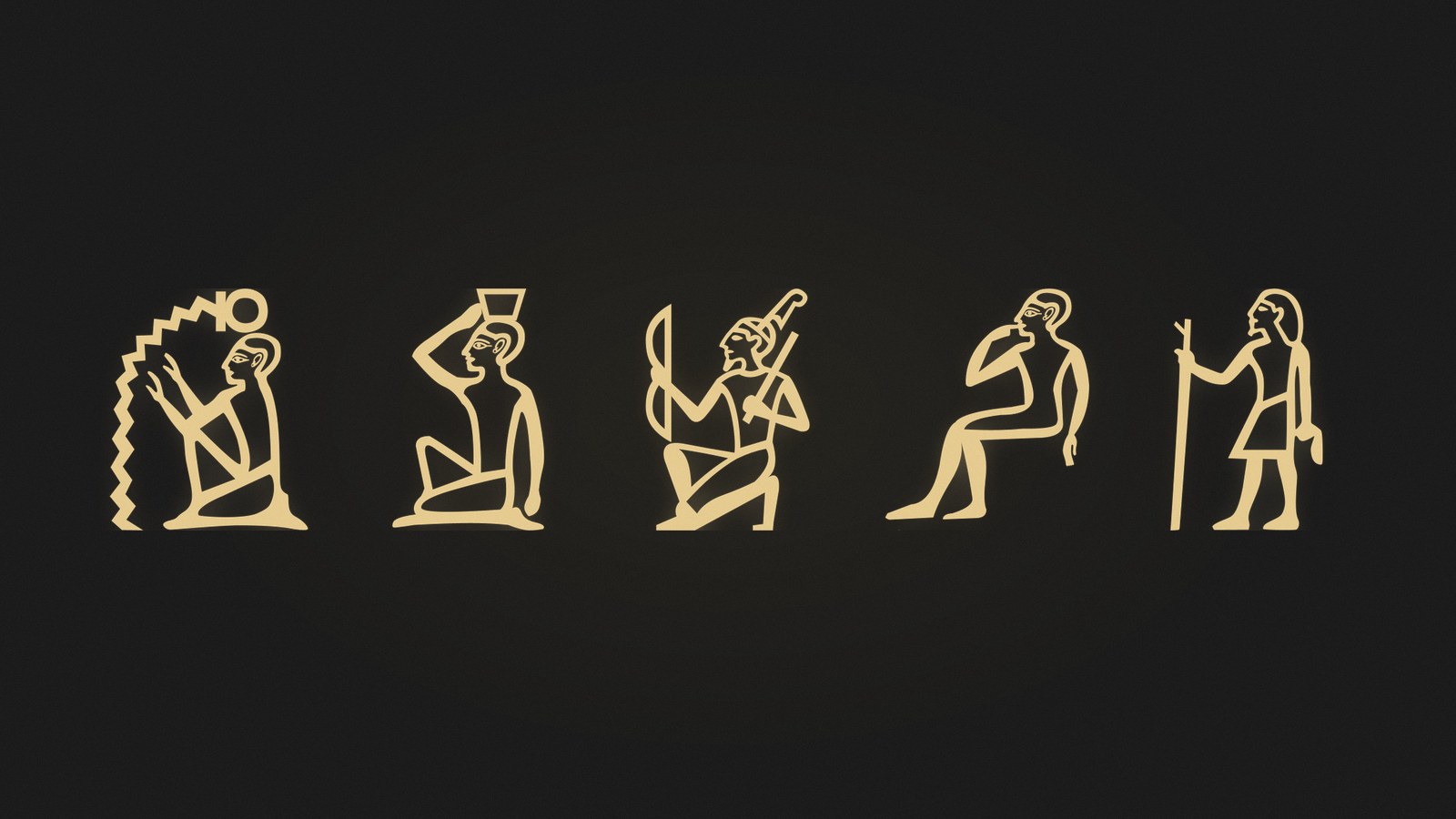
Open the sign list at the very beginning and you meet the A group, a crowd of small human figures. Each one is frozen mid-action, arms raised or a load balanced on the head or a staff held ready. Set side by side, they read almost like a picture of who was in an Egyptian town and what everyone was doing. For a beginner, they are one of the friendliest places to start, because the meaning is often visible in the pose.
Most of these figures do a quiet but important job in writing. They work as classifiers: they sit at the end of a word and tell you what kind of thing it concerns. When one of these little people closes a word, it signals that the word is about a person of that particular kind. You do not sound them out. They guide your reading instead, like a small label added to the end.
The clever part is that the posture is the whole message. A figure with a basket on its head, a bow on its shoulder or a staff in its hand is doing the work of an entire English suffix. Where English might add a few letters to turn an action into the person who does it, Egyptian could simply draw the person in the act.
Take the jubilating figure, with its arms flung high.

This exuberant figure appears after words for festival (ḥb) and celebration, capturing the mood of Egypt's many religious holidays. Those festivals could last days and involved feasting, music and public celebration, and the raised arms carry all of that feeling straight into the word.
Next comes a man balancing a basket on his head.

This sign appears after words for carrying and bearing loads. It reflects a method of transport seen along the Nile for millennia, and one still practised there today, so the picture and the meaning fit together neatly.
Then there is a figure armed with a bow and quiver.

This one served as the determinative for archers and soldiers, reflecting the critical role of bowmen in Egypt's military. Nubian archers in particular were legendary throughout the ancient world, and the bow on the shoulder is enough to tell you the word is about such a fighter.
Not every figure is an adult at work. One is a small figure with a finger to the mouth.

This represents the Egyptian word ẖrd ("child"), capturing the universal gesture of a child sucking its finger. It is one of the few signs that doubles as both determinative and logogram, which means it can stand for the whole word by itself as well as classify others.
Last comes a seated figure holding a scepter of authority.

Holding a sekhem-scepter, this seated official represents sr ("official" or "magistrate"), one of the most important social ranks in Egypt's elaborate bureaucratic hierarchy. Once again the object in the hand does the defining work.
Learn to read the posture and you have a key to the whole A group. The gesture, the load or the tool tells you the sort of person the word is about, without a single sound being spelled out. If you would like to build this habit slowly, Hierolyte, the iPhone and iPad app behind this site, teaches one of these signs a day, with the same notes you have just read.