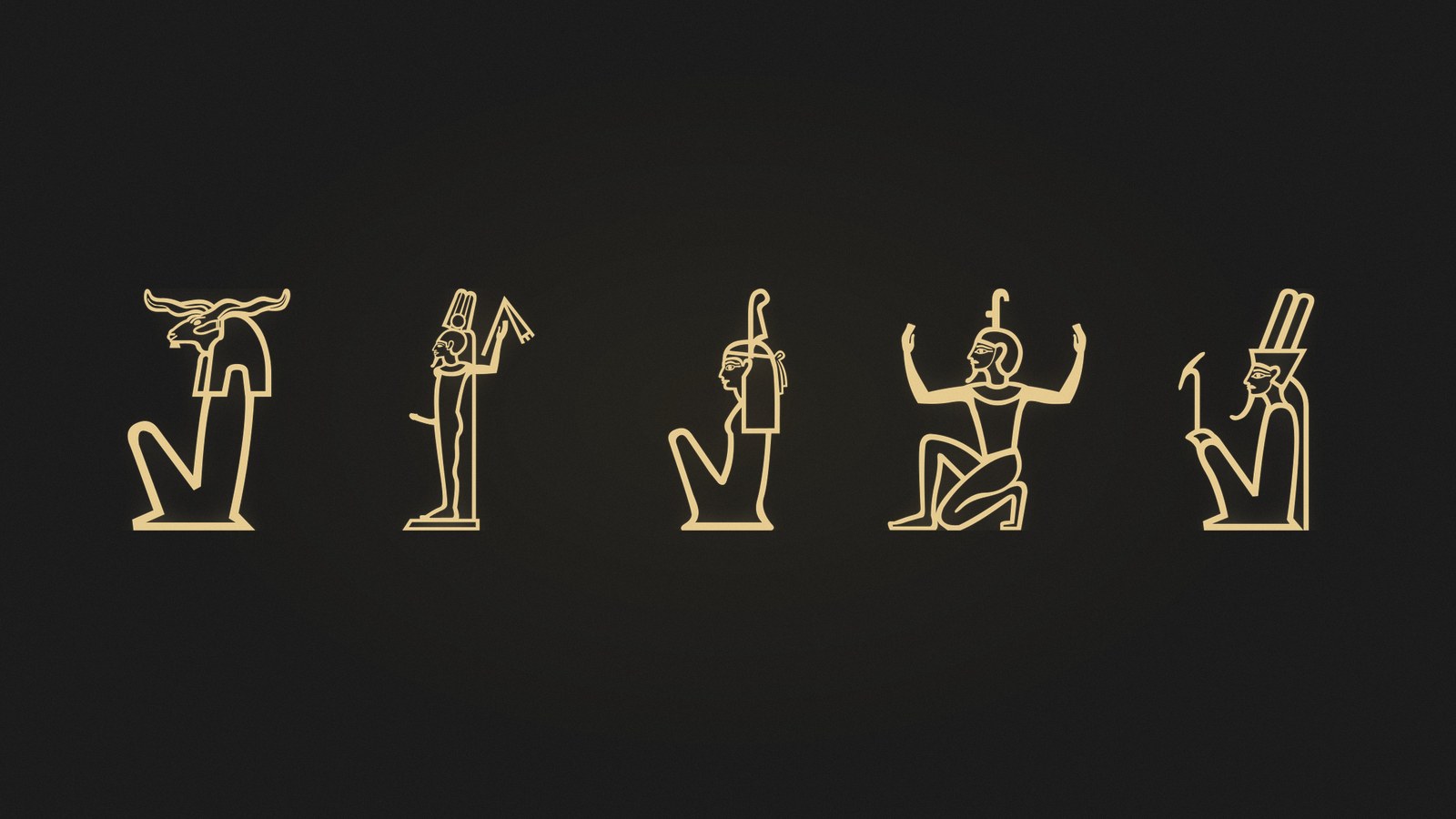
One of the friendliest facts for a beginner reading hieroglyphs is that the Egyptians marked a god's name with a little figure of that god. Because of this, divine names are among the easiest things to pick out of an inscription. You do not need to sound anything out to spot them. In an earlier lesson we met the divine figures you come across most often. These five are the next tier, and each one gives itself away through a single feature: a ram's head, a tall double plume, one ostrich feather, a pair of palm ribs. Once you know the detail to look for, the god falls into place.
We begin with Khnum. This sign shows a ram-headed deity, and the ram's head is the whole clue. Khnum is the potter god of Elephantine, who was believed to shape every human being and their ka, their spirit double, on his potter's wheel before birth. When you see a figure with a ram's head standing in for a name, you can be confident you are looking at Khnum.

Next comes Min, written with an ithyphallic standing figure. Min is the ancient god of fertility, of the harvest, and of the Eastern Desert's mineral wealth. His posture is his signature, and once you have seen it you will not confuse him with the other standing gods in an inscription.

The third sign belongs to Maat, a goddess you can recognise by the single tall ostrich feather she wears. Maat, written Mꜣꜥt, is the personification of truth, justice, and the cosmic order that held the universe together. That one feather is the detail to fix in your mind, and it appears again and again in inscriptions that touch on order and rightness.

Fourth is Heh, shown as a kneeling god holding two palm ribs. The palm ribs are symbols of counted years, and Heh personifies the concept of eternity as well as the number one million, ḥḥ. When you meet a kneeling figure with a rib held out in each hand, you have found Heh, and with him the vast idea of a million years.

The last of the five is Amun, and his tall double-plumed crown is his iconic mark. This sign writes the name of Imn, Amun, whose name is often understood as "the Hidden One". Amun rose from a local Theban deity to become king of all the gods during the New Kingdom, and the double plume on his crown is the feature that lets you name him on sight.

Take these five together and you can see the underlying trick of reading divine names. Each god carries a badge: a ram's head for Khnum, an unmistakable posture for Min, a single feather for Maat, a pair of palm ribs for Heh, a tall double plume for Amun. You do not have to memorise them all at once. Look for the one feature, and the name will follow. Hierolyte, the iPhone and iPad app behind this site, teaches one of these signs a day, with the same notes you have just read, so the details settle in gently over time. Keep an eye out for these five in the inscriptions you meet, and soon spotting them will feel like second nature.