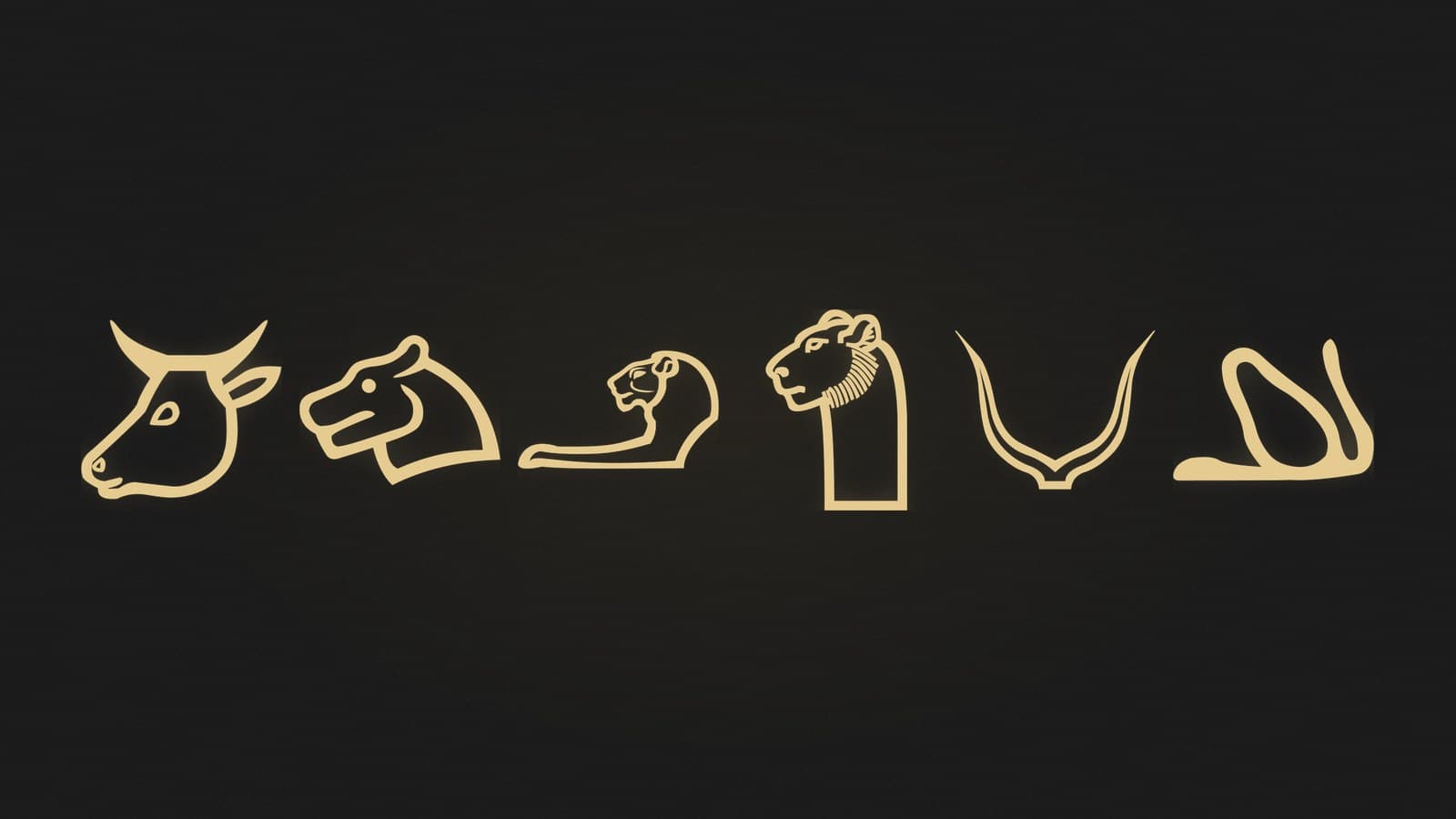
One of the first things you notice when you start reading hieroglyphs is how rarely the scribes bothered to draw a whole animal. A head, a pair of horns, or a single limb was often enough. This habit of letting a part stand for the whole is one of the script's most economical tricks, and it had a practical reward: it kept signs legible even when they were carved very small. A fragment is easier to cut cleanly into stone than a complete beast, and it reads just as clearly once you know what it means.
What makes these signs so rewarding to study is that the leap from picture to meaning can be a long one. Sometimes the fragment points straight at the animal it came from. At other times it carries an idea with no obvious connection to the beast at all. A pair of horns, as we will see, carries a word for opening, and an animal's hindquarters a word for what is innermost. Learning to follow that logic is part of the pleasure.
Start with something straightforward. The ox head, sign F1, is a frontal view of the animal's face with its horns spreading to either side. It marks cattle-related words and appears prominently in offering formulas, where cattle were among the goods presented. Here the picture and the meaning sit close together: the head stands in plainly for the animal and everything associated with it.

The hippopotamus head, sign F3, works in a similar way but with a very different mood. Its massive jaws convey the raw danger the Egyptians associated with encountering these animals along the Nile. The sign does not soften the beast into a symbol; it keeps the threat visible, jaws and all.

With the forepart of a lion, sign F4, the meaning begins to travel further from the animal itself. This is the aggressive front half of a lion, all claws and teeth, and it represents isft, the Egyptian concept of chaos, wrongdoing, and injustice. The menace of the creature has been lifted away from the lion and attached to an abstract idea.

The leopard head, sign F9, read sty, shows the same widening of meaning. It appears in words for the priestly leopard-skin garment, which is easy enough to picture, and, intriguingly, in words for "shooting" and "piercing". The leopard's lethal bite and the piercing gaze of its eyes may explain this semantic link, though the connection is one you have to reach for rather than one that is obvious at a glance.

Then come the two signs that stretch the logic furthest. A pair of spreading horns, sign F13, writes wp, meaning "to open" or "to separate", perhaps because horns divide and part whatever stands before them. The horns are no longer really about the animal; they are about the action they perform.

Last is the hindquarters, sign F22, an animal's innermost, hidden part. It writes ẖn, meaning "interior" or "inside". The logic here is visceral: what lies behind the rear of an animal is its internal cavity, making this sign a vivid metaphor for what is deepest and most concealed.

Taken together, these six signs show a script that trusts a fragment to do the work of a whole. Once you learn to read the part, you begin to see the idea it stands for. Hierolyte, the iPhone and iPad app behind this site, teaches one of these signs a day, with the same notes you have just read.