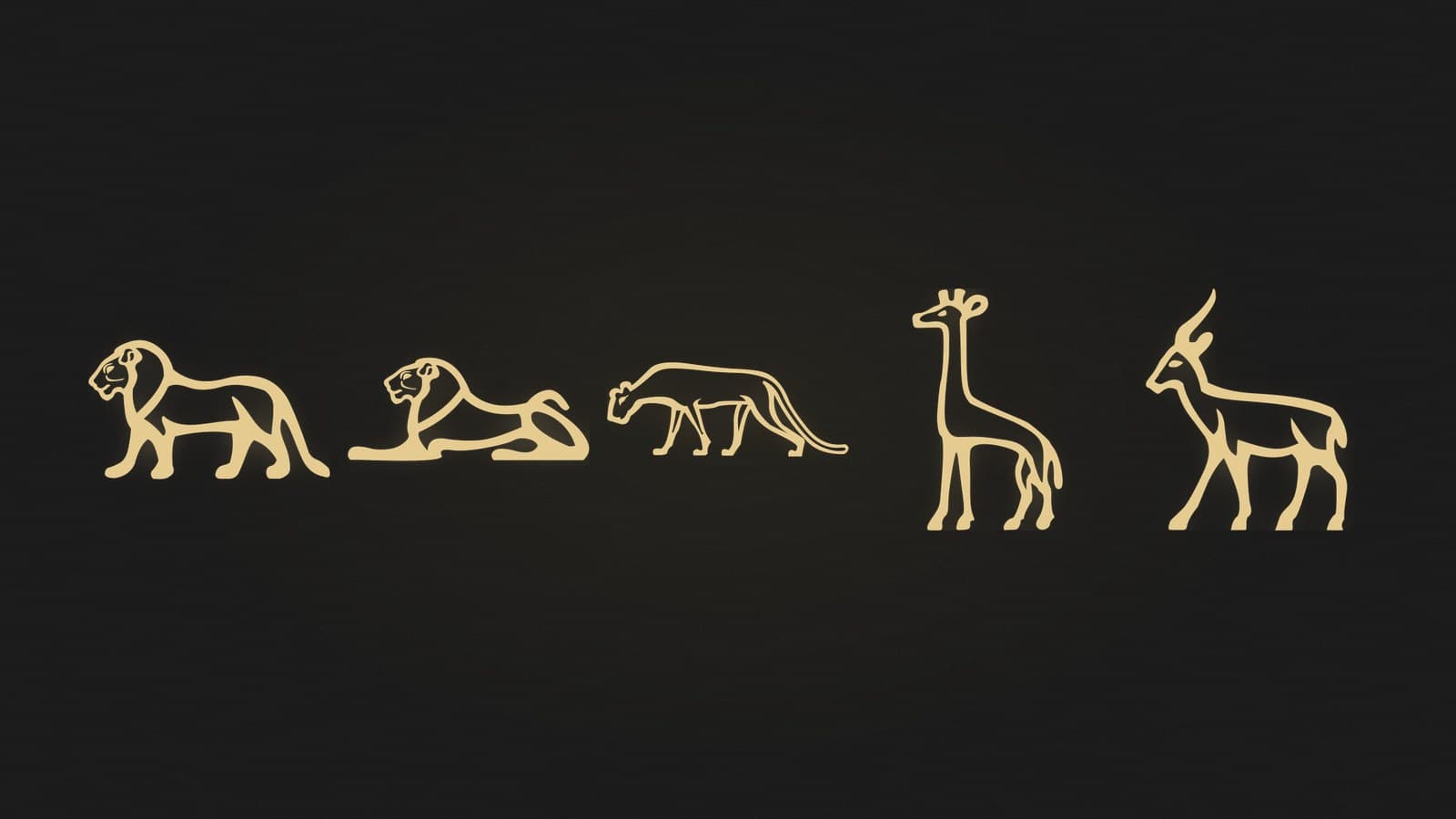
Most of the animals an ancient Egyptian met day to day were the creatures of the river and the fields. Beyond that green ribbon, though, in the deserts and the lands further south, lived animals that ordinary people saw rarely, if ever. The script still kept a sign for many of them. When you meet one of these animal pictures, it very often works as what we call a classifier: a sign that sits at the end of a word and quietly tells you that the word names that animal. A few of them, as we shall see, do more than classify.
The most powerful of the group is the standing lion. Alert and upright, this lion (mꜣi) embodied royal ferocity. Pharaohs were compared to lions in battle, and one king, Amenhotep III, claimed to have personally slain 102 of them. It is easy to see why the animal became a natural image of kingly strength.

The same animal appears again in a different pose, this time lying down. The reclining lion can stand for the sound rw, and it holds a special place in the imagination, because this is the posture of the Great Sphinx of Giza, the most famous lion image in human history. So one sign classifies a word as a lion, while its resting cousin can also lend its sound to the words it helps to spell.

Next comes the leopard, an animal woven into Egyptian religious life. Sem-priests wore real leopard skins draped over their shoulders during the sacred Opening of the Mouth ceremony, the ritual that reanimated the dead. When you see this sign, then, you are looking at more than a spotted cat; you are looking at a garment charged with sacred meaning.

The giraffe is where the script does something surprising. This tall animal was used to write sr, meaning to foretell or to predict. Here is a word with nothing obviously animal about it, yet it is written with a giraffe. The explanation usually offered is a charming one: perhaps its towering neck let it see what was coming over the horizon. It is a lovely reminder that the people who built this script were watching animals closely and thinking about what each one did best.

Last is the gazelle, swift and elegant, the quintessential quarry of elite desert hunts. It was depicted leaping across tomb walls as noblemen pursued them in chariots. The gazelle brings us back to the everyday side of these signs, working as a classifier that marks a word as naming this graceful desert runner.

Taken together, these five signs show how the script handled the animals of the wild lands. Most of the time they simply classify, telling you the word in front of you names a lion, a leopard, a giraffe or a gazelle. But two of them slip beyond that role: the reclining lion lends its sound rw, and the giraffe writes a whole verb about seeing the future. If you would like to learn signs like these a little at a time, Hierolyte, the iPhone and iPad app behind this site, teaches one of these signs a day, with the same notes you have just read.