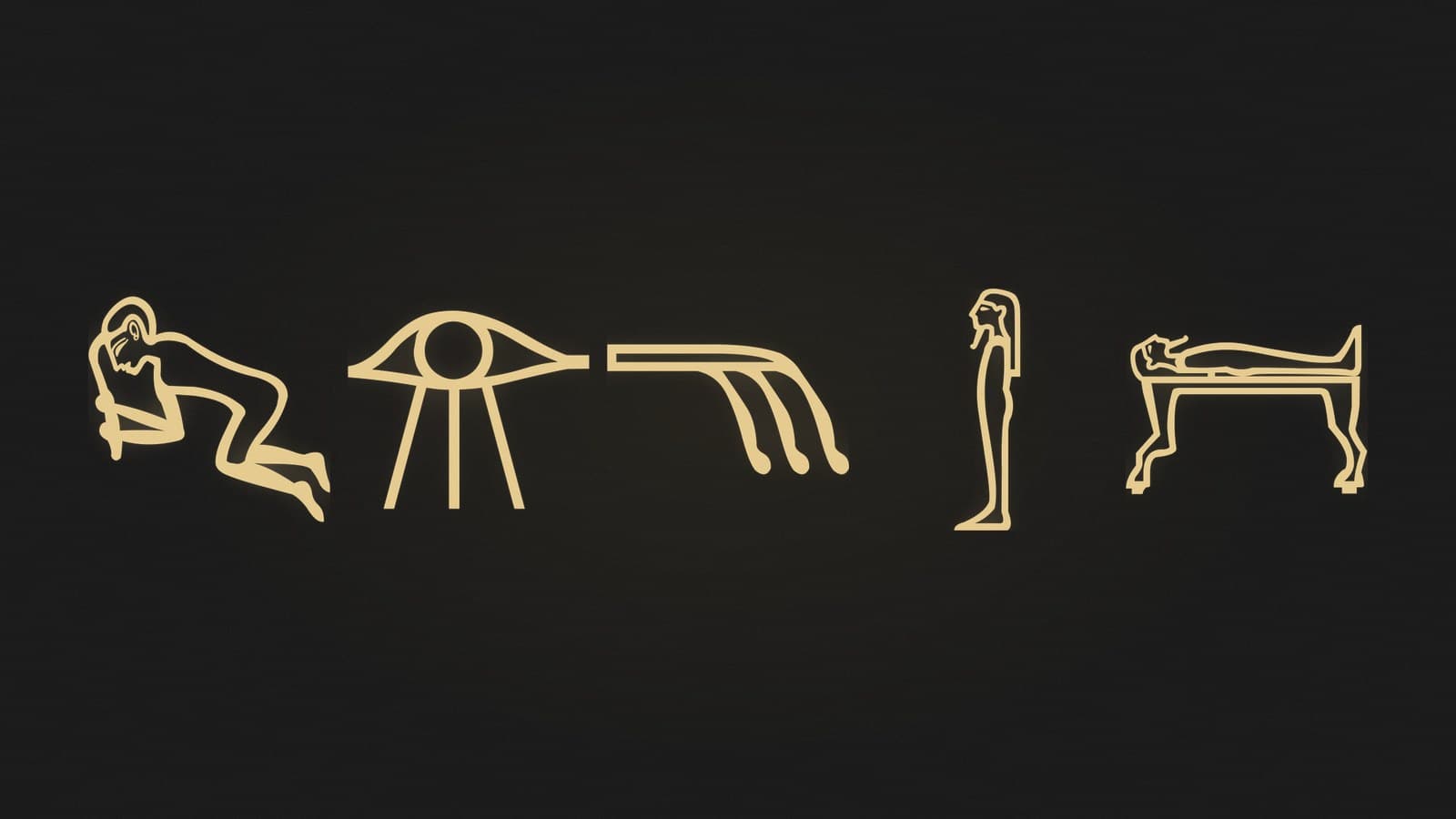
Egyptian writing does not look away from death. Where many cultures reach for gentle words or careful silence, the hieroglyphic script sets down the hard reality in a handful of small signs. Together these signs carry the whole sequence, from the moment of dying, through mourning, to the wrapped body resting on its bed.
To follow how they work, it helps to know about a feature of the writing called the classifier. A classifier is a sign that closes a word and tells the reader which part of the world that word belongs to. It is not sounded out. Instead it acts as a quiet label at the end. This is why an unfamiliar word can still be understood in outline. You may not know the word itself, but a weeping eye at its end tells you it is about tears. Once you learn to spot these signs, whole areas of meaning open up even before you can read every letter.
The starkest of them shows a man fallen, with blood streaming from his head. This is the death sign, A14. It determines words like mwt ("to die") and ẖft ("enemy"). There is no softening here. The Egyptians did not shy away from graphic clarity in their writing system, and this sign is proof of it.

Where death is blunt, grief is tender. The weeping eye, D9, is an eye with tears streaming downward. It determinatively marks the verb rmi, "to weep." The Egyptians depicted grief with striking literalness, and you can almost feel the sorrow in the cascading drops beneath the eye. It is a small picture that says exactly what it means.

Mourning had its own gesture, and the writing preserved it. A single lock of hair served as the determinative for words related to hair, mourning, and grief. Ancient Egyptian mourners ritually tore and disheveled their hair, so the Egyptians literally wrote sorrow with a strand of hair. The sign, D3, is a quiet reminder that grief was something the body performed as well as felt.

After the dying and the mourning comes the transfigured dead. The standing mummy, A53, shows an upright body wrapped in linen bandages. It appears after words related to the afterlife. The standing posture suggests resurrection and the deceased's ability to move freely in the next world, so the sign carries a note of hope rather than loss.

The last sign brings us to the tomb itself. The mummy bed, A55, shows a mummy resting on a lion-shaped bed. It represents the most elaborate form of funerary preparation, evoking the actual gilded lion beds found in tombs like Tutankhamun's, where the lion's protective power guarded the deceased. In one small picture the writing gathers together the body, the bed and the care that surrounded it.

Set side by side, these five signs form a small map of how the Egyptians thought and wrote about the end of life. The fallen man, the weeping eye, the lock of hair, the standing mummy and the mummy on its bed each close a word and point it toward death or sorrow, and together they show a script willing to face difficult things directly.
Hierolyte, the iPhone and iPad app behind this site, teaches one of these signs a day, with the same notes you have just read. A sign at a time, this hard and beautiful vocabulary becomes something you can read.