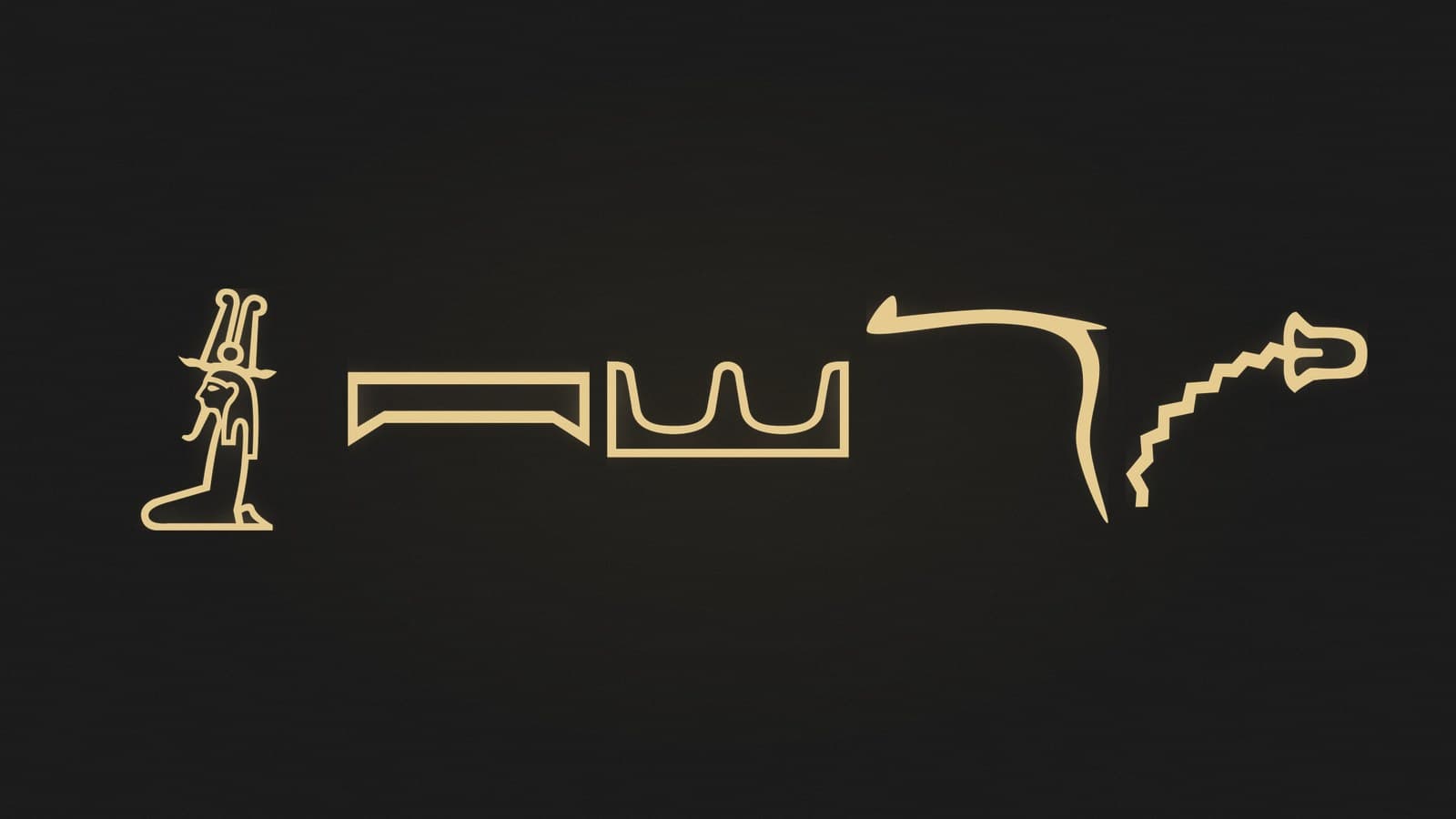
The Egyptians told more than one story about how the world began, and those stories are surprisingly physical. In one account the god Ptah made the world by conceiving it in his heart and speaking it with his tongue. In another, the creator Atum produced the first pair of gods, Shu and Tefnut, by sneezing and spitting. Land rising out of water, a sky stretched overhead, a world spoken into being: these are not abstractions in Egyptian thought, and the script has a sign for each of them. In this beginner lesson we will meet five of those signs and see how the world of creation was written down.
We begin with the ground itself. The Egyptians pictured their own country as the black land of the Nile's fertile silt, with the sky above and the red desert and foreign hills beyond. At the very start of things, in one telling, a single mound of earth pushed up out of the waters of chaos. That first dry land had a name and a divine form of its own.

This sign depicts a god with ram horns topped by two tall feathers. It represents Tatenen (tꜣ-ṯnn), the "Risen Land", the primordial mound that emerged from the waters of chaos at the moment of creation. In a single figure it holds the whole idea of a solid beginning: the moment when there was somewhere to stand.
Above that land stretched the sky, and the script has a plain and memorable way of showing it.

Depicted as a flat slab stretching across the top of a scene, this sign represents the vault of heaven, the body of the sky goddess Nut arching over the earth. When you see it running along the upper edge of a wall or a papyrus, it is doing exactly what a sky should do: covering everything beneath it.
Beyond the black land and under that same sky lay a very different kind of country. The desert and the hills that ringed the Nile Valley had their own sign too.

Three hills with sand between them evoke the harsh desert landscape beyond the Nile Valley, the "red land" (dšrt) of foreign territory. Placed against the sky above and the fertile land below, this sign completes the map that the Egyptians carried in their minds.
The last two signs take us back to creation by speech and by the body. Ptah spoke the world with his tongue, and the tongue itself is a sign.

The tongue sign writes ns, meaning both "tongue" and "language", a conceptual link that English shares in the phrase "mother tongue". A single sign for the organ and for speech itself fits an account in which the world is spoken into being.
Atum's method was more bodily still, involving spitting, and here too there is a sign that fits.

A lip with liquid dripping from it, this sign marked words for spitting and saliva. It is a reminder that Egyptian writing was happy to be concrete: even the making of gods could be shown through the plainest human act.
Taken together, these five signs sketch a small model of the cosmos: the risen land, the sky above, the desert beyond, and the tongue and lip through which the world was uttered. Hierolyte, the iPhone and iPad app behind this site, teaches one of these signs a day, with the same notes you have just read, so that the shapes become familiar a little at a time.