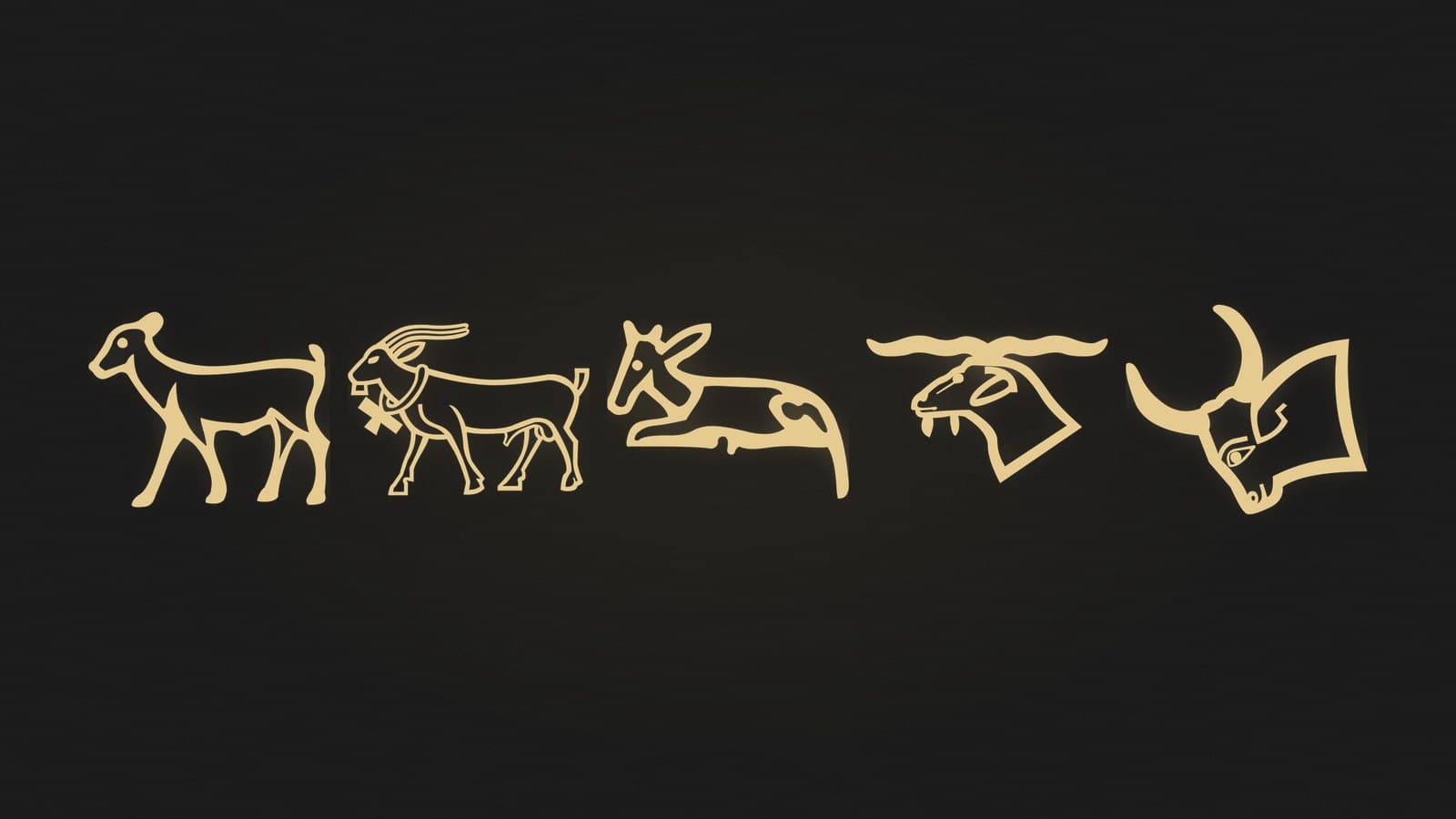
An Egyptian estate ran on animals. Goats, sheep and cattle moved through its fields and pens, and someone had to keep track of them all. That someone was often a scribe, and the script that scribe used had a neat way of counting the herd without confusion. Small pictures of these animals appear at the ends of words, and when they do, they are working as classifiers. A classifier closes a word and tells you the kind of thing the word names. If a goat sign sits at the end of a word, you know at once that the word names a goat. This is how a scribe kept a herd list unambiguous, so that a note about young goats could never be mistaken for a note about cattle.
One of the first of these little herd pictures is the kid goat. This sign marks words for young goats in the script, and you can imagine how useful that was on an estate where the difference between a full-grown animal and a newborn one mattered for the record.

A grown goat could be shown too, and here the script added a small but telling detail. The goat with collar wears a collar around its neck, and that collar marks the animal as domesticated, distinguishing it from wild varieties. A single loop of a line around the neck was enough to tell a reader that this was an animal of the farm rather than the wilderness.

Cattle mattered just as much, and the script paid the same close attention to their young. The newborn calf is depicted still wobbly, and sometimes glistening from birth. It captures a moment Egyptian artists loved to render in tomb paintings, and it is a lovely reminder that the people who drew these signs had watched real animals closely and with affection.

Not every animal in the herd stayed simply an animal. The ram's head connects to Khnum, the creator god who shaped humans on his potter's wheel at the First Cataract. So the same ram that stood among the sheep of an estate also stood, in the Egyptian imagination, as the god who formed people out of clay. The everyday and the divine sat side by side in the same picture.

As you learn more of these signs, you will notice that the catalogue often keeps more than one drawing of the same animal. Scribes chose between the variants by region and period, which is why the sign list holds several ox heads and several rams. The ox head variant is one such case. It is a variant of the ox head, sometimes drawn with more prominent ears, and it appears in the same cattle-related contexts as its close relative. Meeting a variant like this is not a trap. It is simply the script showing its long history and its many local hands.

Learning to recognise these animals is a gentle way into reading, because each sign carries a clear picture and a clear job. Take them a few at a time and they will start to feel familiar. Hierolyte, the iPhone and iPad app behind this site, teaches one of these signs a day, with the same notes you have just read, so the herd, and its ram-headed god, come to you steadily rather than all at once.