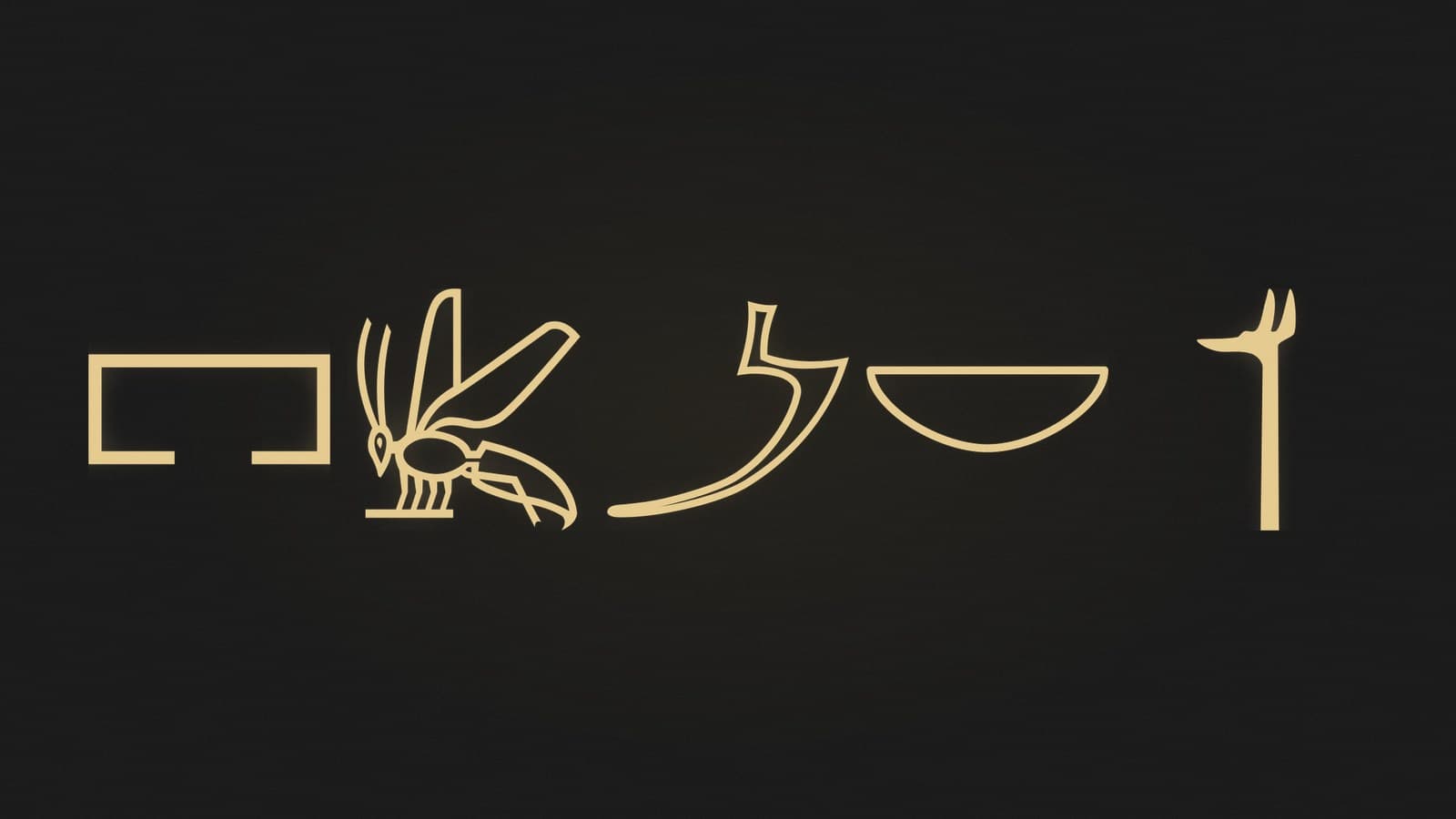
Some of the grandest phrases in Egyptology are not built from grand pictures at all. Pharaoh, maat, lord of all, King of Upper and Lower Egypt: behind these towering ideas sit five very ordinary drawings. A house plan, a bee, a sickle, a basket and the neck of an animal do most of the work. If you are just beginning, this is one of the most useful things to understand early, because it changes how you look at the whole script.
The key point is this. Each of these signs writes a group of sounds rather than naming what it draws, so the picture and the meaning can part company completely. A bee in a royal title is there to spell a word, not to suggest industry. That is why the script rewards learning signs rather than symbols. Once you accept that a picture is often just a sound, the reading becomes much steadier.
Take the house first. This simple house plan shows an entrance at the bottom, and it stands at the heart of one of the most familiar words of all. The word 'pharaoh' comes from 'pr-ꜥꜣ' meaning 'great house'. The palace, the building itself, became a title for the king. So a small plan of a house helped carry a word that we still use in English today.

The bee looks modest, yet it carried enormous political weight. It appeared in the royal title nsw-bity, "King of Upper and Lower Egypt," where it symbolized the fertile Delta region of Lower Egypt. This is a good example of a tiny drawing standing in for something far larger than itself, a whole part of the country folded into one small sign.

The sickle depicts a tool used for harvesting grain, but again its job is sound rather than farming. It provides the 'mꜣ' sound and appears in words like 'mꜣꜥt' (truth/justice) and 'mꜣꜣ' (to see). Truth and seeing are among the deepest ideas the Egyptians wrote about, and a harvesting tool helped spell them both.

The basket is one of the most common hieroglyphs you will meet. This wicker basket means 'lord', 'master', 'all', or 'every'. Combined with 't' it becomes 'nbt' (lady). From something as everyday as a basket, then, come words of ownership and totality, and the makings of a great many royal and divine phrases.

Last comes the head and neck of an animal, which gives us wsr, meaning "powerful" or "mighty". This was one of the most prestigious epithets in the Egyptian language, a word reached for when strength needed to be praised. It is a fitting close to the group, because it shows once more how a plain image of a body part can carry an idea of real grandeur.

Put these five together and you can begin to see how the biggest Egyptian words are assembled from small, patient parts. None of them shouts its meaning from the picture alone. Each asks you to know it, to remember its sound and its uses, and then to read. That habit, of learning signs one at a time, is the whole craft. Hierolyte, the iPhone and iPad app behind this site, teaches one of these signs a day, with the same notes you have just read. A house, a bee, a sickle, a basket and a neck are a fine place to start.