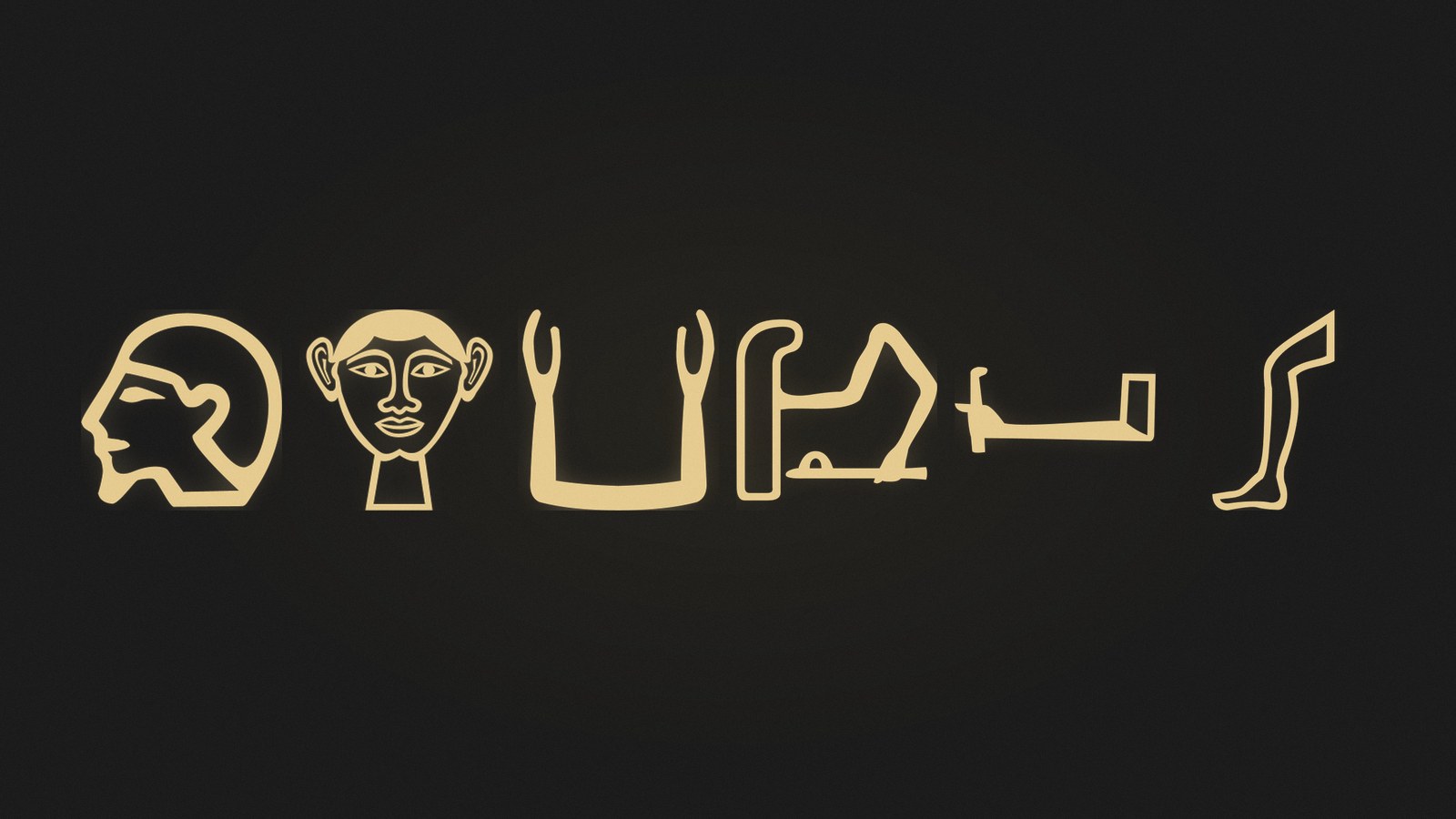
One of the most useful habits to notice, when you begin reading hieroglyphs, is how often the ancient script takes a picture of the human body and puts it to work for an idea. A drawing of a head came to mean first. A face came to mean upon. Again and again the Egyptians borrowed a body part for the thought that body part suggested, and once you see the pattern you start reading it everywhere.
This is also why a sign list is not a dictionary. Many signs began as a plain picture and ended up carrying an abstract sense that the picture only hints at. The same drawing can be a sound, a whole word, or a silent marker of meaning, depending on where it sits in the writing. That flexibility is not a flaw in the system. It is the point of it.
Start with the head. This profile of a human head writes the word tp, which meant both "head" and "first" or "chief". The step from one to the other is easy to feel: the head sits at the top, so it stands for what comes first. Ancient Egyptian bureaucrats were literally called "heads" of their departments, just as we say today.

The face follows the same logic. This sign depicts a face in profile and writes ḥr, meaning "face" or "upon." A face is the part turned towards you, the surface presented to the world, so it comes to mean the thing on top or in front. The same sign also spells the name of the falcon god Horus, whose face was believed to be the sky itself, his right eye the sun, his left the moon.

Arms give us some of the clearest examples. Two arms raised upward form the kꜣ symbol, representing the vital life force that distinguished the living from the dead. Here the body is not standing in for a nearby idea so much as for something invisible, a force the gesture was felt to hold.

Change the pose and you change the meaning. Arms thrust high overhead write ꜥḥꜥ, meaning "to stand" or "to rise." This sign determined words for height, standing upright, and rising up, the triumphant gesture of a person reaching skyward.

An arm can also carry force. A muscular arm gripping a stick or mace writes nḫt, "strong," and determines words for strength, force, and military power. The picture shows what a strong arm does, and the abstract idea of strength rides along with it.

Finally the leg. A single leg from thigh to foot writes rd, "leg," and also determined the word for "place" or "station." The connection between a leg and a place reflects the practical reality that in the ancient world, everywhere you went, you went on your own two legs.

None of these leaps needs to be memorised as a list of exceptions. Each is a picture of the body reaching towards an idea the body suggested. Learn to read that reach and the script becomes far friendlier. Hierolyte, the iPhone and iPad app behind this site, teaches one of these signs a day, with the same notes you have just read.