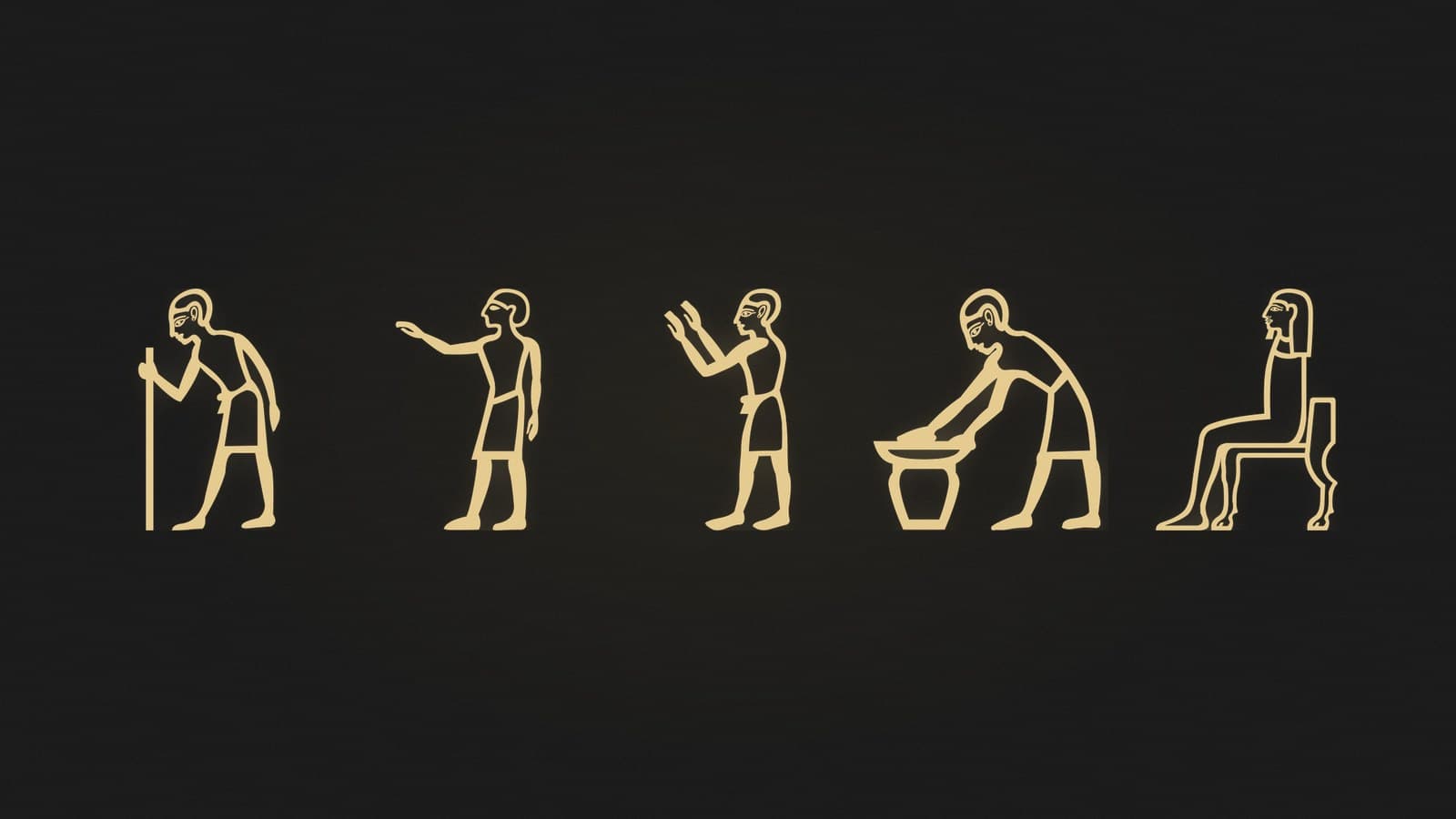
When beginners first meet the little human figures of the hieroglyphic script, it is easy to assume they must all be jobs or titles. Many of them are, but the family reaches much further than that. Some of these figures record age, some record status, and some record a single telling gesture. Like the other human figures, they are classifiers: silent signs that close a word and point to its general meaning. They are not read aloud. Instead they sit at the end of a word and quietly tell you what kind of thing you are looking at. What makes this particular group so useful is that posture carries the meaning. A bent back and a staff mean age, raised hands mean worship, and a man bent over a vat means brewing. Once you learn to read the body, a single figure can tell you whether a word concerns an elder, a noble or someone at prayer.
Consider first the sign known as A19, the old man. Here a man leaning heavily on a walking staff represents iꜣw, meaning "old man". You can feel the whole idea in the shape: the weight thrown onto the staff, the back giving way to years. This sign appears in one of Egypt's most famous literary works, "The Instruction of Ptahhotep", which opens with a vivid lament about the miseries of old age. That a single silent figure can stand behind such a heartfelt passage is a good reminder that classifiers are not dry technical markers. They carry the texture of lived experience.

Next comes A26, the calling man, shown with one arm extended in a beckoning gesture. This figure marks words for calling, summoning and invoking. It appears frequently in ritual texts, where priests call upon deities to manifest. Notice how the reaching arm does the work that the standing old man's staff did: the gesture is the meaning, and the reader takes the sense of the whole word from that one outstretched limb.

Closely related in spirit is A30, the man with hands, who raises both hands toward his face in a gesture of reverence. This figure appears in contexts of prayer and supplication. It is closely related to A4, but it emphasises the personal, intimate nature of devotion. Where the calling man reaches outward to summon, this figure turns the gesture inward and upward, a quieter act of worship.

From devotion we move to daily bread, or rather daily beer. The sign A36 shows a man stirring the contents of a large vat, and it marks words for brewing. Beer, ḥnqt, was a dietary staple in ancient Egypt, consumed daily by workers, priests and pharaohs alike. The classifier captures the labour behind that staple: the bent body, the vat, the steady work of the stir.

Finally there is A50, the noble, a seated dignitary who represents špsi, meaning "noble" or "wealthy". This is a term that in Egyptian thinking linked material prosperity with moral worth. To be špsi was to be both rich and respected, and the calm seated posture reflects that settled standing in the world.

Taken together, these five figures show how much a silent sign can say. Age, calling, prayer, labour and status all reside in the body's posture. Hierolyte, the iPhone and iPad app behind this site, teaches one of these signs a day, with the same notes you have just read, so that recognising them slowly becomes second nature.