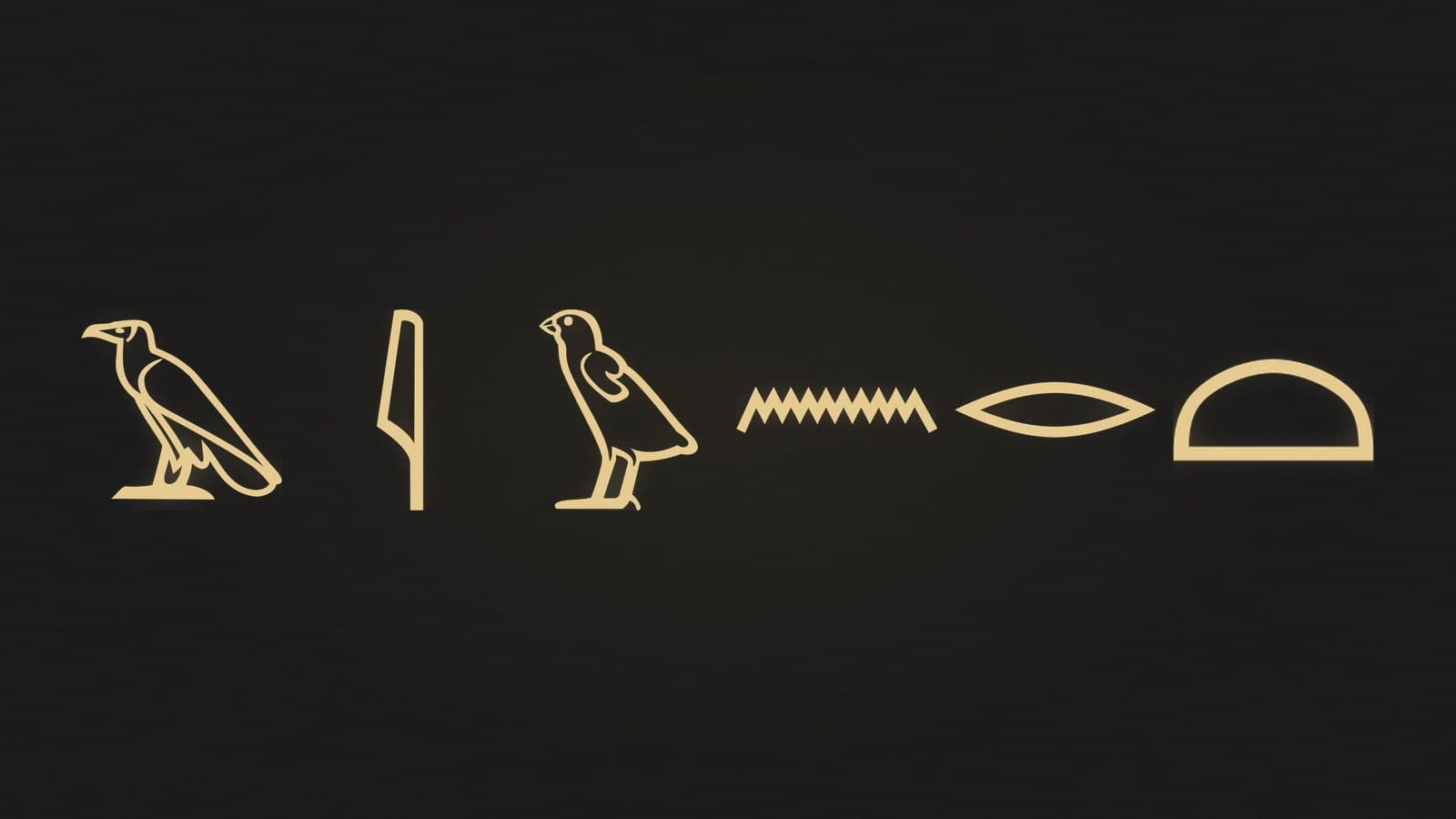
Across three earlier lessons we worked through eighteen of the single-consonant signs, the small alphabet-like group that Egyptologists call the uniliterals. Eighteen is not the whole set. Six were held back, and there is a good reason for the order. These six belong to the same uniliteral set as the earlier lessons, and they complete it at twenty-four. They come last in the lesson order and first in almost any real text. Once you know them, the names of gods and lands you have always half-recognised begin to open up.
Before we meet them, one habit of the script is worth keeping in mind. Vowels were not written. To make words sayable, Egyptologists slip a conventional e between the consonants. Two of our six signs, the reed and the quail chick, are semi-vowels, the nearest the script comes to writing a vowel, and even they count as consonants. So do not expect these signs to behave like the vowels of an English alphabet. They are consonants first.
We begin with the egyptian vulture, listed as G1. It writes the single consonant ꜣ, a glottal 'ah' sound. You will meet it in the word ꜣst, Isis, the goddess.

Next comes the flowering reed, M17, one of the two semi-vowels. It writes the single consonant i, sounded 'ee' as in 'sheep'. It turns up in the word imn, Amun, the hidden god.

The other semi-vowel is the quail chick, G43. It writes the single consonant w, a 'w' or 'oo' as in 'wood'. You will find it in the word wsir, Osiris, god of the afterlife.

The water ripple, N35, writes the single consonant n, an 'n' as in 'noon'. It turns up in the word nṯr, meaning god, or divine, a word you will see again and again.

The mouth, D21, writes the single consonant r, an 'r' as in 'run'. It appears in the word rꜥ, the sun, and the sun god Ra.

Last is the bread loaf, X1, which writes the single consonant t, a 't' as in 'top'. It turns up in the word tꜣwy, the two lands, a name for Egypt itself.

Look back over the six words we have gathered and you can feel why these signs matter. Isis, Amun, Osiris, the word for god, the sun god Ra, and the two lands: much of what ancient Egyptian texts talk about is built from exactly these letters. The signs that came last in the teaching are the ones that come first on the wall.
Take your time with them. Say each sound aloud, slip in that conventional e where you need it, and read the six sample words until they feel familiar. Hierolyte, the iPhone and iPad app behind this site, teaches one of these signs a day, with the same notes you have just read, so the set settles slowly rather than all at once. With these six added to the eighteen before them, your uniliterals are complete, and the real reading can begin.