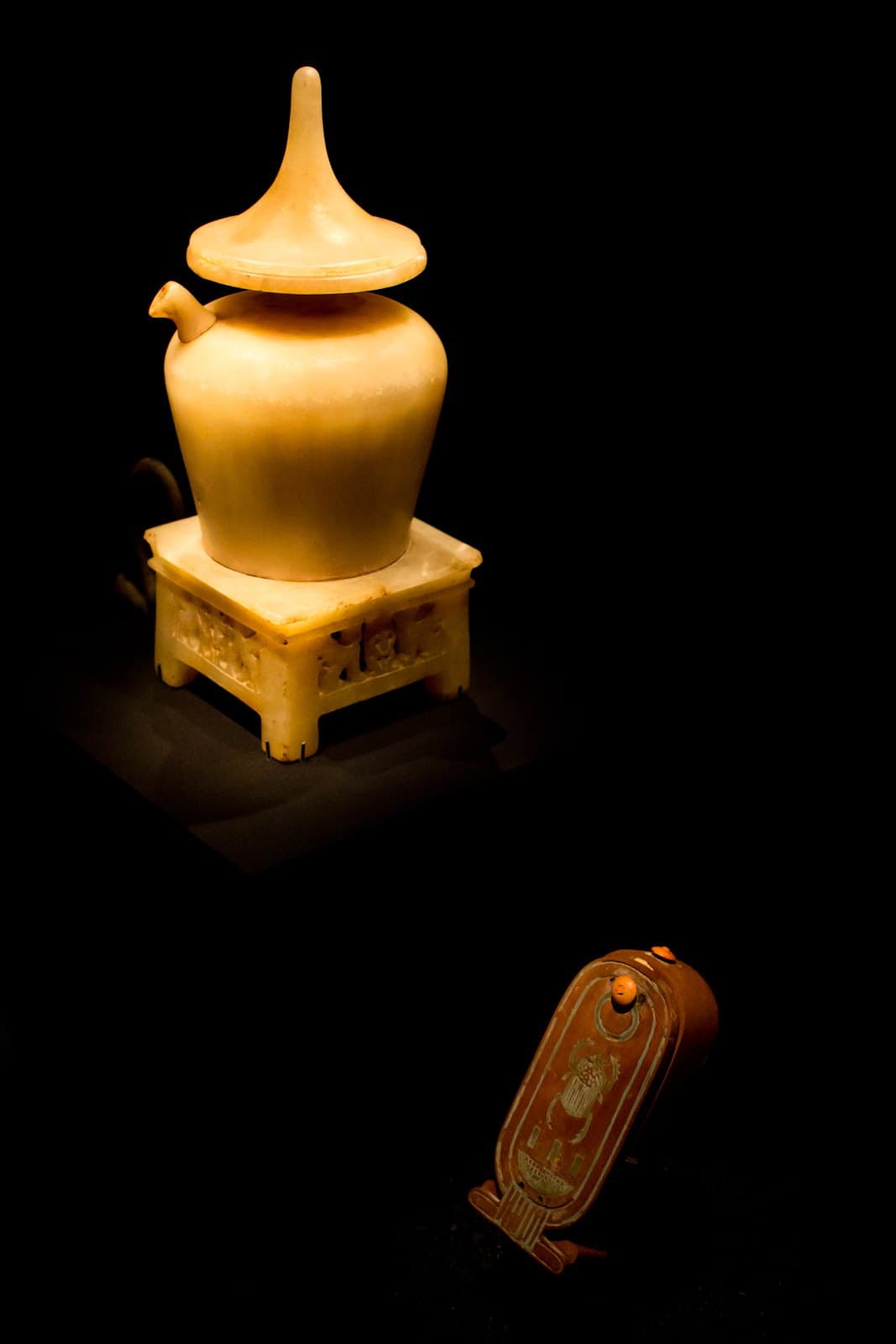
Tutankhamun's name is probably the most-photographed Egyptian text in the world. It appears on jewellery, on furniture, on gold, and in museum cases across the globe. The good news for a beginner is that it is genuinely readable. There are only two little groups of signs to learn, each wrapped in its own oval ring, and one elegant rule that explains why the signs sit in the order they do.
That oval ring is called a cartouche, and it marks out a royal name. Kings carried two of these names, and each was written in its own cartouche. One is the throne name, taken at the start of a reign, and the other is the birth name. Once you know what to look for, you can pick out either one at a glance.
Start with the throne name, Nebkheperure. It is written with four elements: a sun disc, which stands for the god Ra, a basket, which gives the sound neb and means lord, a scarab beetle, which gives kheper, and three small strokes that mark the plural, turning kheper into kheperu. Read in order, the signs give nb-khprw-ra, conventionally rendered Nebkheperure.

Here is where the elegant rule comes in. Look at the cartouche and you will see the sun disc sitting at the very top, first inside the ring. Yet when you read the name aloud, that sun disc comes last. This is not a mistake and it is not random. The sun disc stands for the god Ra, and divine names were written first out of respect, even though they are read in their proper place. Egyptologists call this habit honorific transposition. It is worth remembering, because it explains a great deal once you start reading royal names for yourself.
Now turn to the second cartouche, the birth name, which reads twt-ankh-imn, Tutankhamun. This name is usually translated as living image of Amun. Amun is a god, and so, just as with Ra in the throne name, his name is written first out of respect. That means the signs for the god Amun stand at the front of the cartouche, followed by the signs of twt, meaning image, and then the ankh, meaning life. Read them in their proper order and you have Tutankhamun.
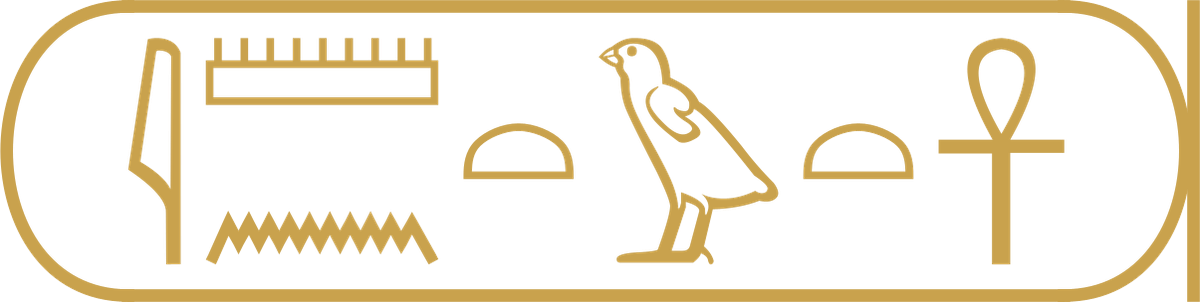
Once you have both cartouches fixed in your memory, the same rule ties them together neatly. In each one, the name of a god has been pulled to the front as a mark of honour, and in each one you read that divine name in the place it truly belongs. The throne name honours Ra, the birth name honours Amun, and both follow the same courteous pattern.
There is a practical reward for learning this. Spotting Nebkheperure is the quickest way to identify Tutankhamun's objects in any museum case. You do not have to read every label or memorise every piece. If you can recognise the sun disc, the basket, the scarab and the three strokes gathered inside one ring, you can name the king who owned the object in front of you.
If you enjoy this kind of steady, sign-by-sign reading, Hierolyte's Reading Royal Names course does exactly this walkthrough for a dozen kings, so you can carry the skill well beyond a single famous name. For now, though, you have earned it: two cartouches, a handful of signs, and one rule about the gods coming first. You can read Tutankhamun.