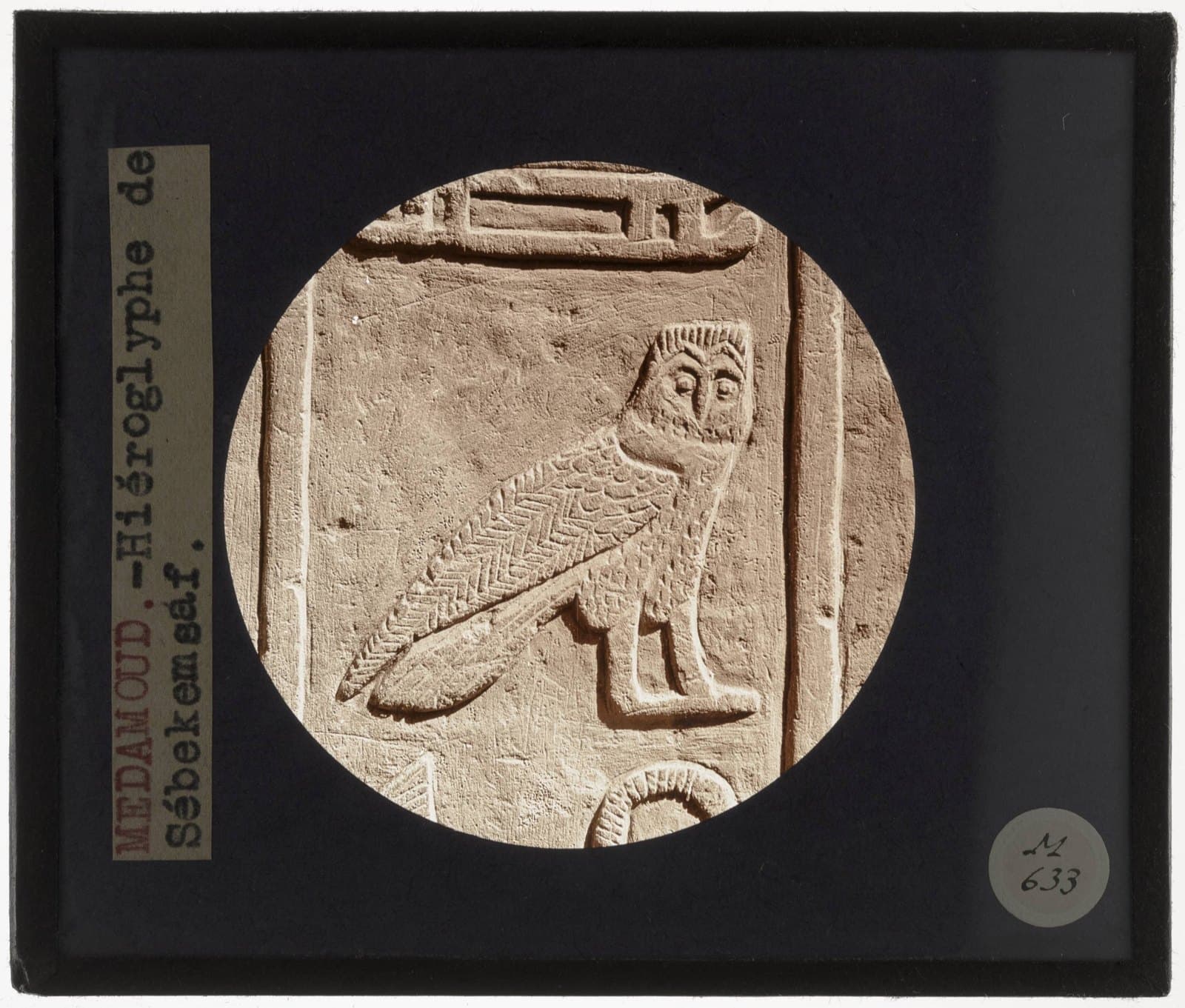
The most tempting mistake in reading hieroglyphs is to assume that a picture means what it shows. A carved bird surely stands for a bird, and a drawing of a mouth surely means mouth. It feels natural, and it is almost always wrong. Ancient Egyptian writing is a script, not a gallery of little illustrations, and the pictures usually work as sounds or as silent signposts. Learning to distrust the obvious reading is half the trick of getting started.
Take the owl. Many beginners meet it expecting something grand, some hint of wisdom, of night, or of a warning about the future. In fact the owl simply writes the sound m. It is not a symbol of wisdom, night or omen. It is doing the humble work of a single letter, no more mysterious than an m in an English word. A picture-perfect owl in an inscription is usually just that quiet sound, turning up wherever the language needs it.

The mouth sign tells the same story. You might reasonably guess that a drawing of a mouth writes the word mouth, and just occasionally a sign does line up with the thing it shows. Here, though, the mouth usually writes the sound r rather than the word mouth. So when you spot it, your first instinct should not be to read a body part, but to sound out a letter. This is exactly the habit that separates a reader from a guesser: the shape is a clue to a sound, not a caption.

The third false friend behaves differently again, and it introduces one of the script's cleverest ideas. The walking legs are usually silent. They add no sound at all. Instead they act as a classifier, often called a determinative, placed after words of motion to signal their meaning. You do not pronounce them; you read them as a hint about what the surrounding word is about. When the legs appear, they whisper that this word has something to do with movement, and then they step aside.

It is worth pausing on why such silent signs exist, because they solve a real problem. Vowels were unwritten, so many words looked alike on the page. Stripped of their vowels, quite different words could end up sharing the same run of consonants, and a reader could easily take one for another. The classifier told the reader which sense was meant. In that light the walking legs are not a decoration but a genuinely helpful tool, a small picture doing the practical job of resolving confusion.
Put these three together and a pattern appears. The owl is a sound, not an omen. The mouth is usually a sound, not the thing it depicts. The walking legs are usually a silent guide to meaning, not a word to be spoken. None of them means what the picture first suggests, and that gap between image and reading is precisely where the writing lives. Once you expect it, the surprise fades and the logic takes over.
So the real beginner's skill is not memorising what each picture looks like, but unlearning the assumption that it means what it shows. Treat every sign as a question rather than an answer, and the inscriptions slowly begin to open. Hierolyte flags these traps sign by sign, with one new glyph each morning, so the habit of doubting the obvious becomes second nature before you notice.