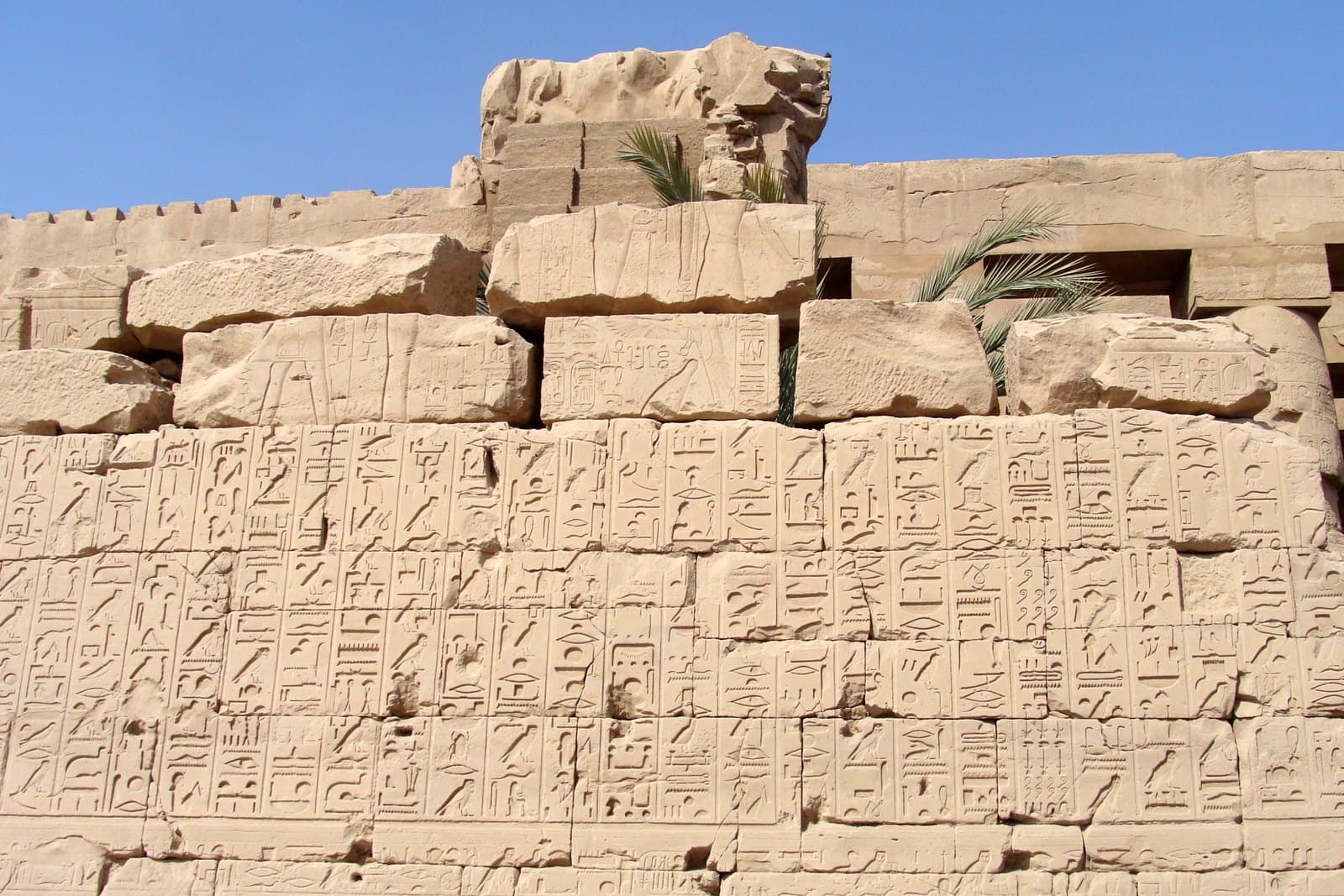
When you first stand in front of a wall of hieroglyphs, the sheer density of it can feel overwhelming. There seem to be hundreds of little pictures, each one a fresh puzzle. The reassuring truth is that some signs do far more work than others. A handful of short, simple shapes turn up again and again, because the phrases carved on temple walls and tomb chapels are full of repeated titles and epithets. Learn just three of these, and you will suddenly find yourself picking out familiar friends across an entire gallery. Those three are nfr, nb and ra.
The first, nfr, means good, beautiful or complete. Its shape is usually explained as a heart and windpipe, though you do not need to picture that to recognise it once you have seen it a few times. This is a warm, generous little sign, the kind of word the ancient Egyptians reached for constantly when they wanted to praise something. It also hides inside some very famous royal names, including Nefertiti and Nefertari, so once you can spot it you already have a foothold in names you may have heard long before you ever tried to read a wall.

The second sign is the basket, nb. On its own it means lord, but it is a flexible little thing: it can also write all or every, which is why it appears in so many different phrases. There is one habit worth watching for. When the basket sits beneath or before another sign, it reads lord of. That small arrangement unlocks a great many titles, since so much of what is carved on a wall is a matter of who is lord of what. Keep an eye out for the basket tucked under something else, and you will start to feel the grammar working.

The third is the plain sun disc, ra. This simple circle writes both the sun itself and the sun god, Ra. It is one of the most recognisable shapes in the whole script, and it carries a special reward for beginners: it closes many royal throne names. Once you know the disc, you will find yourself reaching the end of a king's name and recognising the sun sitting there, quietly finishing the thought.

What makes these three so valuable together is not any single meaning but their sheer frequency. Titles and epithets repeat constantly, and these signs are woven through them. A wall that looked like an impossible wall of pictures becomes something you can begin to read, phrase by phrase, simply because the same good, the same lord, the same sun keep coming back. Three signs alone unlock a surprising amount of wall text, which is exactly why they are the ones to start with.
The best way to fix them in your memory is gentle repetition rather than a single hard study session. All three are early signs in Hierolyte's one-a-day path, so if you prefer to meet them one at a time and let them settle, that steady rhythm suits them well. However you choose to practise, the goal is the same: to walk into a museum, glance at a case or a wall, and feel that first small jolt of recognition. Spotting nfr, nb and ra is the moment the script stops being decoration and starts being writing.