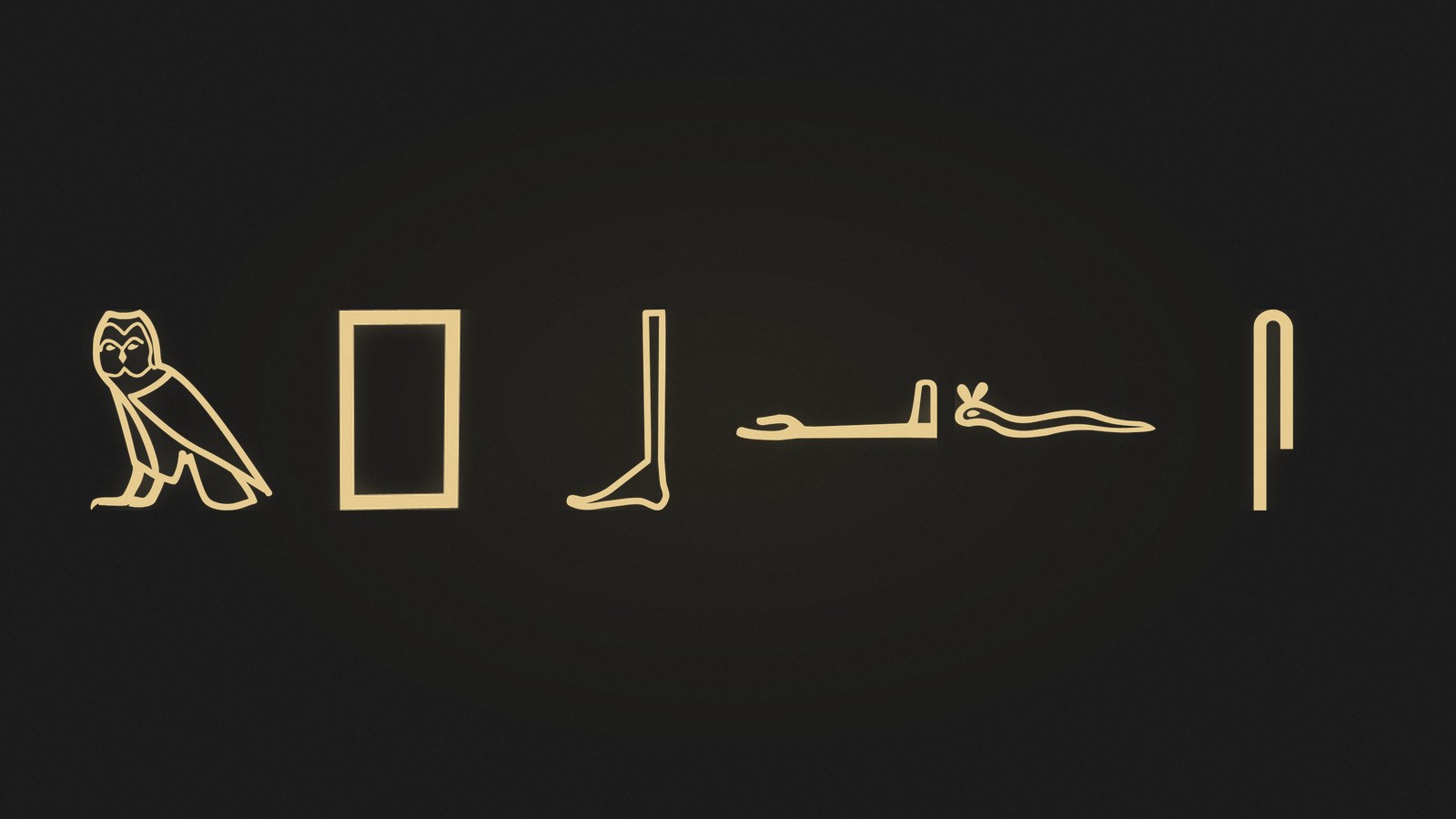
An earlier lesson introduced six hieroglyphs that behave like letters, each standing for a single consonant. Here are six more. Between them you can already sound out a surprising number of real Egyptian words.
It is worth being clear about what this set is. About two dozen Egyptian signs each write a single consonant, and Egyptologists call them the uniliteral set. It is a scholarly grouping rather than an alphabet the Egyptians themselves recited, but it is the quickest way into the script, and it is where nearly everyone starts.
One warning before the signs themselves. Vowels were not written down. To make words sayable, Egyptologists slip a conventional e between the consonants, which is why nfr is usually read aloud as nefer. Every modern pronunciation you hear is therefore an approximation rather than a recording of how anyone actually spoke. The consonants are what the Egyptians committed to the wall. The vowels are ours.
The first sign is the owl, which writes the consonant m, as in mom. It turns up in the word mꜣꜥt, the goddess of truth.

The stool writes p, as in pet. It is a small, plain shape that is easy to skim past, and it appears in pt, the word for sky or heaven.

The foot writes b, as in bat. You will find it in bꜣw, meaning power or might.

The forearm writes ꜥ, and this is the awkward one. It is a voiced pharyngeal fricative, the sound of Arabic ayn, which English simply does not have. It sits inside one of the most familiar Egyptian words of all, ꜥnḫ, meaning life, or to live.

The horned viper writes f, as in fun. For all the drama of the picture it is doing nothing more than carrying a consonant, and it appears in nfr, meaning beautiful, good or perfect.

The folded cloth writes s, as in sun. It closes this group, and turns up in sn, the word for brother.

Set these beside the six from the earlier lesson and the effort starts to pay off. ꜥnḫ, nfr and mꜣꜥt are all in that list, and you can now take their consonants apart one sign at a time, working out roughly what a word sounds like before you know what it means. That is the point where the script stops looking like decoration and starts behaving like writing.
The single-consonant signs that remain are the ones English speakers find hardest, the ones written with dots and hooks underneath, and they are worth a lesson of their own. In the meantime, Hierolyte, the iPhone and iPad app behind this site, teaches one of these signs a day, with the same notes you have just read.