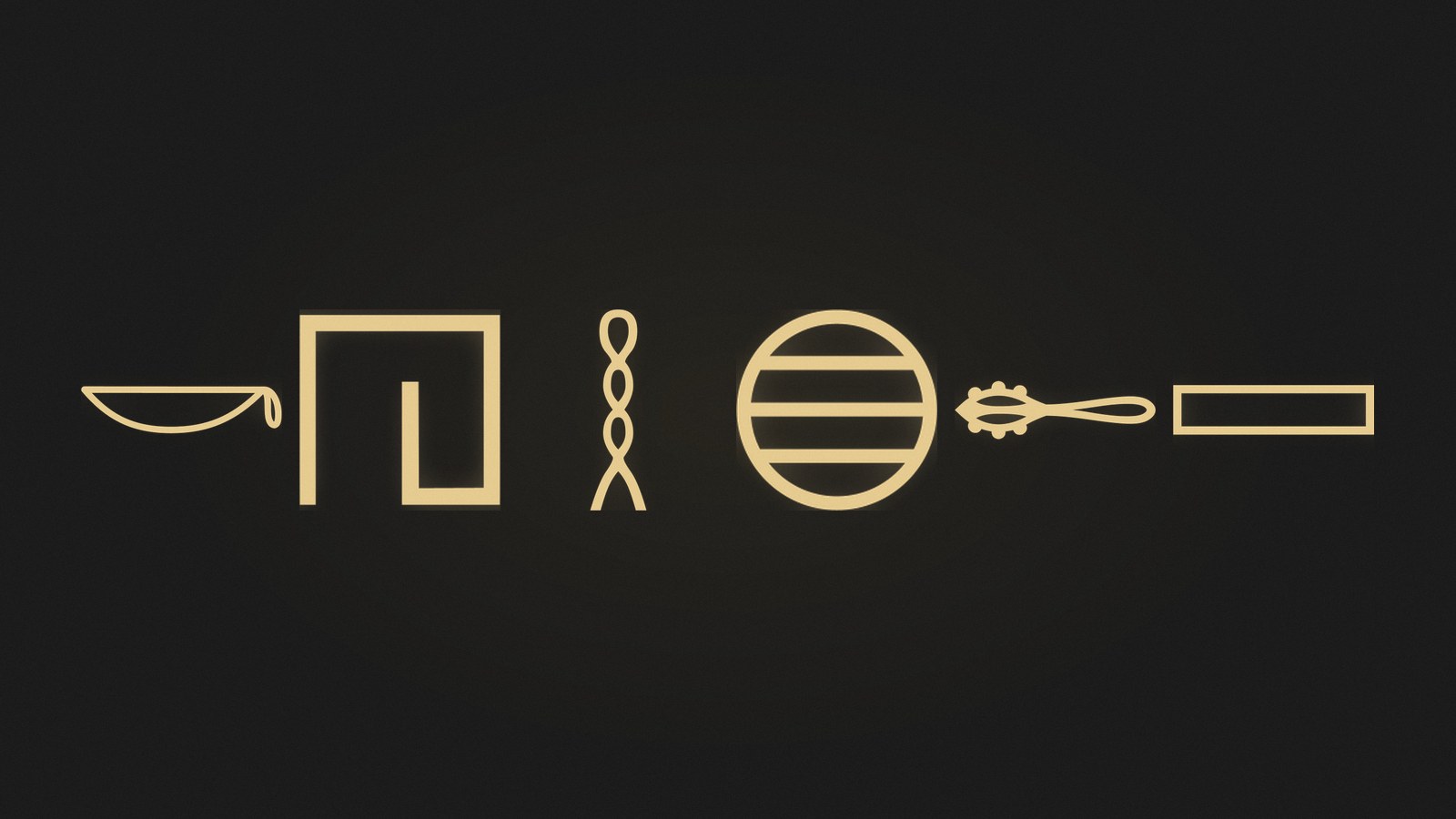
When you begin to read hieroglyphs, most of the sounds feel familiar. A few do not. Egyptian distinguished sounds that English merges together, and the way scholars keep them apart is to add dots and accents underneath certain letters. That is why a transliterated word can look oddly punctuated, as if someone had peppered it with tiny marks. Those marks are not decoration. A plain h and an emphatic h are genuinely different consonants, and swapping one for the other changes the word. Six signs sit right at this boundary, and they are where beginners tend to slow down.
It helps to start with a sound that gives no trouble at all. The basket with handle writes the single consonant k, the 'k' as in 'kite'. It turns up in the word kꜣ, meaning soul or spirit. Nothing about the sound is unusual for an English speaker, which makes it a calm place to begin before the harder cases arrive.

Next comes the reed shelter, which writes the single consonant h, the 'h' as in 'hello'. Again this is an ordinary, easy sound, a soft breath at the front of a word. You can hear it in hb, meaning festival. Keep this plain h clearly in mind, because the sign that follows sounds close enough to catch you out.

The twisted wick writes the single consonant ḥ, an emphatic 'h' that sounds a little like the breath you make when clearing your throat. Notice the dot beneath it. That dot is the whole point, because it tells you this is not the plain h of the reed shelter but a stronger, deeper sound. You can hear it in ḥqꜣ, meaning ruler or chief. English has no comfortable equivalent, so it takes practice to feel the difference between h and ḥ in your own mouth.

The placenta or sieve writes the single consonant ḫ, the 'ch' as in the Scottish word 'loch'. This is a rasping sound made at the back of the mouth, and if you have ever said 'loch' properly you already know it. It appears in ḫprr, meaning scarab beetle. Here the mark under the letter is a small hook rather than a dot, which is your signal that this is a different consonant again.

Closely related is the animal belly, which writes the single consonant ẖ, a softer 'ch' sound. It is gentler than the rasping ḫ, and the two are easy to confuse at first. You will meet it in ẖrd, meaning child or youth. Take your time comparing ḫ and ẖ, since the marks beneath them are all that separate two neighbouring sounds on the page.

The last of the six is kinder. The pool writes the single consonant š, the 'sh' as in 'ship'. This is a sound English speakers use every day, so the only new thing to learn is the mark above the letter that stands in for it. It appears in šw, the name of Shu, god of air.

None of these signs is truly hard once you know what the marks are telling you. The dots and hooks are simply a careful way of writing sounds that English lets blur together. If you would like to build them up gradually, Hierolyte, the iPhone and iPad app behind this site, teaches one of these signs a day, with the same notes you have just read.