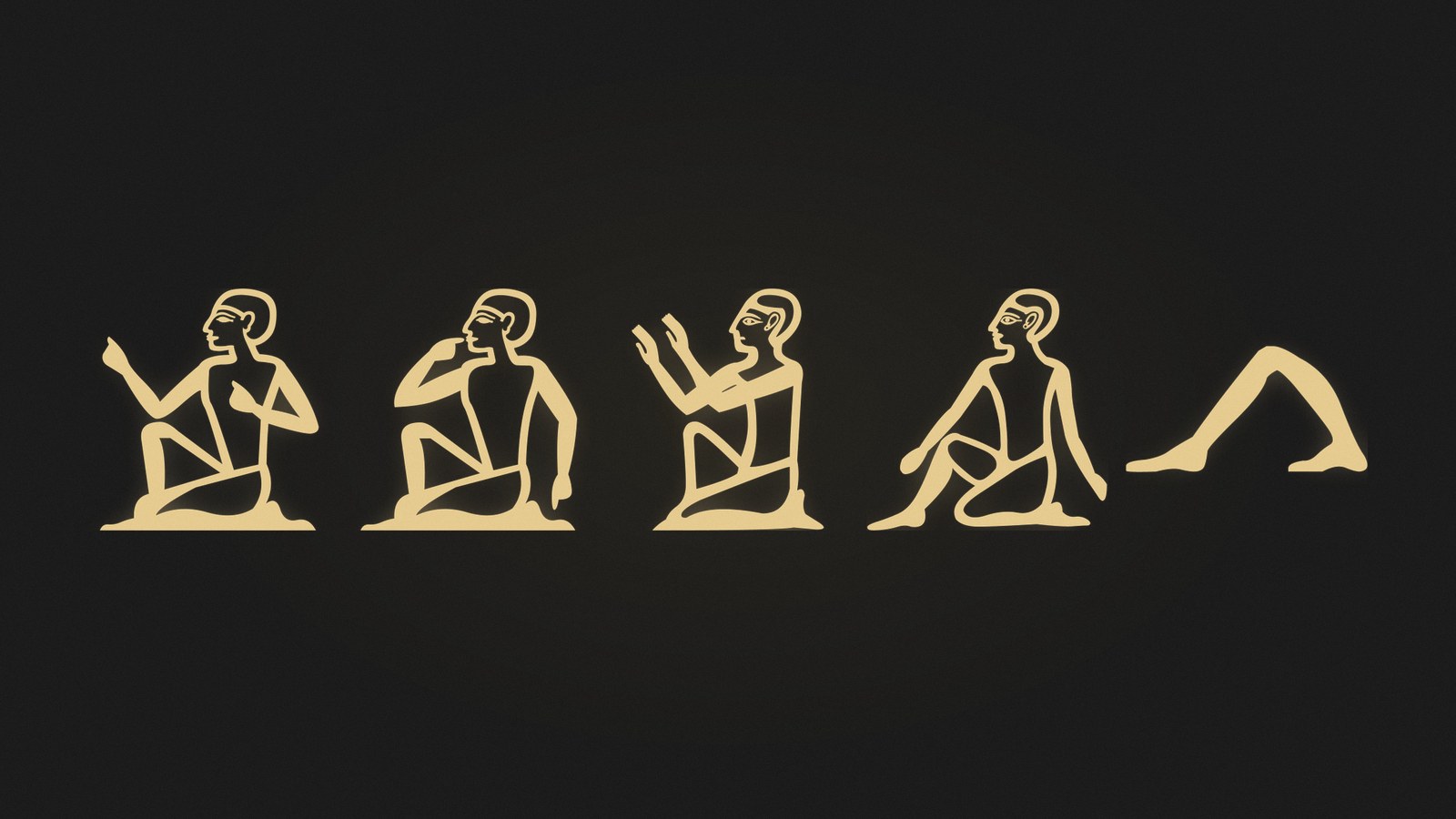
When you begin reading hieroglyphs, one of the most surprising discoveries is that some signs are never spoken aloud at all. They carry no sound. Instead, they sit quietly at the end of a word and tell you what kind of word it is. These silent signs are called determinatives, or classifiers, and they are one of the cleverest things about the whole script.
To understand why they exist, it helps to know one basic fact about how the Egyptians wrote. Vowels went unwritten. Because of this, many different words looked exactly alike on the page. A reader could stare at the same string of consonants and have no way to know which word was meant. The classifier solved this problem. Placed at the end of a word, it signalled the word's meaning and pointed the reader towards the right one. This is why the script needs them at all, and once you start noticing them, you see them everywhere.
The most common of all is the seated man, known to scholars as A1. This simple seated figure is the workhorse of the hieroglyphic script. It appears after nearly every male name and masculine occupation, silently telling the reader that the word refers to a man. It says nothing out loud, yet it quietly settles the meaning of the word it follows.

A close relative is the sign called to speak, A2, which depicts a man with his hand raised to his mouth. This one covers a surprisingly wide semantic range. It marks words for speaking, but also eating, thinking, and even feeling. The Egyptians saw all of these as activities of the mouth, so a single gesture could gather them together under one silent sign.

Not every classifier is so everyday. The praying man, A4, shows a figure with both arms raised skyward. It captures the Egyptian posture of adoration called dwꜣ, used when praising the gods at dawn. This gesture was carved on countless temple walls, showing pharaohs greeting the rising sun, and the sign carries that same sense of reverence into the words it follows.

Classifiers could also express something far more human. The fatigued man, A7, shows a man slumped with his hand to his face in exhaustion. It marks words for weariness and weakness. It is a vivid reminder that even in monumental inscriptions, meant to last for eternity, the Egyptians acknowledged human frailty.

Finally, there is the sign called to come, D54, a pair of walking legs caught in mid-stride. This is one of the most common determinatives in the entire writing system. Wherever movement is involved, these little legs are likely to appear at the end of the word, silently pointing the reader towards the idea of going and coming.

Once you have met a handful of these signs, reading hieroglyphs starts to feel less like decoding and more like recognising old friends. The classifier at the end of a word is a quiet helper, always there to tell you what kind of thing you are looking at. Hierolyte, the iPhone and iPad app behind this site, teaches one of these signs a day, with the same notes you have just read, so that these silent signs gradually become second nature.