The last lesson was about some peculiarities of hieroglyphic writing. This one goes back to words, and to a point left open in the second lesson. That lesson taught nb, "every", which James Allen counts as the only adjective not made from another word, and noted that ky, "other", comes before its noun because it is really a noun. Allen puts the wider point plainly: "Some Egyptian words that are translated by English adjectives are not adjectives in Egyptian." Alan Gardiner gathers them under the heading "Equivalents of English adjectives": the words for "other", "many", "few", "entire", "each", "someone" and "everyone".
Other, and one and the other
Gardiner gives the word for "other" as masculine ky, feminine kt and masculine plural kywy. Its ending, he says, is "doubtless dual in origin", the form for pairs met in the first lesson. Allen agrees that it is "actually an old dual noun", and adds: "the plural looks like a dual dual!"
"Ky is no true adjective," Gardiner goes on, "but a noun to which another may be added in apposition": two nouns side by side for one thing, as in the forty-first lesson. So ky sp, "another time", is literally "another, a time", and kywy nsyw is "other kings". Like any noun, it can take a suffix: kty·f wꜣt, which Gardiner translates "its other side" and Allen "its other path", literally "its other one, the path". For "others" on their own, Egyptian uses kt-ḫt, literally "other things".
To say "one ... the other", Gardiner lists four ways. The first is wꜥ, "one", followed by ky: iw wꜣt·f wꜥt ẖr mw, kt ẖr it, "its one side was under water, the other under corn". The second repeats ky:

ḥpt, "embrace", ends with a pair of arms enclosing; the water line after it is n, and each ky is a basket and two reed leaves. The third way uses sn-nw·f, "his second": wꜥ ḏd·f ḫft sn-nw·f, "one said to (lit. before) the other". In the fourth, the word is "merely implied", as in a line of Sinuhe, rdi·n wi ḫꜣst n ḫꜣst, "land gave me to land".
A few, many and the whole
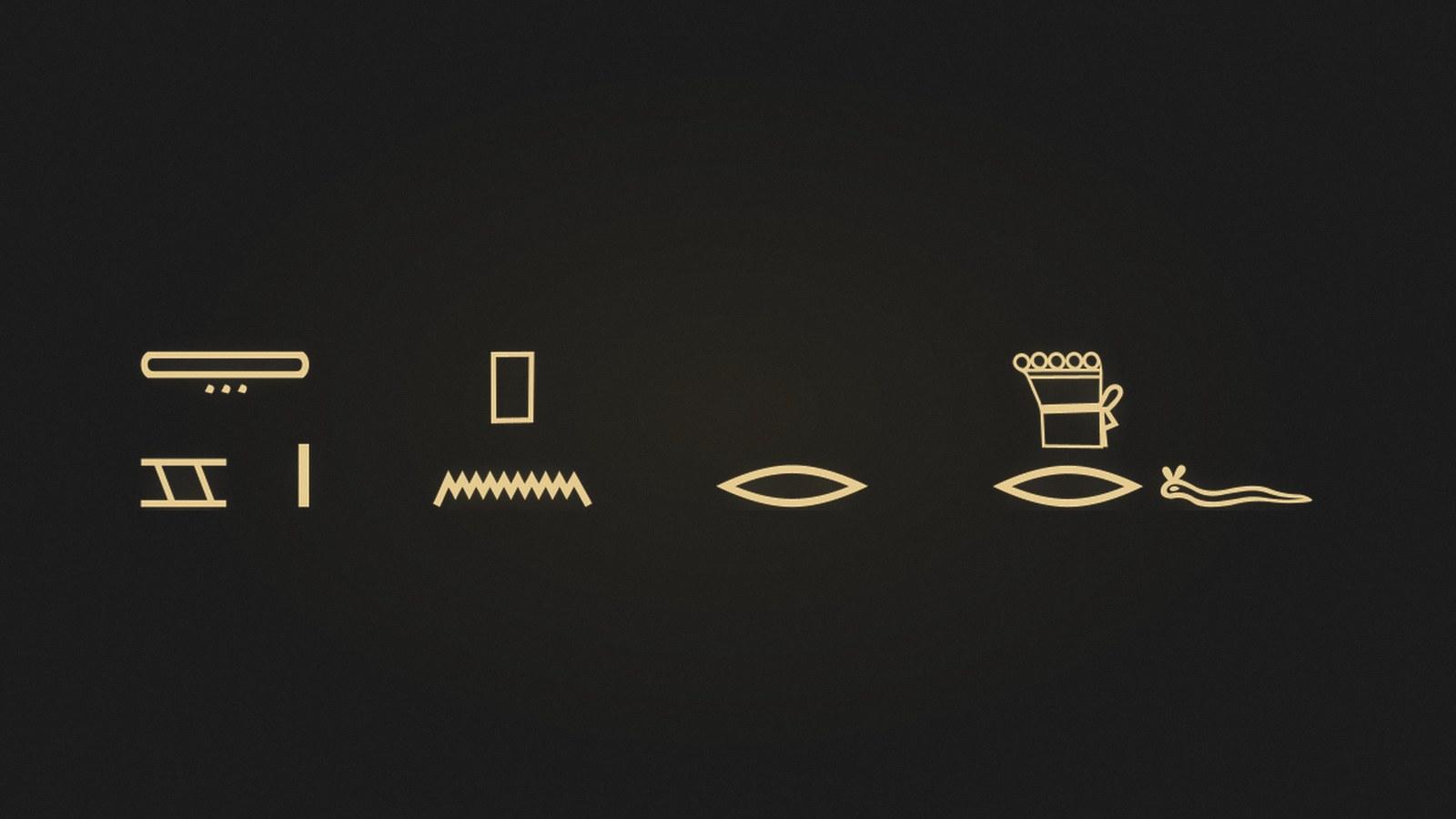
For "many", "few" and "a little", Gardiner says, ḥḥ, "million", and nhy, "a little", "are often used with the indirect genitive", the n of the fourth lesson. ḥḥ n sp is "many times, or often". Both grammars quote this example, with the same reference:

nhy is the water line over a reed shelter, then a sparrow, the determinative of words for small or bad things, two slanting strokes, and a grain over plural strokes. rmṯ, "people", is the mouth over a tethering rope, with a seated man and woman. Allen translates "a few people", literally "some of people".
For "entire", "complete" and "whole", Gardiner lists three phrases, each a preposition, a noun and a suffix: r ḏr·f, literally "to its end"; mi ḳd·f, "like its form"; and r ꜣw·f, "according to its length". Allen lists the same phrases. They "always stand after the noun and any other modifiers the noun may have", he says, usually with a suffix "that agrees in gender and number with the noun". Both grammars quote this from the Westcar Papyrus:

tꜣ, "land", is a strip of land over a canal and a stroke, and pn, "this", the stool over the water line. Then come r, the mouth, ḏr, a bundle of flax over a second mouth, and ·f, "its", the horned viper: word for word, "this land to its end". After a feminine noun the suffix is ·s: tꜣ ḥnyt r ꜣw·s, "the entire navy". Gardiner adds that the suffix can be left out, as in nn n ḫt r ḏr, "all these things". With the noun nb, "lord", the phrase makes nb-r-ḏr, "lord of the universe", literally "lord to the end", "a title given to the sun-god or the king".
Each, someone and everyone
"Each" or "every" of time is a noun too: ṯnw, "number", later written tnw, "followed by a direct genitive in the singular". Allen translates it "each, each one".

r is the mouth. ṯnw is the tethering rope over the water line, a small bowl and the quail chick, then a throw-stick and an alighting duck, a pair that, Gardiner's sign list says, can mark the sound ṯn. rnpt, "year", is the notched palm rib and the loaf over a stroke. Gardiner's literal rendering is "at every year"; Allen gives ṯnw rnpt, "each year", literally "each one of year". With the later spelling, tnw dwꜣw is "every morning".
For "someone" or "anyone", Gardiner says, s, "man", "is common": ir ḫꜣ·k s, "if thou examine someone". "Combined with a negative word", it means "no one":

nn wn is the "there is not" of the ninth lesson: the arms over water, then the hare over water. ib, "heart", is the heart over a stroke, and s, "man", a bolt over a seated man and a stroke. Gardiner's literal rendering is "not is a heart to a man".
The adjective nb can never stand by itself, as the second lesson showed, so "everyone" needs a noun in front of it. Gardiner calls s nb, "every man", "the most usual expression; but bw nb, lit. 'every place', and ḥr nb, lit. 'every face', are also frequent":

s nb is the bolt over the seated man, a stroke and the basket of nb. bw, "place", is a leg and the quail chick, and ḥr, "face", a face and a stroke; both end, like rmṯ above, with a seated man and woman over plural strokes. For "each one", Gardiner adds, s nb serves again, "but wꜥ nb 'every one' is equally common". "Everything" or "anything" is ḫt nbt, literally "all things", the second lesson's "everything", and ḫt alone can mean "something" or "anything".
In each case Egyptian uses a noun or a phrase where English has an adjective. The next lesson turns to Egyptian adverbs, words for "here", "today", "for ever" and "himself".