The last lesson weighed two accounts of one verb form. This one steps back from the grammar to the writing itself, and to the spellings Alan Gardiner gathers under "Peculiarities of hieroglyphic writing": short forms, signs joined into one, letters left out or added, and words that share a determinative.
Gardiner begins with a warning. The signs do not all "stand on an equal footing", and "custom plays a very important part in deciding what writings are possible and what are not, though variant spellings are very numerous". "House" is written with the house plan and a stroke, much more rarely without the stroke, and never with its p and r spelled out in front. James Allen agrees: "You should not expect to find the same word spelled the same way in every text, or even in the same text." So Gardiner advises that beginners, once they know the main principles, "should not inquire too curiously into the nature of individual spellings, but should learn both the hieroglyphic groups and their transliterations mechanically". A few habits are still worth knowing by name.
Short forms
Abbreviations, Gardiner says, "are commonest in monumental inscriptions, stereotyped phrases, formulae, titles, and the like". The eighteenth lesson met one of his examples, ꜥnḫ wḏꜣ snb, "may he live, be prosperous, be healthy", written with just three signs. Another follows the names of the dead:

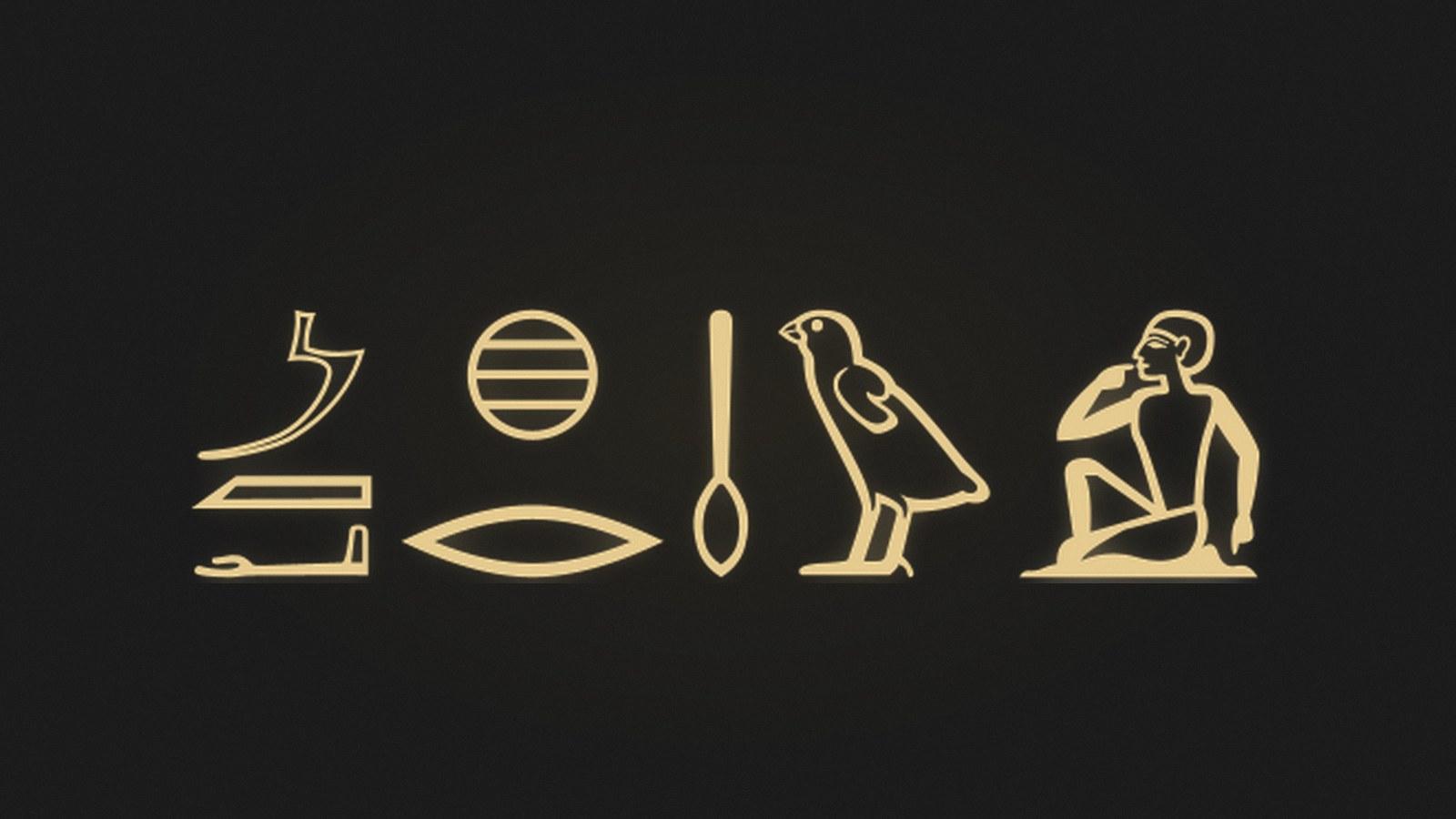
In full, mꜣꜥ-ḫrw is the sickle, plinth and forearm of mꜣꜥ, "true", then the placenta, mouth, oar, quail chick and a man with his hand to his mouth for ḫrw, "voice". The short forms keep only the plinth and the oar, one lying over the other or both standing upright. Gardiner calls the phrase "practically equivalent to our 'deceased'", first used of Osiris, whose royal rights, disputed by Seth, were vindicated before the divine tribunal in Heliopolis. Allen, who prints the same two short forms, translates it "justified": the dead person's heart was weighed against a feather, the sign for mꜣꜥt, Maat, and if the scale balanced, the deceased was declared true of voice.
Titles shrink too:

imy-r, "overseer", the "one who is in the mouth" of the sixth lesson, is the owl and the mouth over a stroke. ḥmw-nṯr, "priests", is the flag for "god", written first as in the fifth lesson, and the club of ḥm, "servant". The short form writes the club once; the fuller one repeats it three times for the plural, like the gods of the first lesson.
Signs that walk
A monogram joins two signs into one. In some verbs of movement, Gardiner shows, the walking legs are combined with a sound sign:

In ii, "come", the legs grow from a reed leaf, i; in šm, "go", they carry the pool, š; in iṯ, "take, carry off", the tethering rope, ṯ, followed by a man striking with a stick, the determinative of force. ii and šm also end with the legs on their own, which Allen calls the determinative of words "having to do with motion".
Letters left out, and letters added
Some spellings skip a consonant. Gardiner admits they "are apt to puzzle beginners":
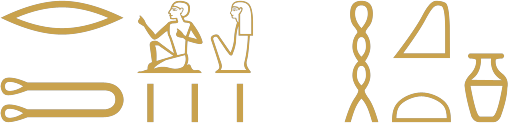
rmṯ, "people", is the mouth, r, over the tethering rope, ṯ, with no m, then a seated man and woman over three strokes. ḥnḳt, "beer", is the wick, ḥ, the slope, ḳ, over the loaf, t, and a beer jug, with no n. For Gardiner the omission "is probably due to calligraphic reasons", and "the Egyptian was under no obligation to prefix to an ideogram more phonetic signs than were needed to remove obscurity". Allen agrees that the m and n were left out so the other signs could be grouped compactly, and notes that both words are sometimes written in full and that their Coptic descendants keep the letters. He writes them r(m)ṯ and ḥ(n)ḳt, with the missing letters in brackets.
The opposite happens too. i(w)f, "flesh", has a superfluous w, Coptic showing that only if was said. And where two like consonants came together, scribes tended to write them once: ir·n·i ist stands for ir·n·i is st, "lo, I did it".
Some readings are still open. Gardiner's ḥnḳt "is in other books on Egyptian almost universally read ḥḳt", and old-fashioned works render nsw, "king", as swtn. "Where there is a choice", he says, "shorter readings are preferable to long ones", so he reads mni, "moor", though the stem is probably mini.
Two words, one determinative
Determinatives stand at the end of a word, so, as Allen points out, they are "a useful guide to knowing where one word ends and the next one begins". Gardiner adds that compounds and other closely connected groups of words may share one:
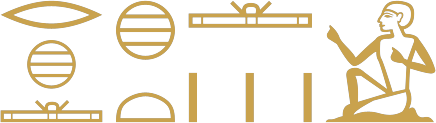
rḫ-ḫt, "a wise man", is literally "a knower of things". rḫ, "know", is the mouth, placenta and papyrus roll, and ḫt, "things", the placenta, loaf, roll and plural strokes; a single seated man then serves both words. "Doubtless for this reason", Gardiner adds, a title before its owner's name usually has no determinative of its own: in sš Nḫt, "the scribe Nakht", the scribe's kit stands alone, and the man comes after the name.
Foreign words and obscure names have a spelling of their own, which Gardiner calls group-writing: signs for two consonants stand in for one, as in a foreign land that is "to be transliterated Iḥi, not Iḥwiw". Allen compares the way English shows how to say paradigm, "PARE-a-dime", and transliterates such names group by group: yꜣ-mt, for the city of Yarmut, uses the word for "death", m(w)t, for its second syllable.
The next lesson returns to words: how Egyptian says "other", "many", "entire", "each", "someone" and "everyone".